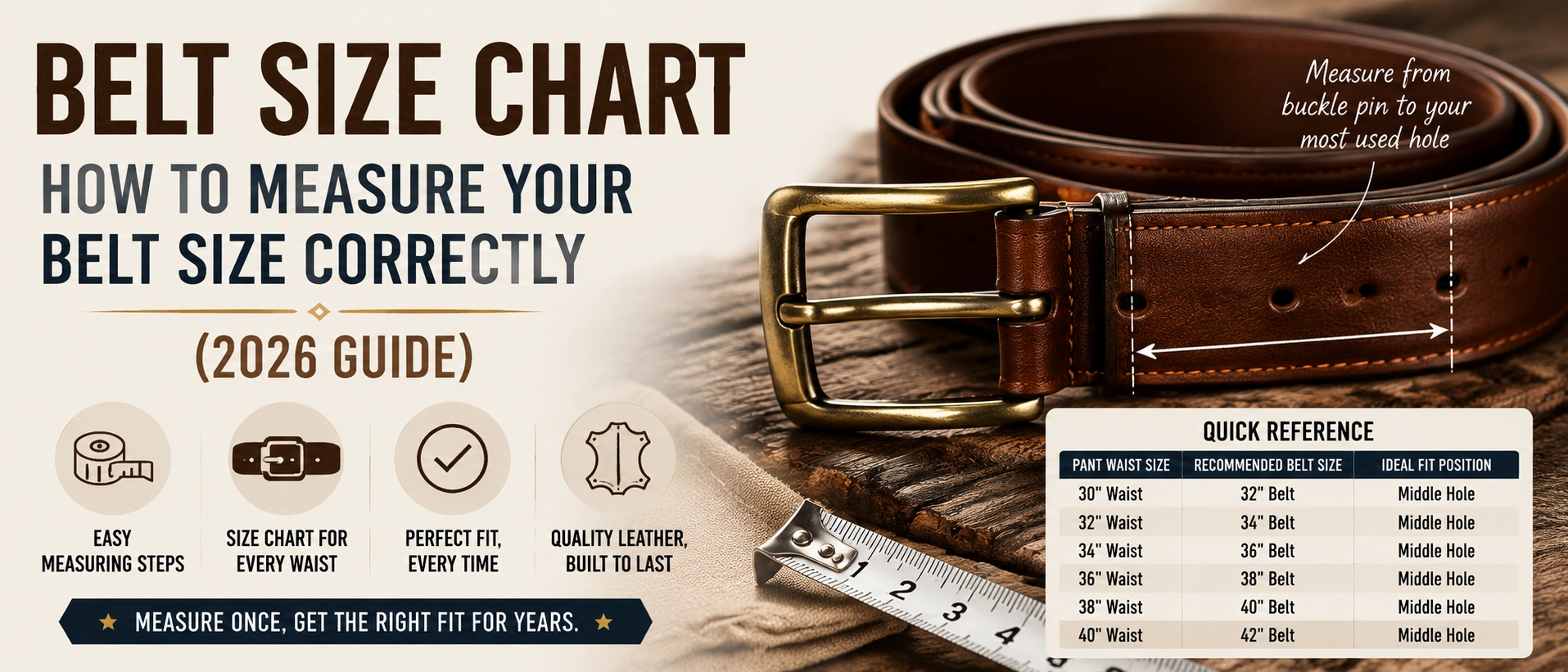
To find your correct belt size, measure from the buckle pin to the hole you use most often on a belt that already fits, or choose a belt approximately two inches larger than your pants waist size. The goal is simple: your belt should fasten comfortably near the middle hole, leaving room for future adjustment.
Finding your belt size sounds simple — until the belt arrives and doesn't fit.
The most common mistake is ordering the same number as your pants size. It seems logical, but a 34-inch pant waist and a 34-inch belt are not the same measurement.
Belt sizing accounts for factors your pants size doesn't:
- the position of the buckle
- the amount of leather that overlaps through the buckle frame
- the holes available for adjustment
- where on your body you actually wear the belt
Buy the matching number and you'll often find the belt fastening at the very last hole — or not closing comfortably.
This complete belt size chart and belt size guide explains how to measure belt size correctly, how pants size converts to belt size, and how to avoid common sizing mistakes before buying.
Men's Belt Size Chart: Quick Reference Guide
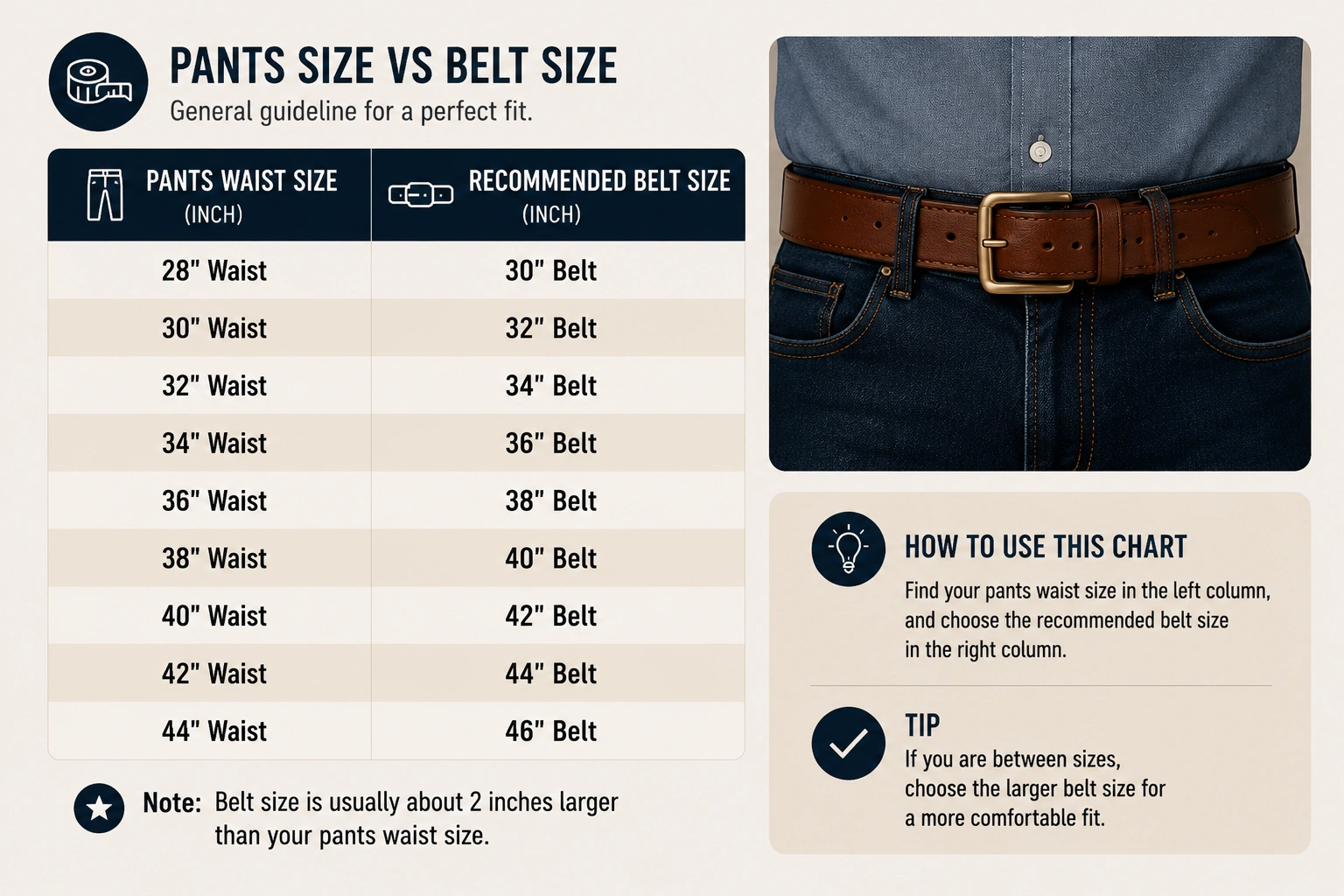
For most men, belt size usually runs approximately two inches larger than trouser waist size.
This helps account for:
- buckle position
- leather overlap
- comfortable fastening point
- adjustment room
Use this men's belt size chart as a starting point, but always check the specific brand's measurement method before ordering.
| Pant Waist Size | Recommended Belt Size | Ideal Fit Position |
|---|---|---|
| 28" | 30" | Middle hole area |
| 30" | 32" | Middle hole area |
| 32" | 34" | Middle hole area |
| 34" | 36" | Middle hole area |
| 36" | 38" | Middle hole area |
| 38" | 40" | Middle hole area |
| 40" | 42" | Middle hole area |
| 42" | 44" | Middle hole area |
Important: Belt size usually refers to the distance from the buckle pin to the middle hole — not the total leather length from end to end.
A belt's total length includes the extra tail after the holes, so it will always be longer than the actual wearable size.
When comparing different brands, always check whether they measure:
- buckle pin to middle hole
- total strap length
These are not the same measurement.
When between two sizes, many people choose the slightly larger option because some belt designs can be adjusted or shortened. However, the best choice is always the size that places you closest to the middle hole.
Why Your Belt Size Is Not the Same as Your Pants Size
This is the source of most belt-sizing frustration.
Your pants waist size measures your body — specifically where your trousers sit.
Your belt size measures something different.
A belt does not sit directly against your body. It passes over fabric, goes through belt loops, and fastens through a buckle system.
The buckle and overlap use part of the leather's functional length.
This is why belt size and pants size don't match.
The common rule:
belt size = pants size + about 2 inches
Example:
A person wearing 34-inch waist pants usually starts with a 36-inch belt.
This usually places the buckle pin near the middle hole, which provides adjustment room.
However, several factors affect fit:
Wearing Position
A belt worn higher on the waist and a belt worn lower on the hips require different lengths.
If you wear jeans lower, your belt measurement may be slightly larger.
Clothing Thickness
Heavy denim or winter clothing can slightly change how a belt fits.
This is why adjustment holes exist.
Brand Measurement Differences
Not every company measures belts the same way.
Some measure:
- usable size
- full leather length
A few minutes checking the sizing notes can prevent choosing the wrong size.
How to Measure Belt Size Correctly
There are two reliable methods:
- Measure a belt that already fits.
- Measure your waist through your belt loops.
The first method is usually the most accurate.
Step 1: Use a Belt That Already Fits
Choose a belt you already wear comfortably.
Lay it flat on a table.
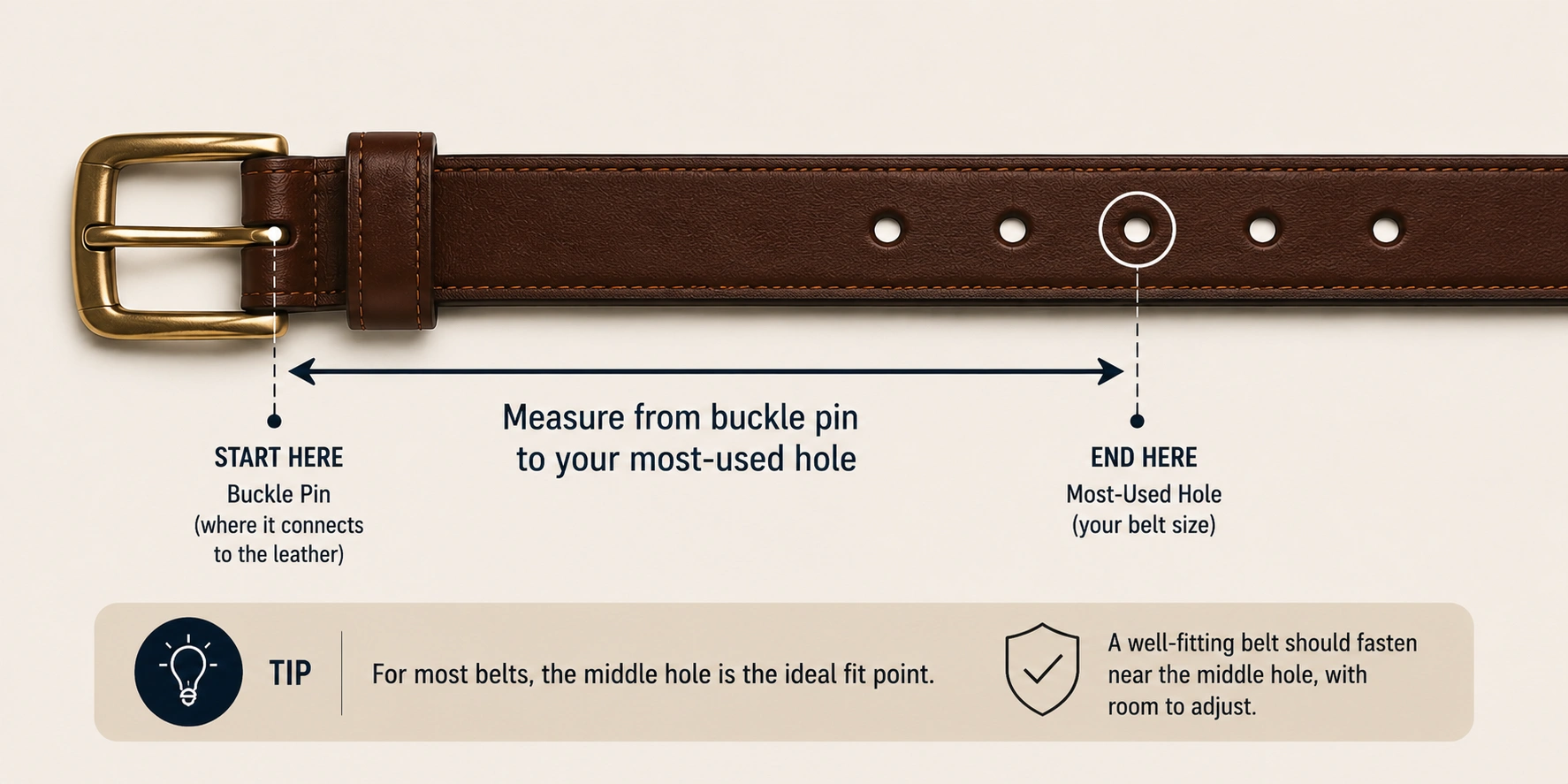
Measure from:
the buckle pin connection point
to:
the hole you use most often
Do not measure from the outside edge of the buckle.
This measurement represents your real wearable belt size.
Most quality leather belts use this measurement method:
buckle connection → middle hole.
Step 2: Measure Your Waist Through Belt Loops
If you don't have a good reference belt:
Use a flexible measuring tape.
Thread it through your belt loops exactly where your belt normally sits.
Keep the tape naturally positioned.
Do not pull extremely tight.
This gives a realistic wearing measurement.
Avoid measuring your bare waist because pants, fabric thickness, and wearing position change the final fit.
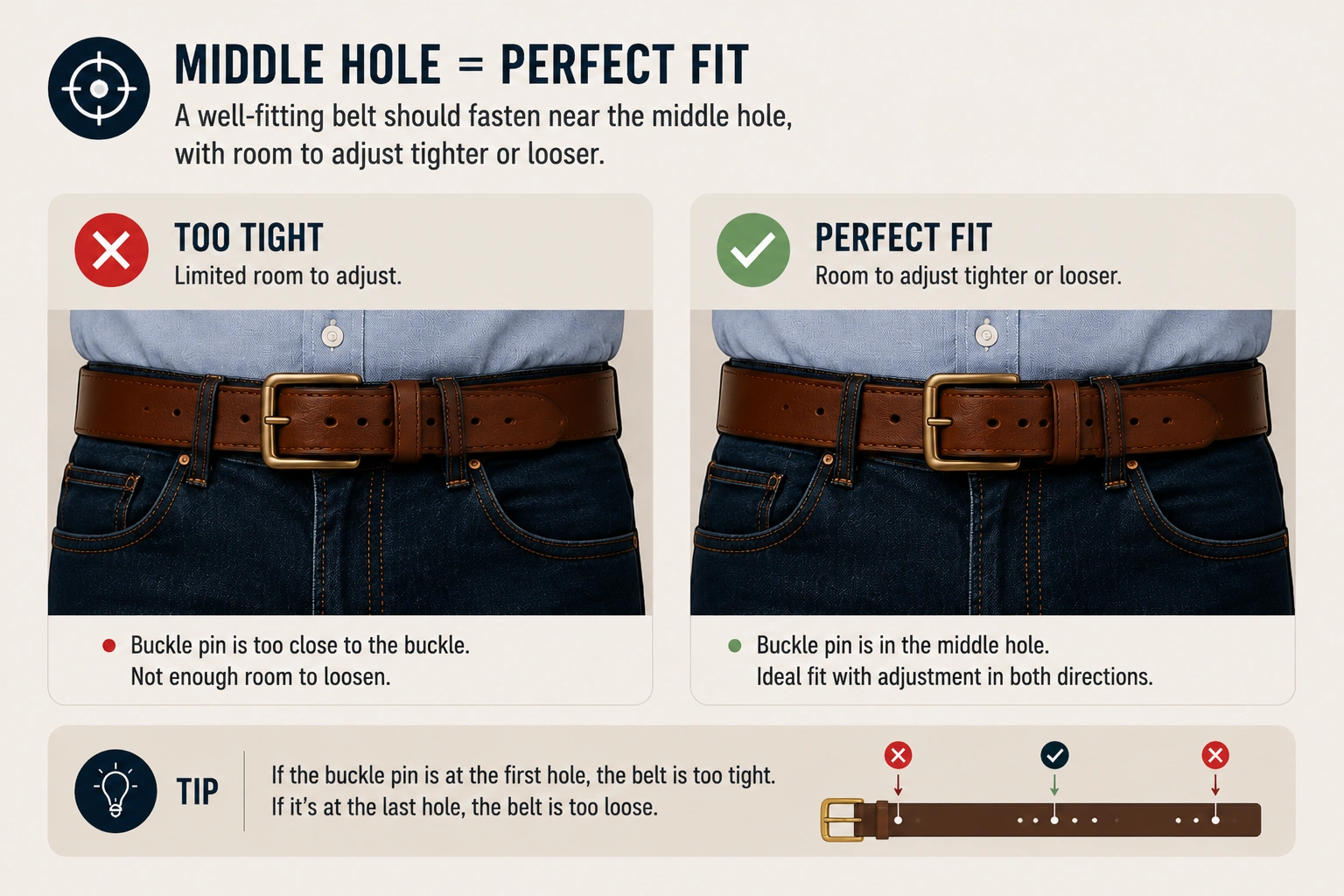
Step 3: Aim for the Middle Hole
A well-designed leather belt usually includes multiple adjustment holes.
The ideal fit:
your most-used position should be the middle hole.
Why?
Because life changes:
- slight weight changes
- seasonal clothing differences
- leather break-in
A middle-hole fit gives room to adjust tighter or looser.
If your belt only fits on the first or last hole, the size probably isn't ideal.
Common Sizing Problem: "I Ordered My Pants Size and the Belt Was Too Small"
This happens frequently.
Example:
Someone wears:
34-inch pants
and orders:
34-inch belt.
The belt arrives and only fastens at the very last hole.
The belt may not actually be defective.
The sizing assumption was wrong.
A size 34 belt usually means:
the middle hole is around 34 inches from the buckle pin.
But someone wearing 34-inch pants often needs that middle position closer to 36 inches.
The better choice:
34 waist → 36 belt.
This gives adjustment room instead of forcing the belt to its limit.
How Long Should a Leather Belt Be?
Belt length and belt size are related, but they are not the same thing.
Belt size tells you where the belt should fasten.
Total belt length tells you the full physical length of the leather strap.
A properly fitting leather belt should look like this:
Fastening Position
The buckle should fasten near the middle adjustment hole.
The belt should sit flat and comfortable without pulling too tightly.
Belt Tail Length
After fastening, the belt tail should:
- pass through the first belt loop
- sit naturally against your waist
- avoid wrapping too far around your body
A very long tail usually means the belt is too large.
Adding more holes may make it close, but it does not fix the extra leather length.
If a belt is significantly oversized, shortening the belt from the buckle end is usually a cleaner solution because it keeps the original tail shape and proportions.
What Size Belt Should I Buy for Common Waist Sizes?
What size belt for a 34-inch waist?
For most people:
A 34-inch pant waist usually pairs with a size 36 belt.
This allows the belt to fasten near the middle hole with adjustment space on both sides.
However:
Always check how the brand measures belt size.
What size belt for a 36-inch waist?
For most people:
A 36-inch pant waist usually pairs with a size 38 belt.
The goal is not simply matching numbers.
The goal is:
a comfortable middle-hole fit.
What size belt do I need?
The easiest starting point:
Choose a belt approximately two inches larger than your pants waist size.
Examples:
- 32 pants → 34 belt
- 34 pants → 36 belt
- 36 pants → 38 belt
For the most accurate result, measure a belt you already own from the buckle pin to your most-used hole.
This gives a better measurement than relying only on clothing size.
Common Belt Sizing Mistakes
Choosing the wrong size usually comes from misunderstanding how belts are measured.
Avoid these common mistakes:
Mistake 1: Buying the Same Size as Your Pants
A 34 waist does not usually mean a 34 belt.
Because belts include:
- buckle position
- overlap
- adjustment space
you usually need additional length.
Mistake 2: Measuring the Entire Belt Length
Many people lay a belt flat and measure from end to end.
This creates confusion.
Total length is not the same as wearable belt size.
A belt may measure much longer overall because it includes:
- unused adjustment holes
- leather tail
- buckle attachment area
Mistake 3: Ignoring Buckle Style
Different buckle designs affect fit.
Large buckles may slightly change the usable length compared with smaller buckles.
This is especially important when you are between sizes.
Mistake 4: Adding Too Many Holes Instead of Fixing the Size
Adding one extra hole can be useful.
But adding several holes usually means the belt is the wrong size.
Problems include:
- extra long belt tail
- off-center buckle position
- uncomfortable fit
For small adjustments, adding holes can work.
For larger adjustments, resizing or shortening the belt often gives a cleaner result.
Does Leather Stretch Over Time?
High-quality leather can slightly adapt with use.
As a leather belt breaks in:
- fibers soften
- bending points become more flexible
- the belt feels more comfortable
However:
A leather belt does not stretch enough to fix an incorrect size.
A belt that is too small will not become several inches larger after wearing.
This is especially true with quality full-grain leather because the dense fiber structure is designed to maintain strength and shape.
The purpose of breaking in leather is comfort — not resizing.
Choosing the Right Leather Belt for Long-Term Fit
Finding the correct size is only part of choosing a belt.
Material and construction determine whether that fit lasts.
A well-made leather belt should maintain:
- clean adjustment holes
- stable shape
- strong buckle attachment
- comfortable flexibility
Important details include:
Leather Quality
Full-grain leather keeps the strongest natural fiber structure of the hide.
This helps the belt:
- resist excessive stretching
- maintain hole shape
- develop character over time
Lower-quality layered materials may stretch unevenly or separate with heavy use.
Hole Construction
The holes experience pressure every time you wear the belt.
Dense leather and clean punching help prevent:
- tearing
- widening
- deformation
Hardware Quality
The buckle is one of the highest-stress areas.
Durable hardware helps maintain:
- secure fastening
- long-term reliability
Materials such as solid brass naturally develop character over time instead of simply wearing away.
Thickness
Daily-use leather belts often benefit from a strong but comfortable thickness.
A belt that is too thin may crease heavily around the most-used hole.
A belt that is too thick may feel uncomfortable.
Balance matters.
Frequently Asked Questions
How do I know my belt size?
The most accurate method is measuring a belt that already fits.
Measure from the buckle pin to the hole you use most often.
That distance represents your functional belt size.
Should I buy a belt one size bigger than my pants?
Usually, yes.
Most people choose a belt around two inches larger than their pants waist size.
For example:
34-inch pants → 36-inch belt.
What size belt should I buy for a 34-inch waist?
A size 36 belt is usually the recommended starting point.
The ideal result is fastening near the middle hole.
What size belt do I need?
Start with your pants waist size and add approximately two inches.
For better accuracy, measure an existing belt that already fits comfortably.
Do leather belts stretch?
Leather can soften and slightly adjust over time, but it should not be expected to stretch enough to correct the wrong size.
Always choose the correct size from the beginning.
Is belt size measured from the buckle or the end?
Traditional belt sizing is usually measured from the buckle pin to the middle hole.
It is not the full end-to-end length of the strap.
What if my leather belt is too long?
If it is slightly long, adding another hole may help.
If there is too much extra length, shortening the belt from the buckle side usually provides a better result.
Final Thoughts
Choosing the correct belt size is not just about matching a number on a label.
A good fit comes from understanding:
- how belts are measured
- where the buckle fastens
- how much adjustment space you need
The best leather belt is not simply the one that fits today.
It is one that continues fitting comfortably as it breaks in, develops character, and becomes part of your everyday routine.