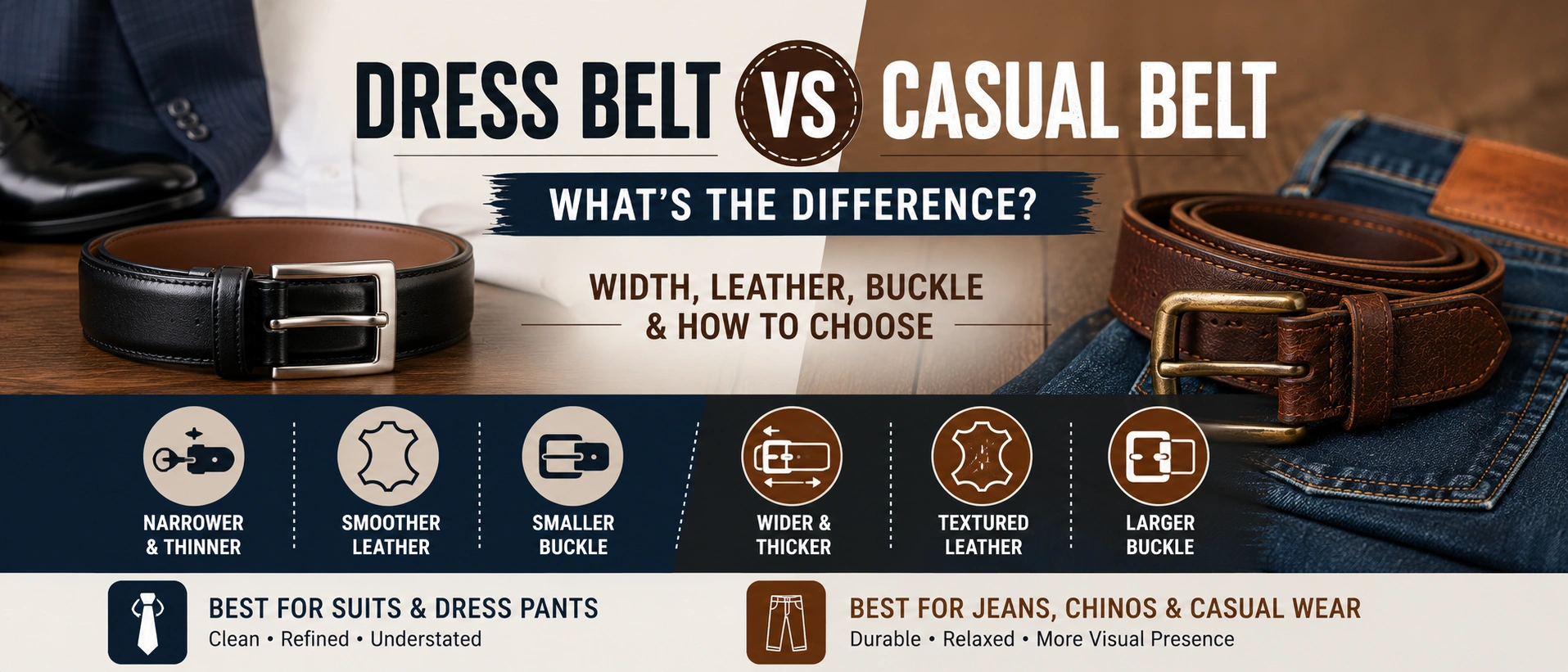
A dress belt is generally narrower, thinner, smoother, and fitted with a smaller buckle, while a casual belt is usually wider, thicker, more textured, and designed to work with jeans, chinos, and relaxed clothing.
No single feature decides whether a belt is dressy or casual.
A narrow belt is not automatically a dress belt. A full-grain leather belt is not automatically limited to casual outfits. Width, thickness, leather finish, buckle size, edge treatment, and the clothing around the belt all affect how formal it looks.
The difference is mainly visual weight: dress belts are designed to disappear into a polished outfit, while casual belts are allowed to become part of the look.
Quick Answer: Dress Belt vs Casual Belt
The easiest way to compare the two is to look at how much visual attention the belt adds to an outfit.
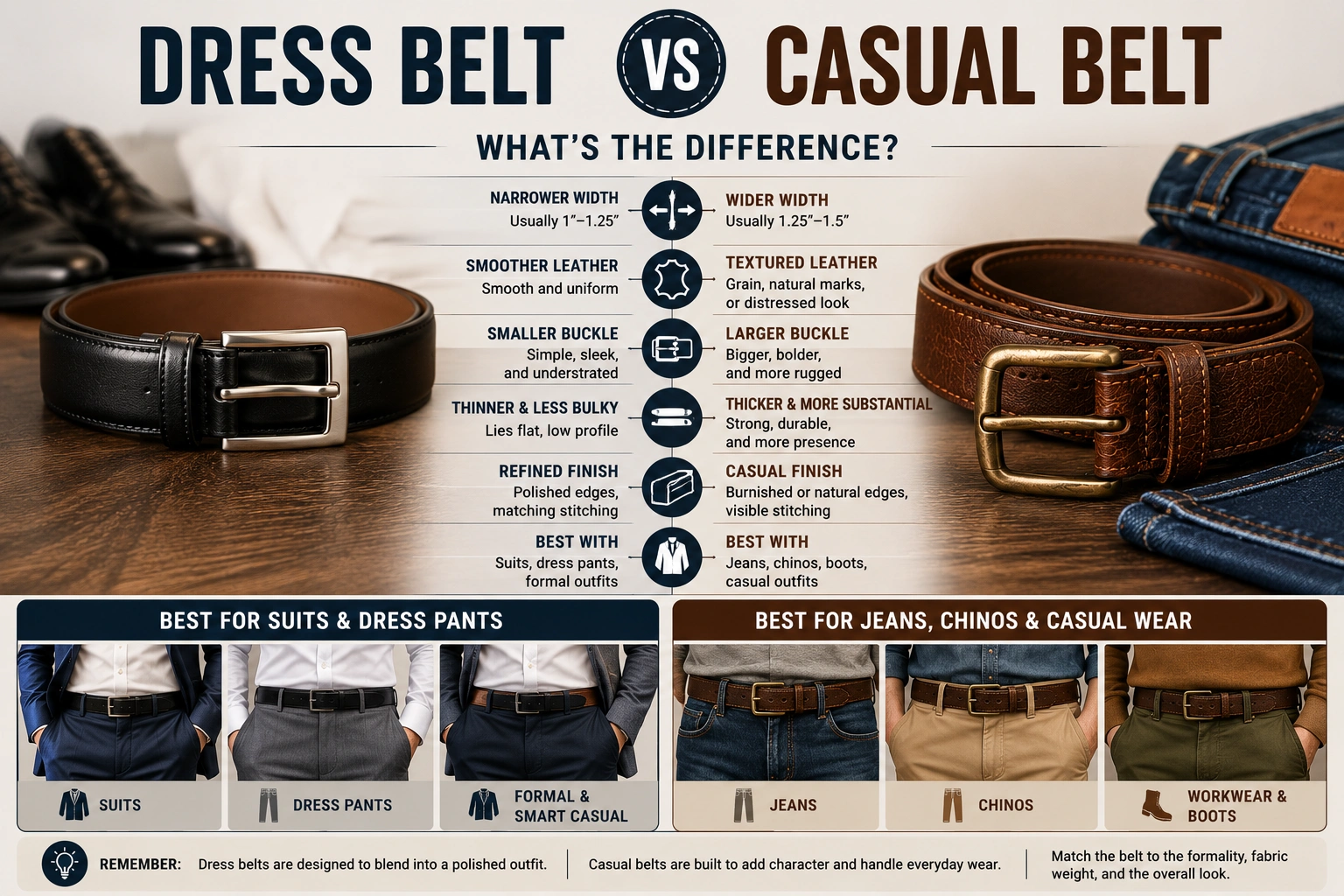
| Feature | Dress Belt | Casual Belt |
|---|---|---|
| Width | Usually narrower | Usually wider |
| Thickness | Thinner and less bulky | Often thicker and more substantial |
| Leather surface | Smooth and uniform | Textured, rugged, or naturally marked |
| Buckle | Small and simple | Larger or more distinctive |
| Edge finish | Refined and polished | Rounded, burnished, natural, or heavier |
| Colors | Black and refined browns | Wider range of browns, black, tan, and distressed tones |
| Best with | Suits and dress trousers | Jeans, chinos, workwear, and casual outfits |
| Overall effect | Clean and understated | Visible and relaxed |
These are general guidelines rather than strict rules.
A simple dark-brown casual belt may work with chinos and a button-down shirt. A smooth dress belt may work with dark jeans when the rest of the outfit is refined.
The belt should match the formality and visual weight of the trousers, shoes, and upper clothing.
What Is a Dress Belt and What Is a Casual Belt?
What Is a Dress Belt?
A dress belt is designed to support a polished outfit without drawing unnecessary attention to the waist.
It usually has:
-
A relatively narrow strap
-
A thin or low-profile construction
-
Smooth leather
-
A small, simple buckle
-
Clean, refined edges
-
Minimal stitching or decoration
-
A color and finish close to the shoes
Dress belts are most commonly worn with:
-
Business suits
-
Dress trousers
-
Formal office clothing
-
Wedding outfits
-
Business events
-
Polished smart-casual clothing
The strap should pass easily through smaller trouser loops and lie flat around the waist. A bulky fold behind the buckle or an oversized buckle can interrupt the clean line of formal trousers.
Black and dark brown are the most common choices because they coordinate easily with traditional dress shoes.
A dress belt should support the outfit without adding unnecessary bulk, texture, or hardware.
What Is a Casual Belt?
A casual belt is allowed to have more visual presence.
It may use:
-
A wider strap
-
Thicker or more structured leather
-
Visible grain or texture
-
Natural color variation
-
More noticeable stitching
-
A larger buckle
-
Brass-tone, black, or aged hardware
-
Burnished, rounded, or substantial edges
Casual belts work naturally with:
-
Jeans
-
Chinos
-
Corduroy trousers
-
Work pants
-
Boots
-
Casual shirts
-
Overshirts
-
Work jackets
Casual does not mean poorly made.
A carefully constructed full-grain leather belt with strong hardware may be casual because of its width, texture, and buckle—not because of lower material quality.
A rugged belt can still use refined stitching and well-finished edges. The difference is that those details are designed to complement heavier and more relaxed clothing.
Casual describes the level of formality, not the quality of the leather or construction.
The Main Differences Between Dress and Casual Belts
Width and Thickness
Dress belts are commonly around 1 to 1.25 inches wide. Casual belts are often around 1.25 to 1.5 inches wide.
These ranges are useful starting points, not universal rules.
Trouser loops matter. A wide casual belt may not pass through the smaller loops found on some dress trousers. A very narrow dress belt may fit through jeans but look visually weak beside thick denim and large pockets.
Body proportions and buckle size also affect how the width appears.
A medium-width belt with a large buckle may look more casual than a slightly wider belt with a simple buckle.
Thickness creates a similar effect.
Dress belts are generally thinner so they lie flat beneath a jacket and do not create a bulky fold at the buckle. Casual belts may be thicker and more structured because they are worn with heavier fabrics.
That does not mean the thickest belt is the best belt.
Excessive thickness can make the strap difficult to bend, uncomfortable around the waist, or incompatible with a smaller buckle.
Read our guides to choose the right belt width and select an appropriate leather belt thickness for the clothing you wear.
Leather Surface and Edge Finish
Dress belts usually have a smoother and more uniform surface.
Common details include:
-
Subtle grain
-
Even color
-
Moderate shine
-
Clean edge paint or polishing
-
Fine stitching close to the leather color
Casual belts may show:
-
Full-grain texture
-
Pebbled leather
-
Matte finishes
-
Pull-up color variation
-
Distressed surfaces
-
Heavier burnished edges
-
More visible stitching
The leather grade alone does not determine formality.
Full-grain leather can be finished smoothly enough for refined outfits. Top-grain leather can also be used in either dress or casual belts depending on its finish and construction.
Similarly, a smooth corrected surface does not automatically indicate poor quality. Surface appearance, leather structure, backing material, stitching, and construction should be judged together.
Our comparison of full-grain and genuine leather belts explains why leather labels alone do not tell you how a finished belt will perform.
Buckle Size and Hardware
Dress buckles are usually small, simple, and proportionate to the strap.
They often use polished silver-tone, brass-tone, or understated metal finishes. The frame and tongue should not dominate the front of the outfit.
Casual buckles may be:
-
Larger
-
Thicker
-
Darker
-
More decorative
-
Made with visible brass or aged finishes
-
Designed as a stronger focal point
Hardware can change the apparent formality of the entire belt.
A large buckle can make an otherwise smooth belt appear casual, while a small simple buckle can make a textured belt feel more refined.
The buckle should also work with the strap width and thickness. A small dress buckle can look undersized on a heavy leather strap, while an oversized plate buckle may overwhelm dress trousers.
Stitching and Construction Details
Dress belts usually use fine, evenly spaced stitching that blends with the leather.
Their edges tend to be slim, smooth, and visually controlled.
Casual belts can use heavier thread, contrasting stitching, double-layer construction, visible screws, thicker edges, and more noticeable hardware.
These details add visual weight.
They do not need to be decorative. A Chicago screw or heavier stitch line may serve a practical function while also making the belt feel more casual.
The overall effect matters more than any individual feature.
Which Belt Should You Wear With Different Pants?
The formality and fabric weight of the trousers provide the clearest starting point.
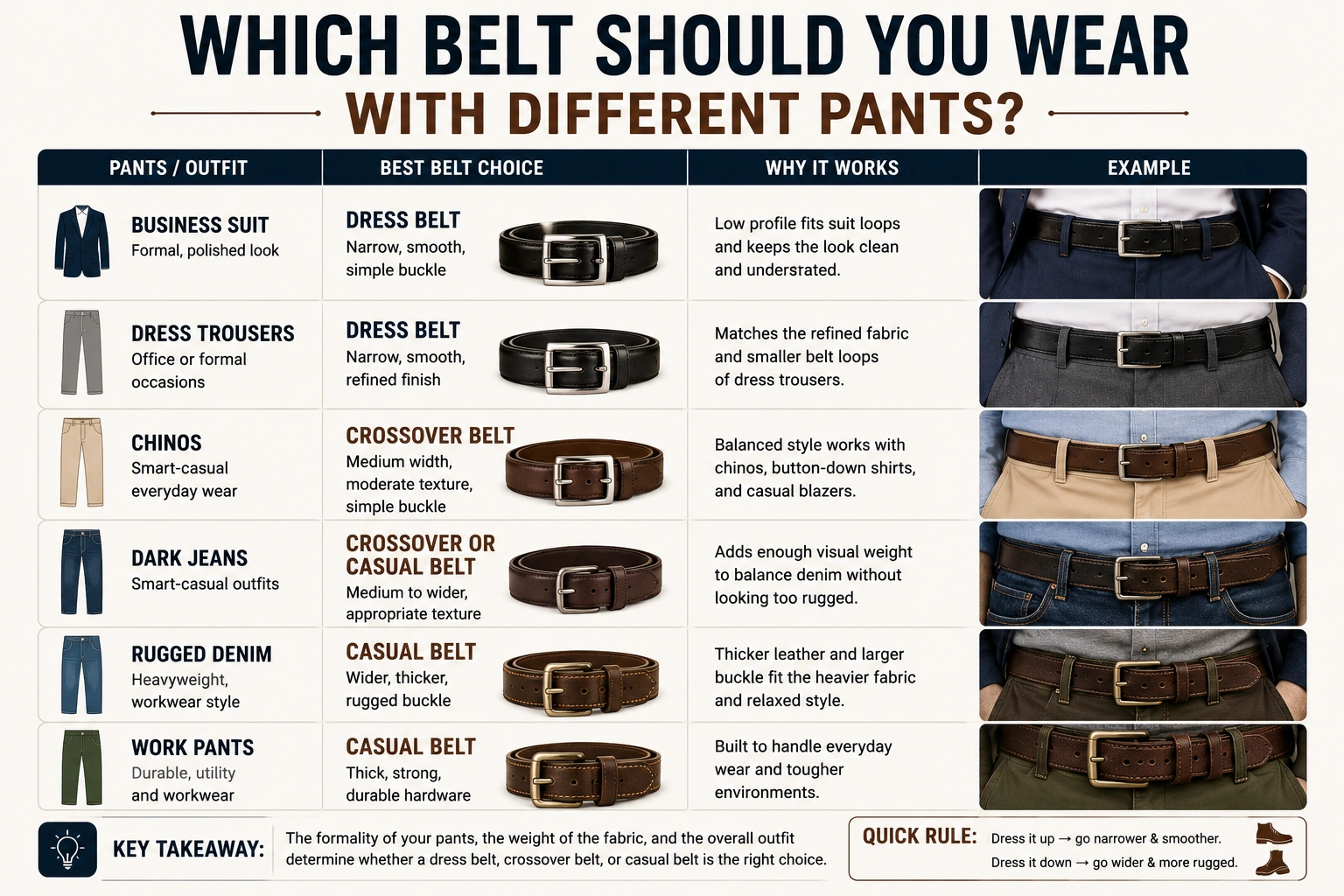
| Pants or Outfit | Better Choice | Why |
|---|---|---|
| Business suit | Dress belt | Narrower, smoother, and less visually heavy |
| Dress trousers | Dress belt | Matches refined fabric and smaller belt loops |
| Dark chinos | Dress or refined casual belt | Depends on shoe and shirt formality |
| Casual chinos | Casual belt | More texture is acceptable |
| Dark jeans | Casual belt or crossover belt | Needs enough visual weight |
| Rugged denim | Wider casual belt | Better balance with heavy fabric |
| Work pants | Casual belt | Thicker leather and stronger hardware fit the style |
| Smart-casual outfit | Refined casual or simple dress belt | Match the shoes and overall formality |
The more formal the trousers, the quieter the belt should usually be.
Fine wool trousers and suits look more natural with a narrow strap, smooth leather, and restrained buckle. Thick denim and work pants can support wider leather, visible grain, and stronger hardware.
Chinos sit between the two.
Dark, sharply pressed chinos worn with loafers and a tucked-in shirt may suit a refined belt. Faded casual chinos worn with boots or sneakers can handle more texture and a larger buckle.
Do not judge the belt from the trousers alone.
A dark pair of jeans worn with polished leather shoes and a blazer calls for a more refined belt than the same jeans worn with work boots and a heavy overshirt.
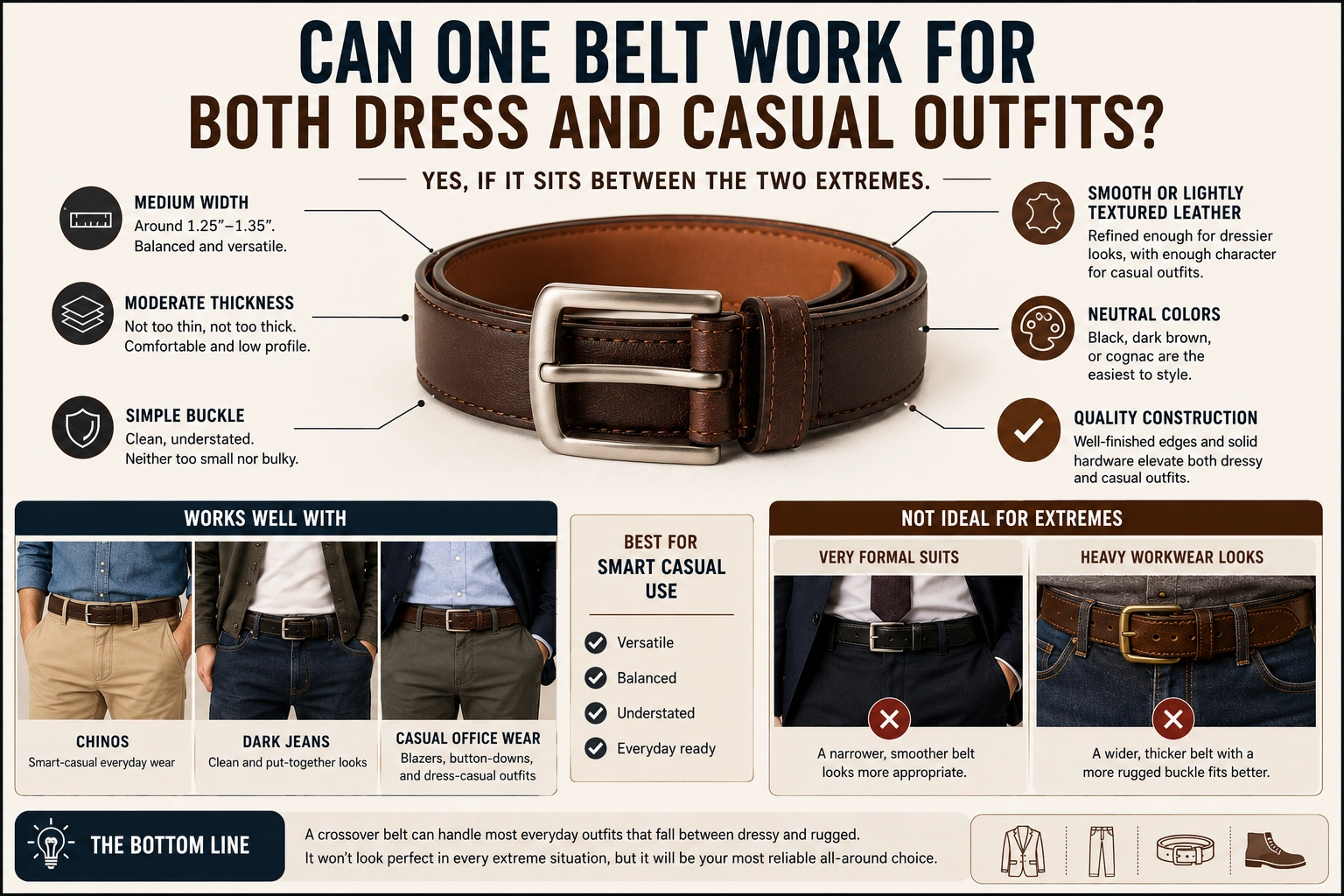
Can One Belt Work for Both Dress and Casual Outfits?
Yes, but it must sit between the two extremes.
A useful crossover belt often has:
-
A width of approximately 1.25 to 1.35 inches
-
Moderate thickness
-
Smooth or lightly textured leather
-
A simple medium-size buckle
-
Refined edges
-
Minimal decoration
-
A dark neutral color
Black, dark brown, and cognac are usually the easiest crossover colors.
This type of belt can work with:
-
Chinos
-
Dark jeans
-
Casual office trousers
-
Loafers
-
Simple boots
-
Smart-casual outfits
It may also work with an unstructured blazer or a relaxed office outfit.
The compromise has limits.
A crossover belt may still look slightly heavy with a formal business suit. It may look too refined beside thick work jeans, heavy boots, and rugged outerwear.
A crossover belt can cover everyday smart-casual use, but one belt rarely looks equally natural with both a formal suit and heavy workwear.
If your wardrobe regularly moves between those two extremes, owning one dress belt and one casual belt usually creates better results than forcing one design into every outfit.
How to Match Belt Color and Avoid Common Mistakes
Dress Outfits
For formal clothing, the belt and shoes should be close in color and level of polish.
Common combinations include:
-
Black shoes with a black belt
-
Dark brown shoes with a dark brown belt
-
Medium brown shoes with a similar brown belt
They do not need to be an exact factory color match.
A slight difference is usually less noticeable than a conflict in texture or formality. A matte rugged belt may look wrong with highly polished dress shoes even when both are dark brown.
Buckle metal can also coordinate with a watch, cuff links, or other visible metal, although an exact match is not always necessary.
Casual Outfits
Casual matching is more flexible.
Brown leather belts can work with boots in different shades of brown. Jeans can be worn with black, dark brown, cognac, tan, or distressed leather depending on the rest of the outfit.
The goal is coordination rather than perfect matching.
A belt can repeat the warmth, texture, or ruggedness of the shoes without copying their exact color.
Common mistakes include:
-
Wearing a wide rugged belt with formal trousers
-
Choosing a buckle that is too large for the outfit
-
Assuming every thin belt is formal
-
Matching color while ignoring texture and hardware
-
Wearing a narrow dress belt with heavy work jeans
-
Buying without checking trouser loop width
The belt should match the clothing’s formality, fabric weight, and proportions—not just the color of the shoes.
How to Choose Between a Dress and Casual Belt
Start with the clothing you wear most often.
Ask:
-
What trousers will the belt be worn with?
-
How wide are the belt loops?
-
Are the shoes formal, casual, or workwear-inspired?
-
Should the belt blend into the outfit or remain visible?
-
Is the buckle restrained or visually heavy?
-
Does the leather texture match the clothing?
-
Will the belt be used mostly for work, weekends, or formal events?
For suits and formal dress trousers, choose a narrow, smooth belt with a small buckle.
For jeans, work pants, and rugged casual clothing, choose enough width, thickness, and texture to balance the heavier fabric.
For chinos and smart-casual wardrobes, a medium-width crossover belt may offer the most flexibility.
Fit still matters after the style is chosen. Use our guide to choose the correct belt size before ordering.
Choose the belt for the outfit you wear most often rather than buying the most formal or thickest option available.
When comparing products, check the listed width, thickness, buckle material, leather finish, and attachment construction instead of relying only on the product title.
Explore our leather belt collection to compare smooth and textured leather, different strap widths, and understated or more substantial buckle designs.
Final Verdict
A dress belt is usually narrower, thinner, smoother, and fitted with a smaller buckle. Its job is to complete a polished outfit without becoming the focal point.
A casual belt is generally wider, thicker, more textured, and more visually noticeable. It works more naturally with denim, chinos, work pants, boots, and relaxed clothing.
The difference cannot be decided from width or leather grade alone.
The trouser fabric, belt-loop size, shoe style, buckle, edge finish, color, and overall formality all need to work together.
A medium-width crossover belt can cover many smart-casual outfits, especially chinos and dark jeans. It is less likely to look equally natural with both a formal suit and heavy workwear.
Choose a dress belt when the outfit needs a clean, understated finish. Choose a casual belt when heavier fabrics, visible texture, and more substantial hardware feel more natural.
Frequently Asked Questions
What Is the Main Difference Between a Dress Belt and a Casual Belt?
A dress belt is usually narrower, thinner, smoother, and more understated. A casual belt is generally wider, thicker, more textured, and fitted with more noticeable hardware. The correct choice depends on the trousers, shoes, and overall formality of the outfit.
How Wide Should a Dress Belt Be?
Dress belts are commonly around 1 to 1.25 inches wide. The exact width should fit the trouser loops and remain proportionate to the buckle and wearer. Formal trousers usually look better with a narrower belt than jeans or work pants.
Can You Wear a Casual Belt With Dress Pants?
A refined casual belt may work with chinos or less-formal dress trousers. Avoid wide, heavily distressed belts, thick edges, and oversized buckles with formal wool trousers or suits. The closer the outfit is to formal businesswear, the more appropriate a traditional dress belt becomes.
Can You Wear a Dress Belt With Jeans?
Yes, especially with dark, slim, or polished jeans worn in a smart-casual outfit. However, a very narrow or shiny dress belt may look too delicate with heavy denim, large belt loops, work boots, or rugged clothing.
Should a Belt Match Your Shoes Exactly?
No. For formal outfits, the colors and level of polish should be close, but they do not need to match perfectly. Casual outfits allow more variation. Texture, hardware, and overall style are often more important than finding an identical shade.
Can One Leather Belt Work for Both Jeans and a Suit?
A medium-width belt with moderate thickness, smooth or lightly textured leather, a simple buckle, and a dark neutral color can work with dark jeans, chinos, and some dress trousers. It may still look too heavy with a formal suit or too refined with rugged workwear.