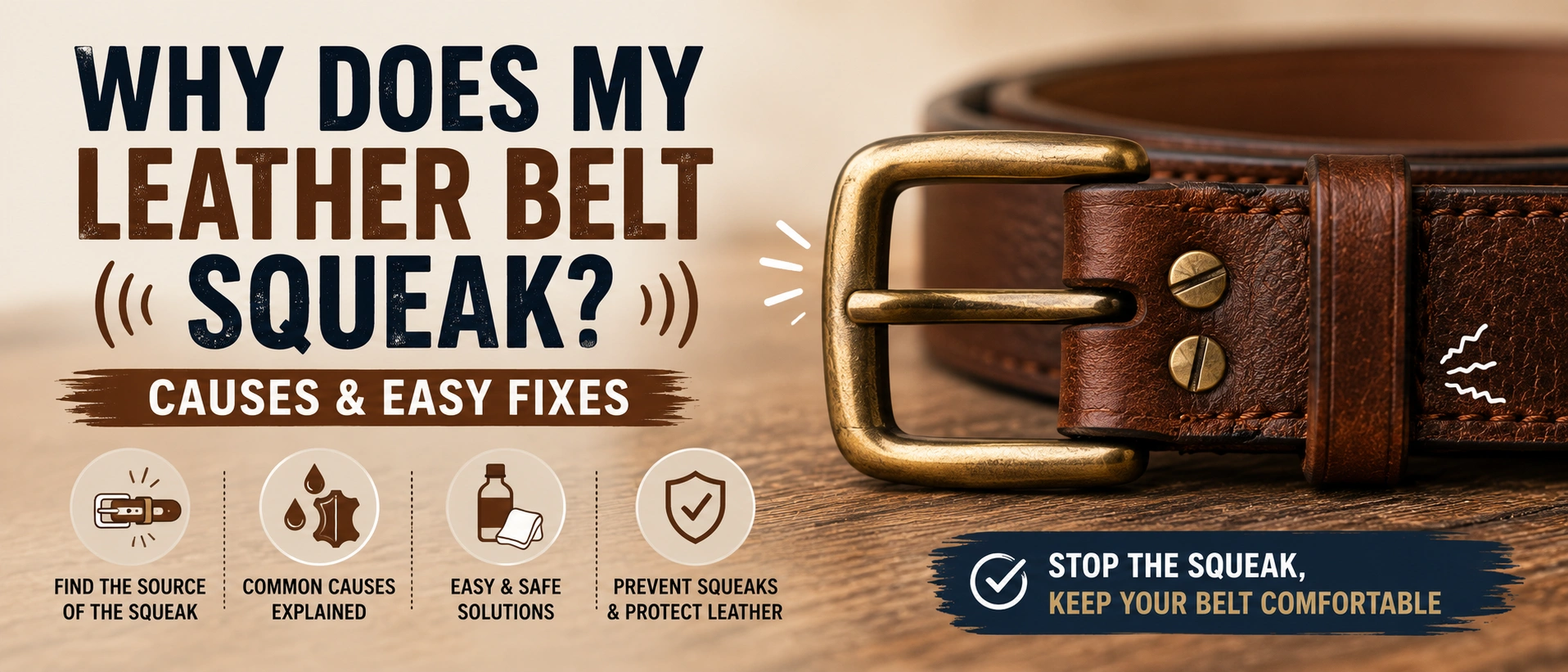
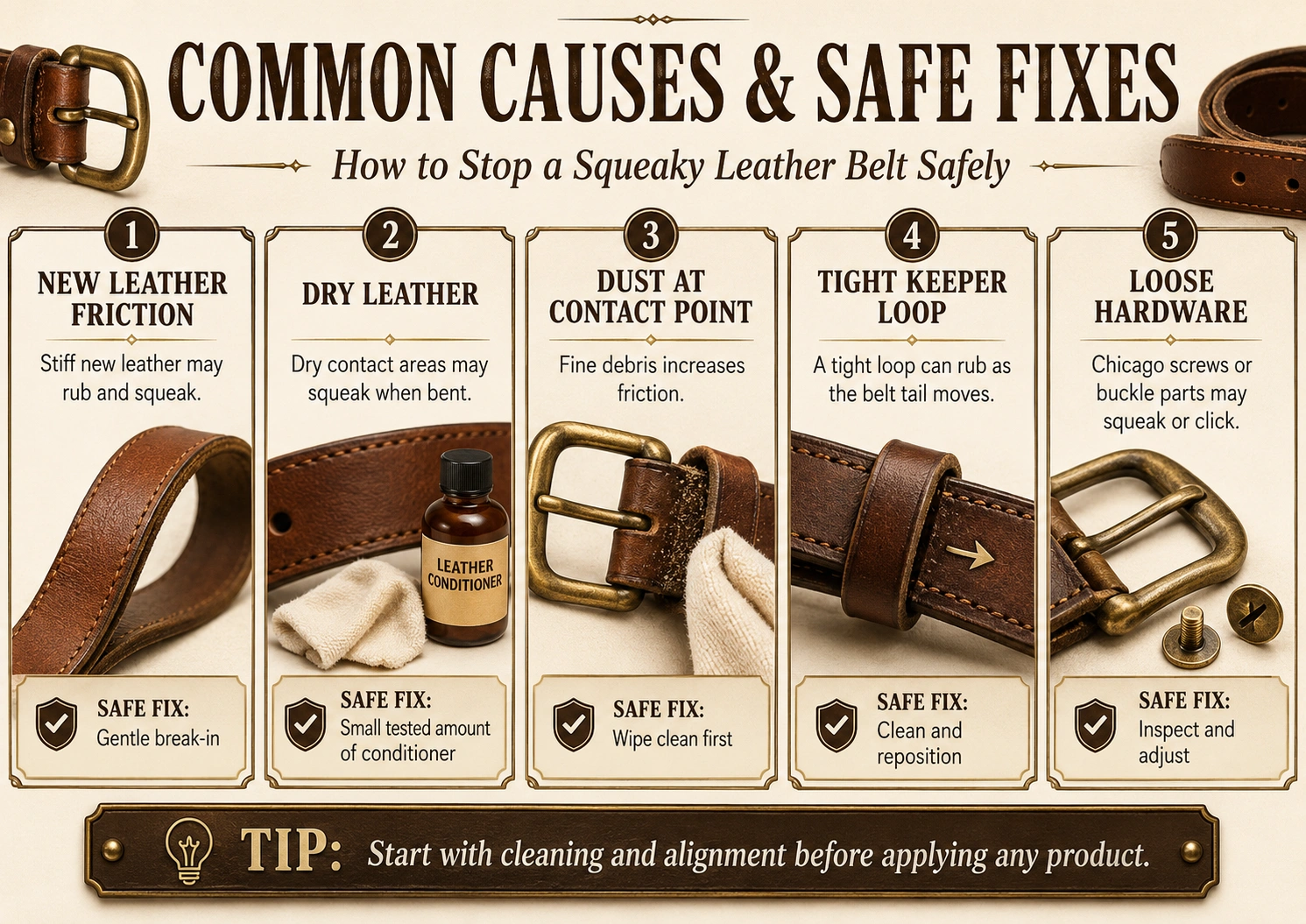
A leather belt usually squeaks because two surfaces are rubbing together—leather against leather, leather against the buckle, or moving metal hardware. New leather, dry contact areas, a tight keeper loop, and loose or misaligned buckle parts are common causes.
The noise does not automatically mean the belt is damaged. In many cases, it comes from a small contact point that needs cleaning, adjustment, or time to break in.
Do not cover the entire belt with oil or conditioner as a first response. That can darken the leather, attract dirt, and hide the actual cause without solving it.
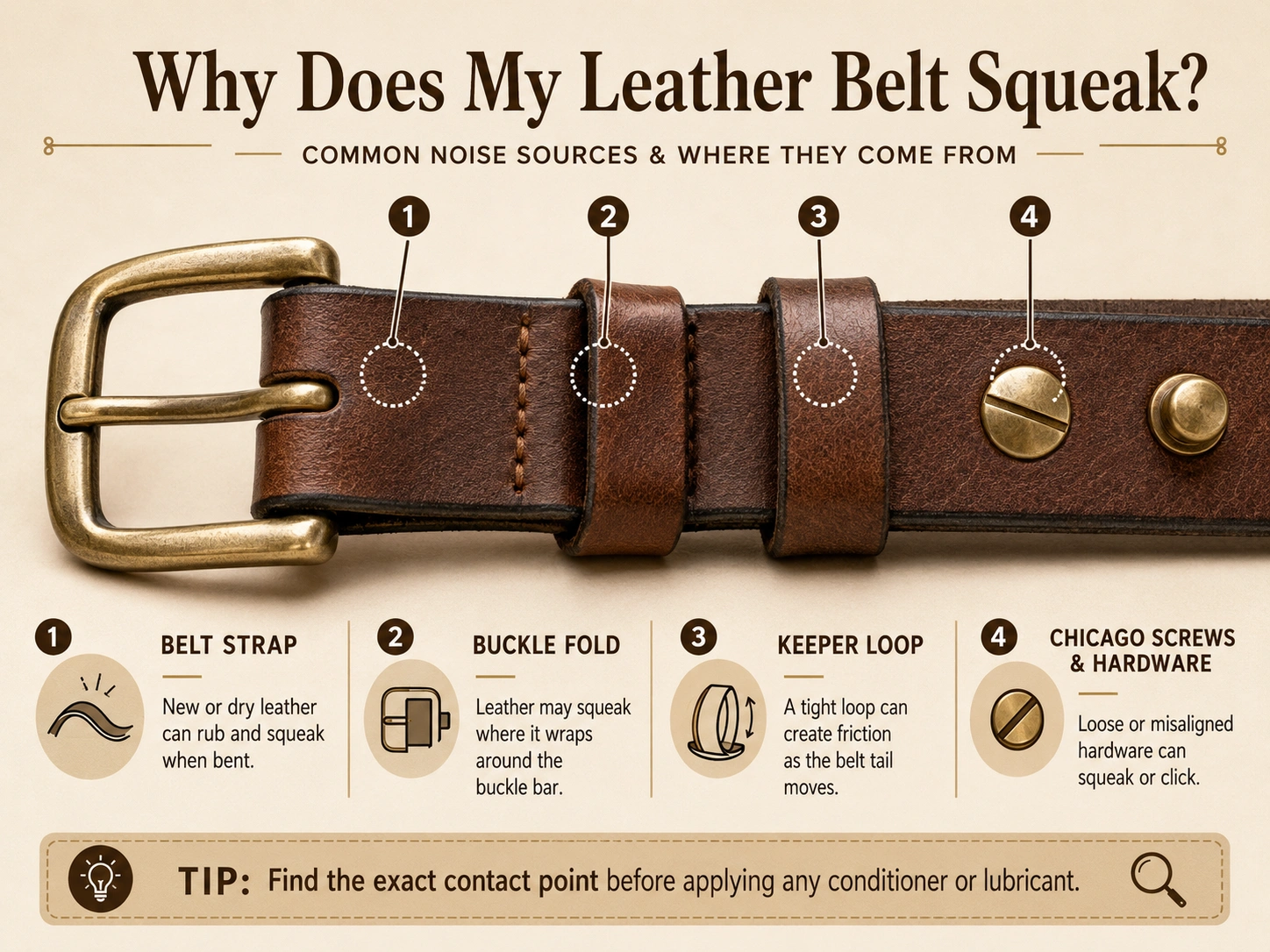
Before applying any product, identify whether the sound comes from the strap, the folded buckle end, the keeper loop, or the metal hardware.
Quick Answer: Why Is My Leather Belt Squeaking?
Start by moving each part of the belt separately.
| Possible Source | Common Cause | First Step |
|---|---|---|
| Belt strap | New or dry leather rubbing | Flex gently and inspect the surface |
| Buckle fold | Leather rubbing against metal | Check alignment and contact points |
| Keeper loop | Loop is tight or rubbing the strap | Clean and reposition the belt tail |
| Chicago screws | Loose, overtightened, or misaligned hardware | Inspect and adjust the screws |
| Buckle hinge or moving metal | Dry or damaged metal contact point | Clean and inspect the hardware |
| Cracked buckle end | Structural leather damage | Stop using and assess repair |
Most squeaks come from ordinary friction. The sound becomes more concerning when it is accompanied by a loose buckle, enlarged fastener holes, cracking leather, or visible movement around the attachment area.
Most squeaks come from normal friction, but noise accompanied by movement, cracking, or loose hardware should be inspected before the belt is worn again.
Find Where the Squeak Is Coming From
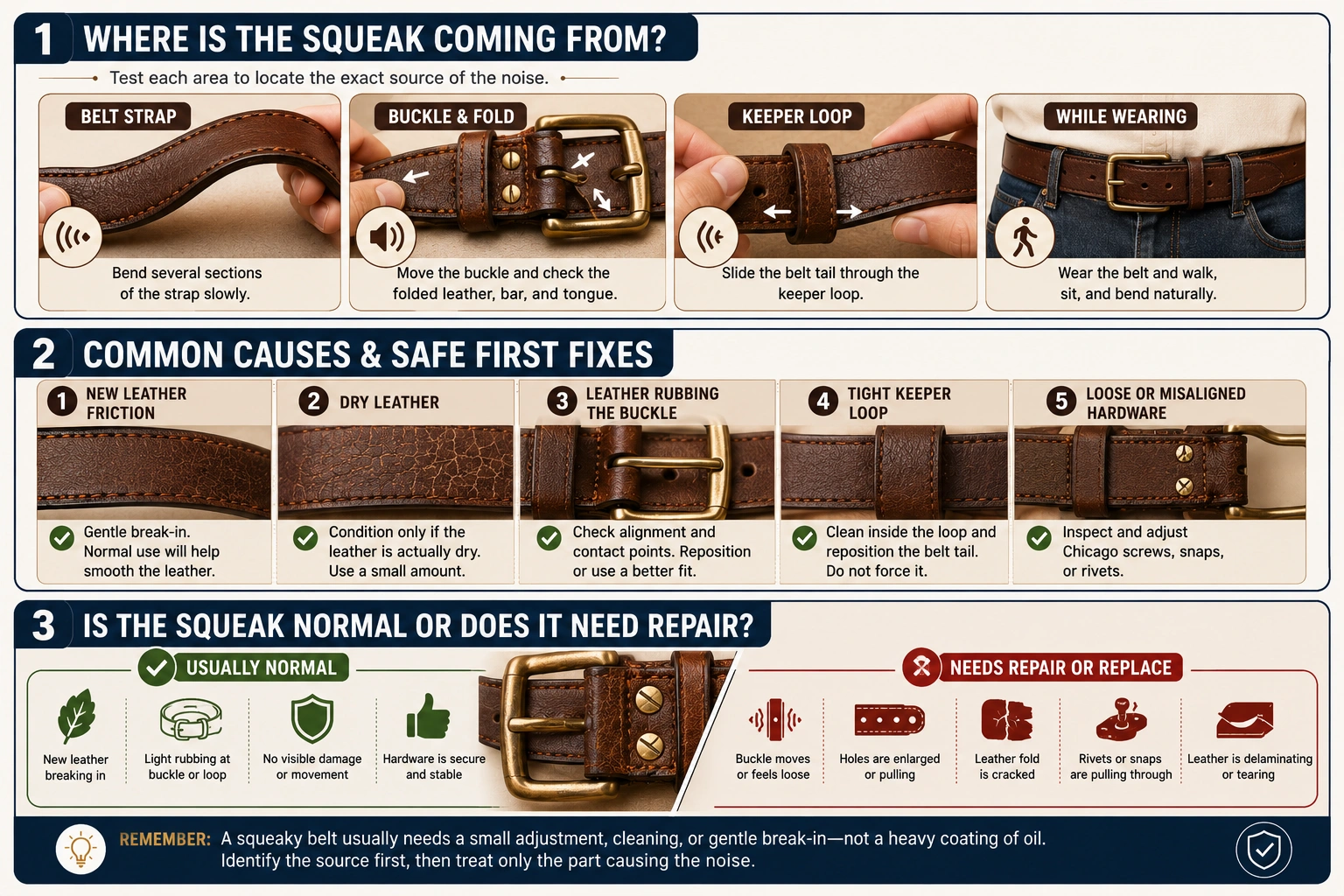
Lay the belt on a flat surface and test one area at a time.
First, bend several sections of the strap slowly. If the sound follows the bending motion, it may come from a stiff surface finish, dry leather, or layers rubbing against each other.
Next, hold the strap still and move the buckle gently. Listen around:
-
The buckle bar
-
The buckle tongue
-
The folded leather end
-
Chicago screws
-
Snaps or rivets
Then slide the belt tail through the keeper loop. If the sound appears only while the tail moves, the loop may be tight, dusty, or rubbing against a firm belt edge.
Finally, wear the belt and move naturally. Walk, sit, and bend slightly.
A squeak that appears only while worn may be caused by the angle of the buckle, pressure around the waist, or the belt rubbing against a trouser loop rather than an internal problem with the leather.
Do not treat the entire belt until you know which small contact point is making the sound.
Common Causes of a Squeaky Leather Belt
New Leather Is Still Breaking In
New leather is usually firmer than leather that has been worn regularly.
The folded buckle end may not yet move smoothly around the buckle bar, and the belt tail may create friction as it passes through a tight keeper loop.
A light rubbing sound that gradually becomes quieter is usually not a defect when the leather remains flexible and the hardware stays secure.
Do not force the break-in process by sharply folding or twisting the belt. Normal wear is safer.
The Leather Is Dry
Dry leather may squeak as its fibers move against each other, particularly around the buckle fold and belt edges.
Other signs of dryness may include:
-
A hard or papery feel
-
Reduced flexibility
-
Pale stress lines when bent
-
A rougher surface
-
Long periods without care
Noise alone does not prove that the belt needs conditioner.
Some coated leather can squeak because of surface friction even when the leather underneath is not dry. Inspect the condition before applying anything.
Leather Is Rubbing Against the Buckle
The folded leather behind the buckle is a common noise source.
Friction may occur where:
-
Leather wraps around the buckle bar
-
The buckle tongue passes through the leather slot
-
The buckle frame presses against the fold
-
The keeper loop sits close to the buckle
-
The buckle is too narrow for the strap
A misaligned or incompatible buckle can keep rubbing the same area.
When the buckle can be removed, it may need to be repositioned or replaced with a better-fitting design. See how to change or realign a belt buckle before taking the attachment apart.
The Keeper Loop Is Too Tight
A tight keeper loop can make a short squeak each time the belt tail moves.
This may happen because the belt is new, the tail is unusually thick, the loop has changed shape, or the belt is being inserted at an awkward angle.
Check that the loop lies flat and is not being compressed by the buckle.
Do not stretch a leather keeper aggressively. A torn or loose loop may be more difficult to repair than the original squeak.
Buckle Hardware Is Loose or Misaligned
Moving hardware can create a sharper metallic squeak or click.
Possible causes include:
-
Loose Chicago screws
-
Screws tightened hard enough to compress the fold
-
An off-center buckle bar
-
A moving rivet
-
A loose snap
-
The buckle tongue rubbing against the frame
A squeak from moving hardware should be inspected before adding conditioner to the leather.
Conditioner will not tighten a screw or correct a damaged buckle.
How to Stop a Leather Belt From Squeaking
Use the least aggressive solution first.
1. Remove dust and debris.
Wipe the buckle bar, folded leather, keeper loop, belt edges, and fasteners with a clean, dry cloth. Fine dust can increase friction between leather and metal.
2. Flex the leather gently.
Bend the noisy section through its normal range of movement. Do not fold it backward, crease it sharply, or repeatedly work an area that is already cracked.
3. Check the buckle alignment.
Confirm that the buckle is centered, the fold lies flat, the tongue moves freely, and the keeper loop is not trapped against the buckle.
An incompatible buckle should be corrected rather than covered with lubricant.
4. Adjust Chicago screws carefully.
If a screw is loose, hold both sides and tighten it slightly. Do not overtighten it or heavily compress the leather.
If the screw is already secure, additional force may make the buckle fold more rigid and increase rubbing.
5. Condition only genuinely dry leather.
Test a small hidden area first. Apply a thin layer of conditioner suited to the leather type, then remove excess product and allow it to absorb fully.
Conditioner may darken leather. It may also be unsuitable for suede, nubuck, coated leather, or specialty finishes.
6. Test the belt again.
Once the surface is clean and dry, bend the strap, move the buckle, slide the tail through the keeper loop, and wear the belt briefly.
Change one thing at a time. Otherwise, you will not know which step solved the problem.
What Should You Not Put on a Squeaky Leather Belt?
Avoid treating a squeak with products that were not designed for leather.
Do not apply:
-
Cooking oil
-
Motor oil
-
WD-40 directly to leather
-
Silicone spray
-
Petroleum jelly
-
Heavy grease
-
Strong household cleaner
-
Excessive leather conditioner
These products may create dark oil stains, sticky residue, dust buildup, uneven softening, damaged surface finishes, or marks on clothing.
If a moving metal joint genuinely needs lubrication, use only a very small amount of a suitable metal product applied precisely to the metal contact point. Protect the surrounding leather and wipe away all excess.
Do not coat the belt with oil simply because the source of the squeak has not yet been identified.
Is a Squeaky Belt a Sign of Damage?
A light rubbing noise is usually normal when:
-
The belt is new
-
The keeper loop is firm
-
Leather rubs lightly against the buckle bar
-
The sound becomes quieter with use
-
The hardware remains secure
-
No cracking or separation is visible
The belt needs closer inspection when:
-
The buckle moves noticeably
-
A Chicago screw repeatedly loosens
-
Leather at the buckle fold is cracking
-
Rivet or screw holes are enlarging
-
The keeper loop is tearing
-
The buckle tongue or frame is bent
-
Layers of leather are separating
Noise alone is not always damage. Noise combined with movement, cracking, or loss of strength is more concerning.
When Should You Repair or Replace the Belt?
A small adjustment may be enough when the buckle is slightly misaligned, a Chicago screw needs tightening, the keeper loop needs repositioning, or one area of leather is mildly dry.
Repair becomes more important when the attachment area is beginning to crack or a replaceable fastener is failing.
Read whether it is possible to repair a cracked leather belt before repeatedly bending a damaged buckle fold.
Professional repair or replacement may be safer when:
-
The buckle attachment leather is deeply cracked
-
Fastener holes continue to enlarge
-
A rivet or snap is pulling through the leather
-
The buckle cannot remain stable
-
The strap is delaminating
-
The leather no longer supports normal tension
Review the signs that a leather belt should be replaced when several problems appear together.
Conditioner can reduce friction in dry leather, but it cannot restore a weakened buckle attachment.
How to Prevent Belt Squeaking
-
Wipe dust from the buckle, fold, and keeper loop regularly.
-
Do not allow the leather to remain excessively dry.
-
Avoid applying more conditioner than the leather can absorb.
-
Keep Chicago screws secure without overtightening them.
-
Use a buckle compatible with the strap width and thickness.
-
Store the belt loosely rolled or hanging rather than sharply folded.
-
Let a wet belt dry naturally away from direct heat.
-
Inspect moving hardware before the noise becomes worse.
A belt with properly aligned hardware and a clean buckle area is less likely to develop persistent rubbing sounds.
Explore our leather belts with secure everyday hardware for removable and fixed-buckle designs intended for regular use.
Final Verdict
Most leather belt squeaks come from ordinary friction.
New leather, a dry contact area, a tight keeper loop, and movement around the buckle are the most common sources.
Locate the noise before treating the belt. Clean the contact area first, check the buckle and screws, and allow new leather to break in naturally.
Use conditioner only when the leather actually shows signs of dryness. Do not cover the strap with WD-40, cooking oil, grease, or excessive leather-care products.
When the sound appears with a loose buckle, cracked fold, enlarged holes, or moving rivets, inspect the structure before continuing to wear the belt.
A squeaky leather belt usually needs a small adjustment, cleaning, or gentle break-in—not a heavy coating of oil. Identify the source first, then treat only the part causing the noise.
Frequently Asked Questions
Why Does My New Leather Belt Squeak?
New leather is often firm, and its surface may rub against the buckle bar, keeper loop, or another leather layer. The noise usually becomes quieter as the belt moves and softens through normal wear, provided there is no cracking or loose hardware.
How Do I Stop Leather From Squeaking?
Find the exact contact point, remove dust, flex the leather gently, and inspect the buckle alignment. Use a small tested amount of conditioner only when the leather is genuinely dry. Do not treat the entire belt before locating the source.
Can I Use Leather Conditioner on a Squeaky Belt?
Yes, but only if the leather shows signs of dryness and the conditioner suits that finish. Test it in a hidden area and apply a thin layer. Conditioner may darken leather and will not fix loose or damaged hardware.
Can I Use WD-40 on a Belt Buckle?
Do not spray WD-40 directly onto a leather belt. It can spread into the leather and leave stains. If metal hardware requires lubrication, apply a tiny controlled amount to the metal contact point while fully protecting the surrounding leather.
Why Does My Belt Buckle Squeak When I Walk?
Walking changes the angle and tension around the buckle. The noise may come from leather rubbing against the buckle bar, a tight keeper loop, moving Chicago screws, or the buckle tongue contacting the frame.
Will Belt Squeaking Go Away on Its Own?
A light squeak from new leather may decrease as the belt breaks in. Persistent noise caused by dry leather, trapped dirt, loose screws, or misaligned hardware usually needs cleaning or adjustment rather than more wear.