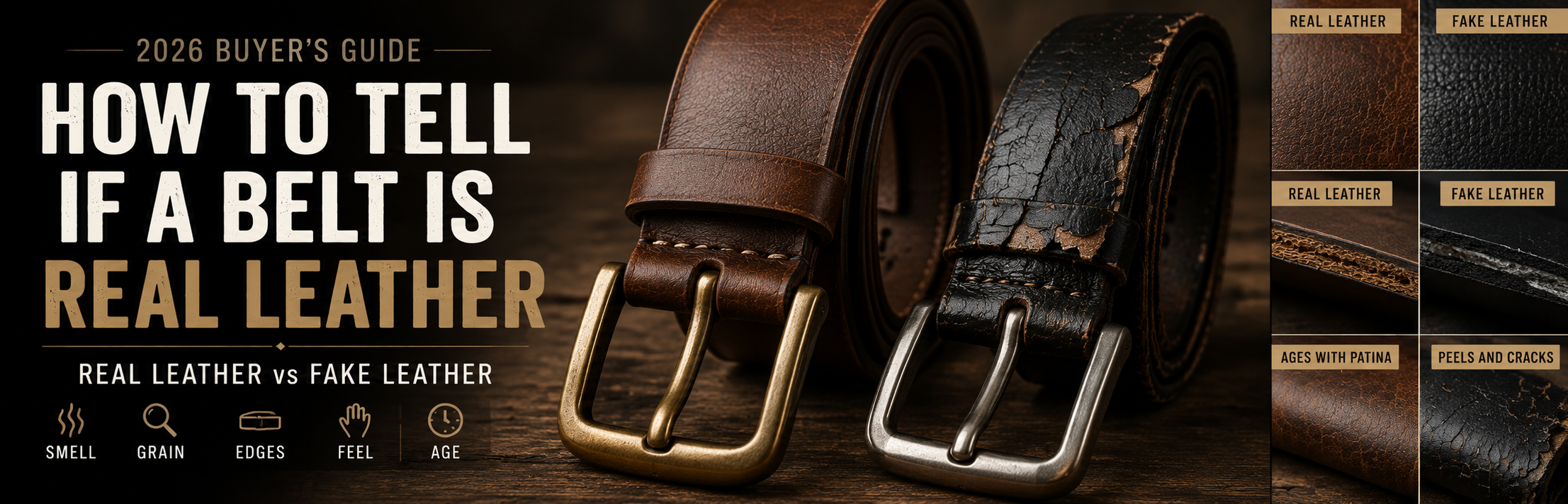
You've bought a belt described as “genuine leather.” It looked right. It felt right. The price was reasonable. And for the first year or so, it was fine.
Then the edges started going.
A faint peeling along the buckle holes. A crack running across the surface near the first fold. Small flakes of what looked like leather — but wasn’t — coming off on your fingers. Within two years of regular wear, the belt looked like it had been left in the sun for a decade.
This is not an unusual story.
It’s the standard trajectory of many “leather” belts sold today, across every price tier, from fast-fashion retailers to supposedly premium brands.
The frustrating part isn’t that cheap belts exist. It’s that the labeling tells you almost nothing useful.
“Genuine leather” sounds like a quality guarantee. In reality, it’s often a legal minimum — a term that can describe everything from carefully tanned full-grain cowhide to shredded leather scraps pressed into sheets with polyurethane binder.
Both are technically leather.
They perform nothing alike.
The problem usually isn’t whether leather exists somewhere in the belt.
The problem is what kind of leather it actually is — and that distinction is almost never printed clearly on the label.
Why More Buyers Are Questioning Leather Quality in 2026
In 2026, more consumers are paying attention to material quality than they did a decade ago.
Part of this comes from frustration:
-
belts peeling too quickly
-
“premium” products failing within a year or two
-
fast-fashion construction hidden behind expensive branding
And part of it comes from a broader shift toward:
-
long-term ownership
-
better craftsmanship
-
fewer but higher-quality purchases
Searches like:
-
“how to tell if leather is real”
-
“why is my leather belt peeling”
-
“full-grain leather vs genuine leather”
have become increasingly common because buyers want to avoid replacing the same product repeatedly.
People are no longer just asking:
“Is this leather?”
They’re asking:
“Will this actually last?”
Not All “Real Leather” Is Equal
To understand why so many leather belts fail prematurely, you need to understand the hierarchy of leather the industry uses — but rarely explains to consumers.
From the bottom up:
Bonded Leather
Bonded leather is the lowest tier and the most common cause of peeling belts.
It’s made by:
-
grinding leather scraps and offcuts
-
mixing them with polyurethane or latex binder
-
pressing the material onto fabric or paper backing
The surface is then embossed with a grain pattern to imitate real leather.
The actual leather content can range anywhere from around 10% to 50%.
The rest is binder and backing material.
Bonded leather often looks convincing when new, but the polyurethane surface layer has a limited lifespan. Once it starts separating from the base material, the process accelerates quickly.
You are no longer watching leather age.
You are watching a plastic coating fail.
Bonded Leather Usually Means:
-
peeling
-
flaking
-
layer separation
-
short lifespan
Genuine Leather
“Genuine leather” is where terminology becomes genuinely misleading.
The phrase sounds like a quality endorsement.
It isn’t.
In industry terms, genuine leather usually refers to leather made from the lower layers of the hide after the stronger upper layers have been removed for higher-grade products.
These lower layers:
-
have looser fiber structure
-
stretch more easily
-
resist wear less effectively
To compensate, manufacturers typically apply:
-
heavy sanding
-
thick coatings
-
artificial grain textures
-
polyurethane finishes
The finish creates the appearance of quality, even when the structural material underneath is relatively weak.
Most mall belts and mass-market leather belts fall into this category.
They are not fake in a legal sense.
But they are often far lower quality than buyers assume.
Genuine Leather Usually Means:
-
lower hide layers
-
heavy coating
-
weaker fiber structure
-
shorter lifespan than full-grain leather
Top-Grain Leather
Top-grain leather is a legitimate quality material and a genuine step up from standard genuine leather.
It comes from the outer layer of the hide — the strongest part — but the surface has been sanded or corrected to remove natural imperfections before a finish coat is applied.
This creates:
-
smoother appearance
-
more uniform texture
-
cleaner color consistency
The trade-off is that sanding removes part of the dense surface fiber structure that makes untouched leather exceptional.
Top-grain leather still offers:
-
good durability
-
improved longevity
-
better structural integrity than lower-grade leather
But because the surface is corrected and sealed, it generally develops less natural character and patina over time than full-grain leather.
Full-Grain Leather
Full-grain leather is the outer layer of the hide with nothing removed.
The surface is never:
-
sanded
-
buffed
-
corrected
The original grain structure remains intact.
This matters structurally because the outermost fibers of a hide are the most densely packed and mechanically strongest part of the skin.
When that layer remains untouched:
-
tensile strength stays higher
-
stretch resistance improves
-
durability increases significantly
It also matters visually.
Because the surface remains breathable and natural, full-grain leather develops a true patina over time:
-
darker contact points
-
softened flex areas
-
deeper color variation
-
natural surface character
No two full-grain leather belts age identically.
That individuality is part of what makes them desirable.
A well-made full-grain leather belt is the baseline for serious leather goods.
Everything below it is a compromise of varying severity.
Why Some “Leather Belts” Peel and Crack
Peeling and cracking are the two most common failure modes for leather belts.
And they usually have different causes.
Peeling
Peeling is most commonly associated with:
-
bonded leather
-
heavily coated split leather
-
polyurethane surface layers
The coating begins separating from the material underneath.
It usually starts at:
-
buckle holes
-
edges
-
flex points
-
first belt loop fold
Once peeling begins, it cannot truly be repaired.
Cracking
Cracking usually indicates:
-
dried-out leather
-
brittle coating layers
-
weak lower-hide leather
-
repeated stress beyond the material’s flexibility
Full-grain leather can crack if neglected completely for years, but it is far more resistant than coated materials.
Layer Separation
Some belts create “thickness” by gluing multiple thin layers together.
Over time:
-
sweat
-
heat
-
moisture
-
repeated flexing
can weaken the adhesive bond.
The result is:
-
spongy feeling leather
-
warped structure
-
visible separation along the edges
Real Case: “My Genuine Leather Belt Started Peeling”
This failure pattern appears constantly in leather communities and buyer forums.
A common example:
someone buys a belt labeled “genuine leather” from a reputable retailer, wears it daily for about a year, then notices peeling around the buckle holes and edges.
When they inspect the cross-section closely, they discover:
-
fabric backing
-
layered construction
-
thin leather-like coating over weaker material
The phrase “genuine leather” was technically accurate.
But practically misleading.
This is one of the main reasons buyers begin researching leather quality seriously — not out of hobbyist curiosity, but because something they expected to last failed far too quickly.
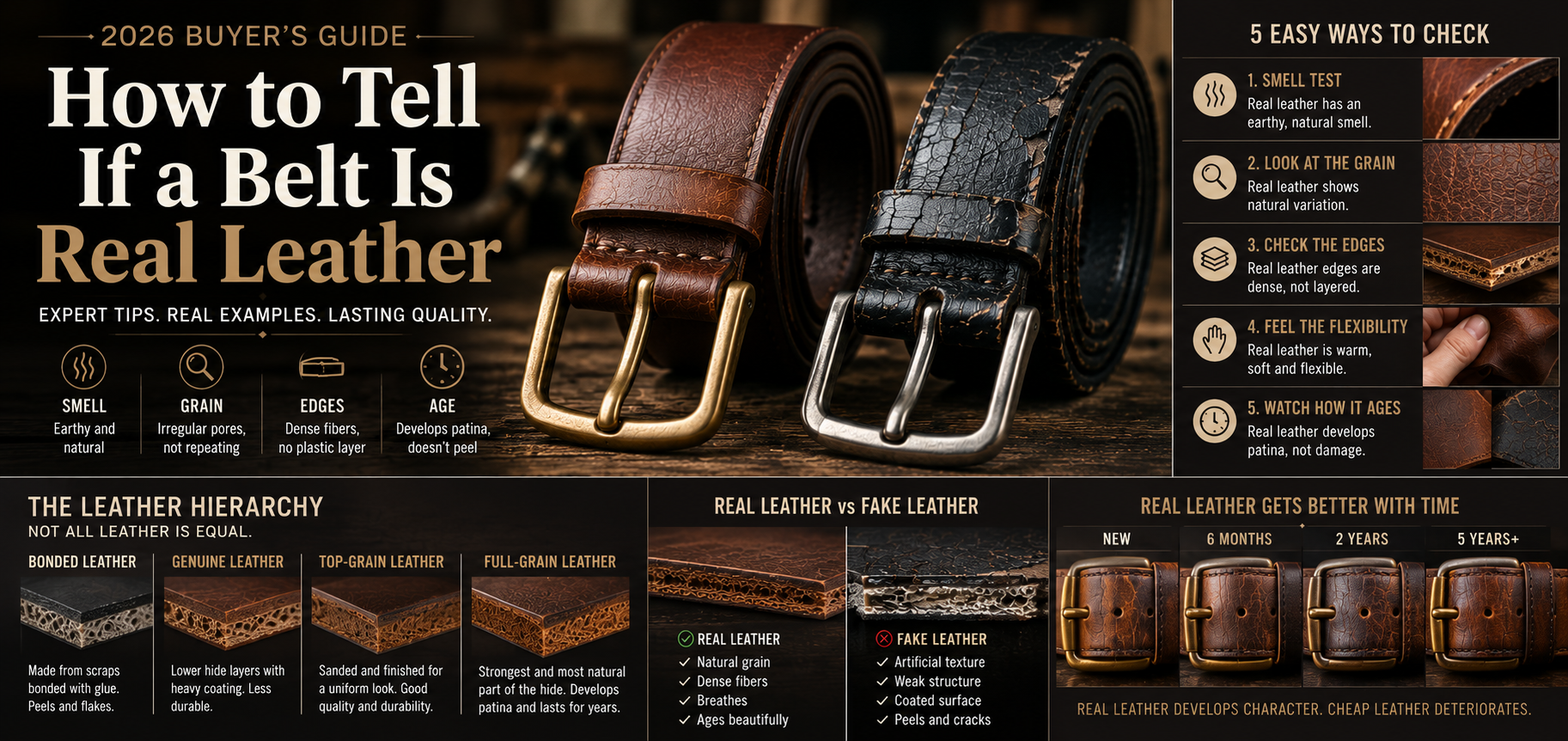
5 Easy Ways to Tell If a Belt Is Real Leather
If you have a belt in hand, these five tests reveal most of what you need to know.
1. The Smell Test
Real leather has a warm, organic smell:
-
earthy
-
rich
-
natural
Synthetic materials and heavily coated belts often smell:
-
plastic-like
-
chemical
-
artificial
This test works best on newer products before outside odors accumulate over time.
2. Look at the Grain Closely
Real leather — especially full-grain leather — shows natural irregularity.
You’ll notice:
-
uneven pore spacing
-
subtle tonal variation
-
non-repeating texture
Fake leather and heavily embossed materials often show repeating patterns stamped mechanically into the surface.
If the texture repeats perfectly across large sections, it’s usually artificial.
3. Check the Cut Edges
This is one of the most revealing tests.
On full-grain leather:
-
fibers appear dense and tight
-
edges look compact and solid
On bonded leather or layered construction:
-
backing layers may be visible
-
coatings may separate from the edge
-
layers may appear stacked or glued
Real Case: “The Edges Started Peeling First”
Many users only discover construction problems after the belt begins failing at the edges.
Typical warning signs:
-
peeling along the side
-
cracking near the holes
-
visible layering at the loop area
This is why experienced leather buyers inspect the edges before almost anything else.
The edge often reveals what the surface is hiding.
4. Feel How It Responds to Warmth and Pressure
Real leather responds naturally to handling.
It:
-
warms slightly in your hand
-
softens subtly with pressure
-
flexes organically
Synthetic materials tend to feel:
-
colder
-
more rigid
-
mechanically uniform
The difference becomes easier to notice with experience.
5. Watch How It Ages
This is the definitive test.
Real leather develops character:
-
patina
-
darker edges
-
softened flex points
-
richer color variation
Fake leather deteriorates:
-
peeling
-
cracking
-
flaking
-
splitting
The simplest summary is this:
Real leather develops character. Fake leather deteriorates.
Before You Buy a Leather Belt
Before buying a belt online or in-store, check these details carefully:
Look For:
-
full-grain leather description
-
solid brass or stainless hardware
-
single-piece construction
-
clean dense edges
-
natural grain variation
Be Cautious Of:
-
vague “genuine leather” labeling
-
perfectly uniform texture
-
overly soft bonded construction
-
thick painted edges hiding layers
-
no leather type specified anywhere
A quality manufacturer usually explains the leather clearly because the material itself is one of the product’s strongest selling points.
Full-Grain Leather vs Genuine Leather Belts
The performance difference between full-grain and genuine leather becomes obvious over time.
Fiber Structure
Full-grain leather keeps the strongest, densest fibers of the hide intact.
This improves:
-
durability
-
shape retention
-
stress resistance
Genuine leather uses weaker lower-hide layers.
Stretch Resistance
Belts experience constant tension around:
-
buckle holes
-
waist pressure
-
daily flexing
Full-grain leather resists stretching significantly better.
Aging Behavior
Full-grain leather develops:
-
patina
-
depth
-
unique wear patterns
Heavily coated genuine leather usually remains static until the coating begins failing.
Why Full-Grain Leather Costs More
The price difference reflects:
-
higher-grade hides
-
lower defect tolerance
-
less artificial correction
-
longer lifespan
The material itself is simply better.
What About PU Leather and Vegan Leather?
PU leather and vegan leather alternatives deserve a balanced discussion.
They offer genuine advantages:
-
affordability
-
consistency
-
easy maintenance
-
wide color options
For many buyers, these are perfectly reasonable priorities.
The trade-off is aging behavior.
PU and vegan materials generally:
-
do not develop patina
-
do not soften naturally over decades
-
eventually degrade differently from natural leather
That doesn’t make them “bad.”
They are simply different materials with different strengths and limitations.
The real problem occurs when synthetic or heavily processed materials are marketed in ways that imply they behave like high-quality full-grain leather.
How Long Should a Real Leather Belt Last?
Lifespan depends almost entirely on material quality.
Bonded Leather
Usually:
-
1–3 years
Common failures:
-
peeling
-
delamination
-
cracking
Genuine Leather
Usually:
-
3–7 years
Depends heavily on:
-
coating quality
-
use frequency
-
climate
Top-Grain Leather
Usually:
-
5–10+ years
Offers solid durability with proper care.
Full-Grain Leather
Often:
-
10–20+ years
And importantly:
-
ages rather than deteriorates
With occasional conditioning, a full-grain belt can remain structurally sound for decades.
Real Case: “I Got Tired of Replacing Cheap Belts”
Many buyers only start researching leather seriously after replacing multiple belts in quick succession.
The pattern is familiar:
-
peeling edges
-
cracked holes
-
stretched leather
-
flaking surface coating
Eventually the question changes from:
“Is this real leather?”
to:
“What kind of leather actually lasts?”
That frustration is exactly why searches for:
-
“Buy It For Life belt”
-
“full-grain leather belt”
-
“belt that won’t peel”
continue growing.
What Makes a Leather Belt Age Beautifully?
A belt that ages well requires the right materials working together.
The leather must:
-
breathe naturally
-
absorb oils gradually
-
flex without coating failure
-
respond to years of contact
A quality full-grain belt develops:
-
softened edges
-
darker buckle areas
-
richer color depth
-
natural shaping from wear
The hardware matters too.
Solid brass develops a warm patina over time that complements aged leather rather than exposing damaged plating underneath.
And construction matters.
A single-piece full-grain leather belt gradually shapes itself to the person wearing it:
-
flex points soften naturally
-
the back surface changes differently from the front
-
the belt becomes unique to its owner
These are not flaws.
They are signs of use.
Real leather doesn’t stay perfect. It develops character.
The best leather belts don’t resist time.
They become more interesting because of it.
Frequently Asked Questions
Does real leather peel?
High-quality full-grain leather typically does not peel under normal use. Peeling is most commonly associated with bonded leather or heavily coated split leather.
Is genuine leather real leather?
Technically yes, but it is often lower quality than full-grain leather and heavily processed with coatings.
How can I tell if a leather belt is full-grain leather?
Look for:
-
natural grain variation
-
dense cut edges
-
organic smell
-
flexibility
-
long-term patina development
Why is my leather belt cracking and peeling?
This is usually caused by:
-
bonded leather
-
coated split leather
-
dried-out material
-
glued-layer construction
How long should a real leather belt last?
A properly made full-grain leather belt can last for decades with occasional maintenance and normal daily use.
Final Thoughts
The easiest way to tell if a belt is real leather isn’t how it looks when it’s new.
Everything looks acceptable when it’s new.
The real test is how the material changes after years of actual use.
Cheap leather deteriorates.
Bonded leather peels.
Coated split leather cracks.
But real full-grain leather does something different.
It softens.
It darkens at the contact points.
The edges round slightly.
The surface develops depth and character unique to the person wearing it.
Quality leather tells a story through wear.
And the best leather belts become more interesting with time — which is exactly how you know you bought the right thing.