Most men own a belt they'd describe as “good leather.” It looks solid. It has weight to it. The buckle feels sturdy enough. They bought it from a recognizable brand, paid a reasonable price, and assumed it would last.
A few years later, the edges start fraying. The leather cracks around the most-used holes. The buckle coating wears through, exposing dull metal underneath. And the belt — supposedly “genuine leather” — begins peeling in thin layers.
This isn’t bad luck.
It’s the predictable result of buying a belt designed to look work-grade rather than actually be work-grade.
The problem is that most belt marketing language is aesthetic, not structural. Terms like “heavy duty,” “premium leather,” and “rugged style” describe appearance more than long-term performance.
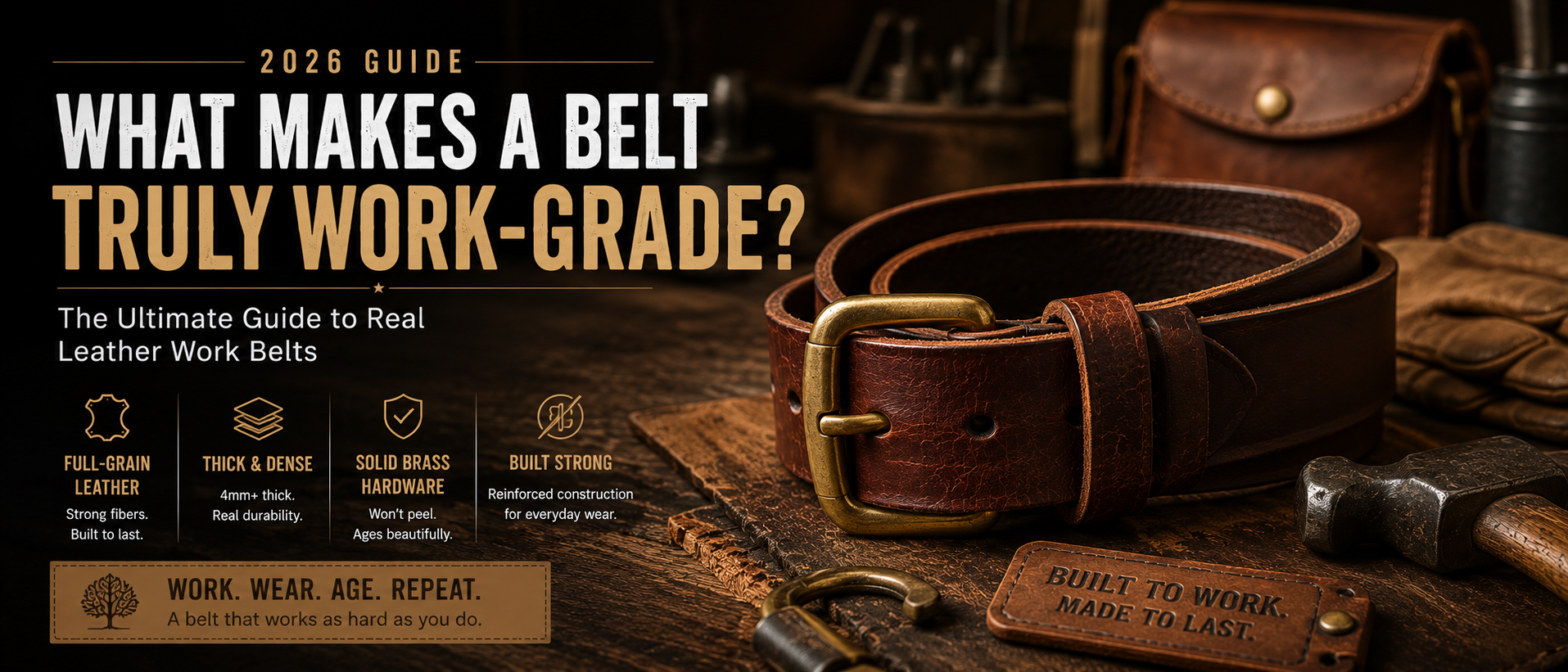
A true work-grade leather belt is different. It’s built around material integrity, fiber density, hardware strength, and long-term durability — not just first impressions.
This guide explains what makes a belt genuinely work-grade, why most belts fail within a few years, and how to choose a heavy-duty leather belt that will still look better after years of real use.
Why Heavy-Duty Leather Belts Are Trending Again in 2026
In 2026, more men are moving away from disposable fashion and returning to products built around longevity, craftsmanship, and utility.
The rise of:
-
heritage workwear
-
quiet luxury
-
rugged utility style
-
buy less, buy better culture
has renewed interest in full-grain leather work belts that are built to last rather than simply look fashionable.
Modern consumers are becoming more aware of:
-
bonded leather
-
fake thickness
-
plated hardware
-
fast-fashion construction shortcuts
And once you understand how belts are actually made, it becomes difficult to unsee the difference between a fashion accessory and a true work-grade tool.
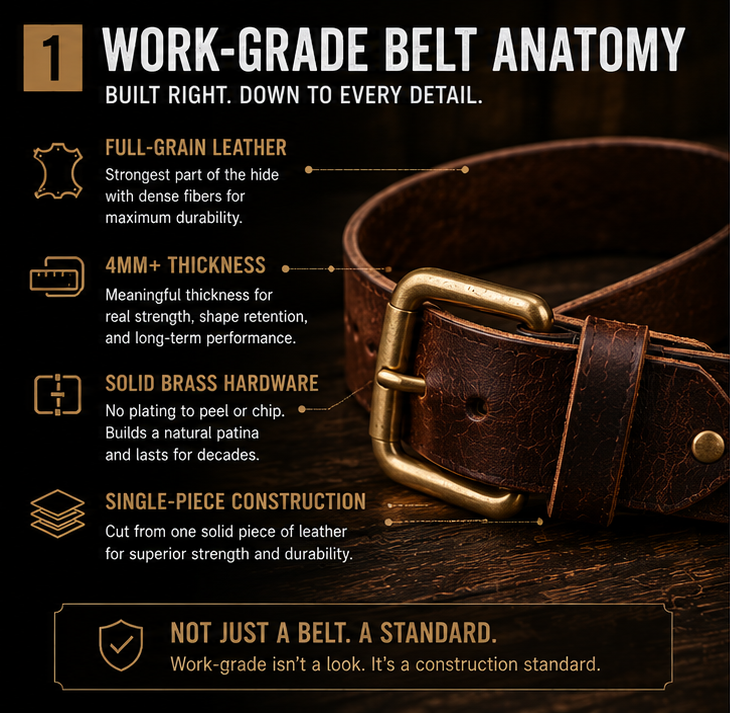
What Is a Work-Grade Leather Belt?
Work-grade is not a style category.
It’s a construction standard.
A real work-grade leather belt is designed to withstand years of sustained stress, movement, moisture, and repeated flexing without losing structural integrity.
That requires four things:
1. Full-Grain Leather Fiber Structure
The leather must come from the strongest layer of the hide, where the collagen fibers are tightly packed and naturally resistant to stretching.
2. Meaningful Thickness
A work belt must have enough material density to distribute pressure properly without deforming over time.
3. Strong Hardware
The buckle must withstand repeated load cycles without bending, cracking, or losing finish.
4. Proper Construction
Single-piece leather construction, reinforced stitching, and secure hardware attachment determine whether the belt stays structurally sound over years of daily wear.
A belt isn’t work-grade because it looks rugged.
It’s work-grade because it performs reliably under real-world use.
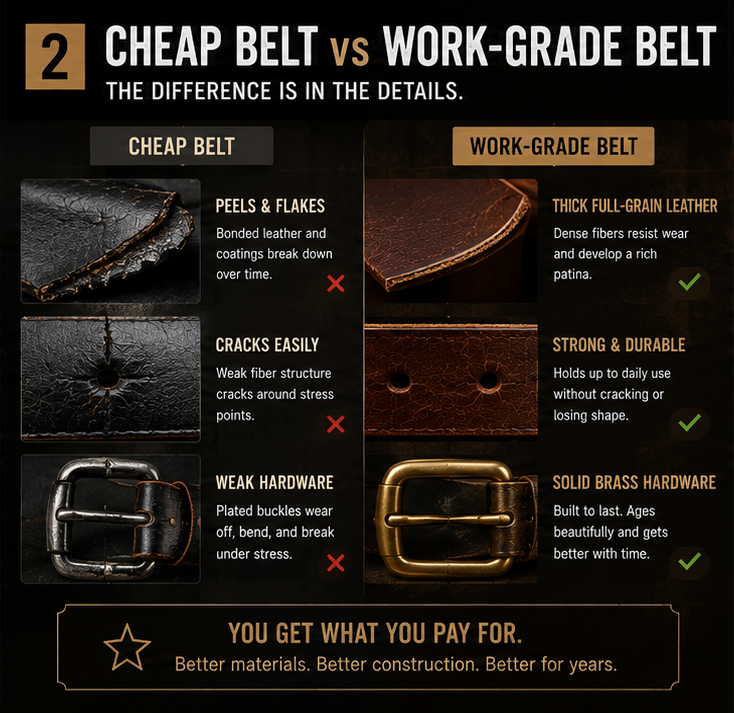
Why Most Leather Belts Fail Within a Few Years
Most cheap belts fail in predictable ways.
Once you understand the construction shortcuts behind them, it becomes much easier to identify quality before buying.
Bonded Leather
Bonded leather is made from shredded leather scraps mixed with polyurethane and glued onto a backing layer.
It may contain very little real leather.
It looks convincing when new, but over time:
-
the surface peels
-
the layers separate
-
the structure weakens
This is the most common reason cheap belts begin flaking after a few years.
Split Leather with Heavy Coating
Many belts use lower layers of the hide coated with artificial grain patterns and thick pigment finishes.
The coating creates the illusion of quality, but underneath:
-
the fiber structure is weaker
-
the leather stretches faster
-
cracks form at stress points
Glued Layer Construction
Some belts achieve “thickness” by gluing multiple thin layers together.
At first this looks substantial.
But over time:
-
sweat
-
moisture
-
repeated flexing
cause the layers to separate internally.
Hollow or Plated Buckles
Cheap alloy buckles often use thin decorative plating over zinc or low-grade metal.
Eventually:
-
the plating chips
-
dull grey metal appears underneath
-
buckle pins weaken under stress
Decorative Stitching
On many fashion belts, edge stitching is cosmetic rather than structural.
A true heavy-duty leather belt uses stitching and construction methods designed to reinforce the belt under tension.
.png?w=730&h=713)
Full-Grain vs Genuine Leather: Which Is Better for a Work Belt?
This is the single most important material difference in belt construction.
Genuine Leather
“Genuine leather” is a broad term that often includes:
-
split leather
-
heavily coated leather
-
bonded leather composites
The term only confirms that real leather exists somewhere in the product.
It says nothing about quality.
Full-Grain Leather
Full-grain leather comes from the outermost layer of the hide — the strongest part with the densest fiber structure.
This layer retains:
-
natural grain
-
natural pores
-
maximum tensile strength
That structure gives full-grain leather:
-
better durability
-
resistance to stretching
-
longer lifespan
-
natural patina development
For a work belt, the difference becomes obvious over time.
A genuine leather belt gradually weakens.
A full-grain leather work belt develops character while maintaining structure.
How Thick Should a Real Work Belt Be?
Thickness matters — but only when paired with proper leather quality.
Around 3mm
Most casual or fashion belts fall around this range.
Fine for light everyday wear.
Not ideal for long-term heavy use.
4mm and Above
This is where true work-grade construction begins.
A properly made 4mm+ full-grain leather belt:
-
distributes pressure better
-
resists stretching
-
holds shape longer
-
performs better under repeated load
Thickness Alone Is Not Enough
A thick bonded leather belt still performs worse than a dense 4mm full-grain belt.
The key is:
👉 dense full-grain fiber structure at meaningful thickness.
Single-Piece vs Layered Construction
A single-piece belt cut from thick full-grain leather is structurally stronger than multiple glued layers attempting to imitate thickness.
Single-piece construction:
-
ages better
-
flexes more naturally
-
resists separation over time
Solid Brass vs Cheap Alloy Buckles
The buckle is the mechanical heart of a belt.
And the material matters.
Cheap Alloy Buckles
Most low-cost belts use plated zinc alloy buckles.
Problems include:
-
plating wear
-
corrosion
-
brittle metal fatigue
-
weak buckle pins
They look acceptable when new but deteriorate quickly under regular use.
Solid Brass Buckles
Solid brass is different.
Because the material is solid throughout:
-
there’s no plating to peel
-
it bends rather than cracks
-
it develops natural patina over time
A solid brass buckle ages alongside full-grain leather instead of deteriorating separately.
That combination — worn brass and aged leather — is one of the defining characteristics of heritage-quality leather goods.
The Difference Between a Fashion Belt and a Work Belt
The difference is not visual.
It’s structural.
Fashion Belts
Typically:
-
thinner
-
softer
-
appearance-focused
-
trend-driven
They’re designed primarily around style and short-to-medium-term wear.
Work Belts
Designed around:
-
long-term stress resistance
-
thicker leather
-
stronger fiber structure
-
durable hardware
-
daily performance
A work belt is a tool first and a style piece second.
Best Work Belt Styles for Everyday Use
Some of the most popular long-term belt styles include:
-
Full-grain leather work belt
-
Heavy-duty jeans belt
-
Solid brass buckle belt
-
Vintage leather work belt
-
Rugged workwear belt for men
These styles prioritize durability and aging character over short-term trends.
What Makes a Belt Age Beautifully?
The best belts don’t resist aging.
They respond to it.
A high-quality full-grain leather work belt develops:
-
darker edges
-
softened contact points
-
richer color variation
-
natural patina around the holes and buckle area
Meanwhile, solid brass hardware slowly develops a warmer, deeper finish through years of contact and friction.
This is why quality leather goods often look better after years of use.
The belt becomes shaped by:
-
your movement
-
your climate
-
your habits
-
your daily routine
No two belts age identically.
That’s not deterioration.
That’s history.
How Long Should a Quality Leather Work Belt Last?
The answer depends entirely on construction quality.
Cheap Belts
Bonded leather and plated hardware belts:
-
often fail within 1–3 years
-
peel
-
crack
-
stretch out
Mid-Range Belts
Moderate-quality genuine leather belts:
-
may last 3–7 years
-
gradually soften and deform
True Work-Grade Belts
A properly maintained full-grain leather work belt with solid brass hardware can last a decade or more under regular use.
More importantly:
It ages rather than deteriorates.
How to Maintain a Full-Grain Work Belt
A work-grade belt requires surprisingly little maintenance — but the right maintenance matters.
Clean Occasionally
Use a soft damp cloth to remove dirt, sweat, and buildup.
Condition Every 3–6 Months
A light application of:
-
beeswax conditioner
-
neatsfoot oil
-
leather conditioner designed for full-grain leather
helps maintain flexibility and prevents cracking.
Avoid over-conditioning.
Too much oil can soften the leather excessively.
Avoid Excessive Moisture
Let wet leather dry naturally.
Avoid direct heat.
Rotate Belt Holes
Using the same hole daily for years concentrates stress on one area.
Rotating between nearby holes can extend lifespan significantly.
Frequently Asked Questions
Q: What is the best leather for a work belt?
Full-grain leather is generally considered the best choice because it retains the strongest fiber structure of the hide.
Q: How thick should a heavy-duty work belt be?
A true work-grade belt is typically around 4mm or thicker, depending on intended use.
Q: Do full-grain leather belts stretch?
All leather stretches slightly over time, but full-grain leather resists deformation much better than bonded or split leather.
Q: Is solid brass better than plated buckles?
Yes. Solid brass does not peel or chip because the material is solid throughout rather than coated.
Q: How long should a quality leather work belt last?
A properly maintained full-grain leather work belt can last ten years or more under regular use.
Final Thoughts
Work-grade isn’t a marketing term.
It’s a construction standard.
The difference between a belt that lasts and one that fails comes down to:
-
leather quality
-
fiber density
-
thickness
-
hardware integrity
-
construction method
Get those details right, and a belt stops being disposable.
It becomes something that improves with age.
The best work belt isn’t the one that stays untouched.
It’s the one that still looks better after years of real use.
At KKICO, our belts are built using thick full-grain leather and solid brass hardware — designed from the beginning to wear in, not wear out.