Yes, leather belts can stretch slightly over time — but the more accurate word for what happens to a quality belt is break in, not stretch.
A well-made leather belt changes after months of regular wear. It softens. It becomes more comfortable. It molds subtly to the shape of your body.
But the actual physical length — the distance from the buckle pin to the hole you fasten — changes very little on a properly made belt.
If you're hoping to buy a belt that's too tight and wait for it to loosen into the right size, that strategy usually doesn't work the way you expect.
Understanding the difference between breaking in and genuinely stretching is the key to choosing a leather belt that fits correctly from the start and stays comfortable for years.
The Short Answer: Do Leather Belts Stretch?
Leather belts can stretch — but how much depends on the type of leather, construction, and how the belt is used.
Leather is a natural material made from animal hide. Unlike plastic or synthetic materials, leather fibers respond gradually to:
- repeated pressure
- movement
- body heat
- moisture
- daily wear
During normal use, most of the change you notice is not the belt becoming longer.
Instead:
- the leather softens
- bending areas become more flexible
- buckle holes naturally settle
- the belt feels less stiff
This is called the leather belt break-in process.
A quality full-grain leather belt may become noticeably more comfortable, but it usually does not stretch enough to change your belt size.
If a belt does not fit when new, waiting months for it to stretch is usually not the solution.
Why Leather Belts Stretch Over Time
To understand why leather changes, it helps to understand the material itself.
Leather is made from collagen fibers. These fibers create the strength, flexibility, and durability people associate with quality leather.
Over time, daily movement affects those fibers.
A belt experiences constant stress:
- bending when you sit
- movement when you walk
- pressure around the buckle
- tension around the holes
Eventually, the fibers relax slightly and adapt to your wearing habits.
This is why an old leather belt often feels better than a new one.
The belt has not necessarily become much longer.
It has simply adapted.
That difference matters.
A broken-in leather belt is a good thing.
A stretched-out belt that loses shape is usually a material or construction issue.
How Much Do Leather Belts Stretch?
The amount depends heavily on leather quality.
| Leather Type | Stretch Level | What Usually Happens |
|---|---|---|
| Bonded Leather | Unpredictable | Layers may separate or deform instead of stretching naturally |
| Genuine Leather | Moderate | Can soften and stretch more depending on construction |
| Top-Grain Leather | Low to Moderate | Usually stable with normal break-in |
| Full-Grain Leather | Minimal | Softens while maintaining shape |
| Heavy-Duty Work Belt | Very Little | Thick leather resists deformation |
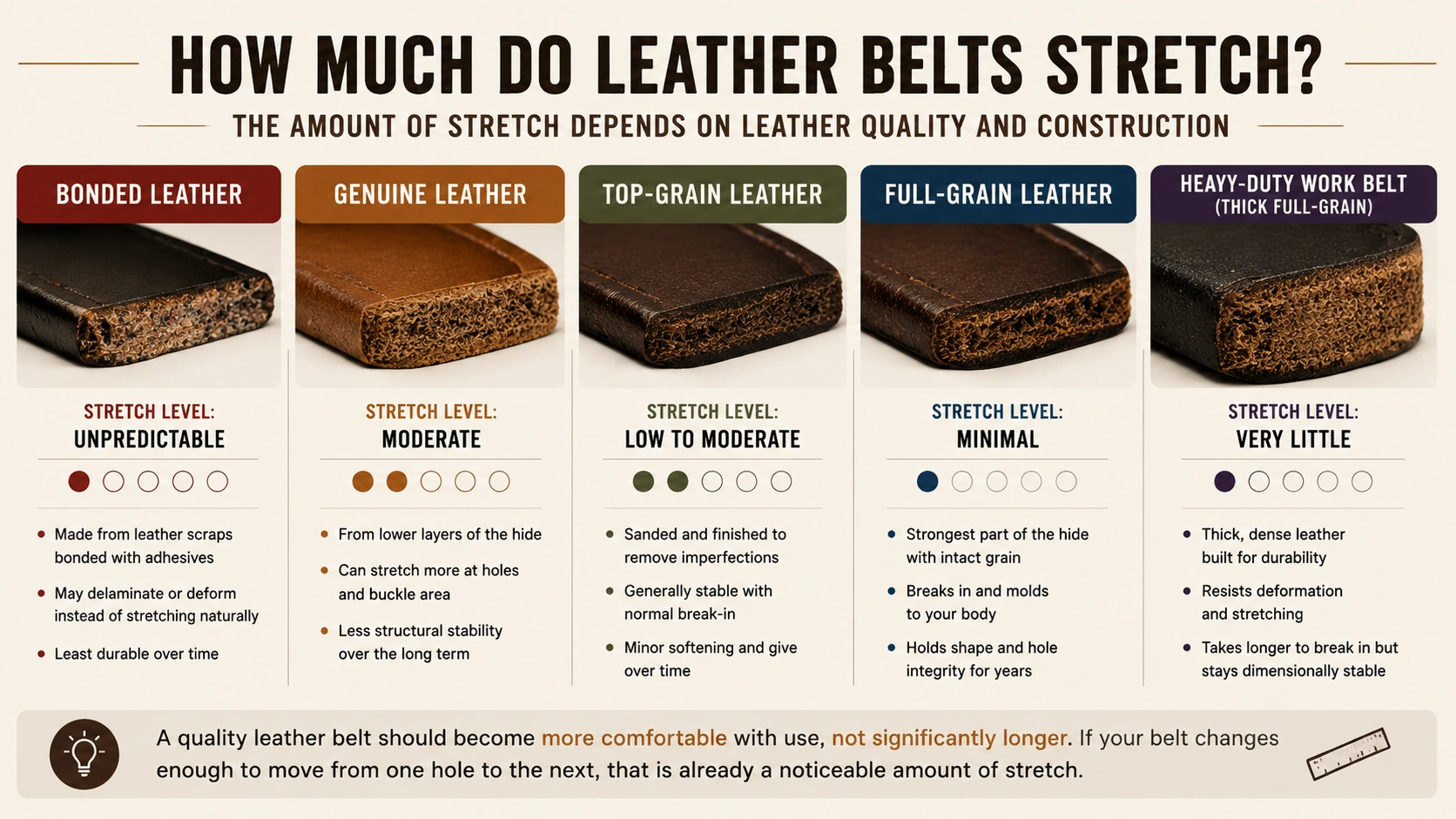
The general rule:
Higher-quality leather usually changes in comfort.
Lower-quality materials often change in structure.
A quality belt should:
- become softer
- develop character
- mold naturally
without becoming loose and misshapen.
As a practical guideline:
If a leather belt changes enough to move comfortably from one hole to another, that is already considered noticeable stretching.
Most well-built leather belts will not stretch several inches.
Full-Grain Leather vs Genuine Leather: Which Stretches More?
The biggest difference comes from fiber structure.
Full-Grain Leather
Full-grain leather comes from the strongest outer layer of the hide.
This area contains the densest natural fiber structure.
Because the fibers remain intact, a full-grain leather belt usually:
- holds its shape better
- stretches less
- keeps holes stronger
- develops a natural patina
Does full-grain leather stretch?
Technically, yes — slightly.
But what most owners experience is break-in rather than real size change.
The belt becomes more comfortable without losing its original structure.
This is one reason many buyers specifically look for a full-grain leather belt when choosing something for long-term everyday use.
Genuine Leather
Genuine leather is still real leather, but the term covers a wide range of materials.
Some genuine leather comes from lower layers of the hide where fibers are less tightly packed.
These layers may:
- stretch more easily
- soften faster
- lose shape sooner
That does not mean every genuine leather belt is bad.
Construction, thickness, and finishing also matter.
A well-made genuine leather belt can still perform well.
The important point:
The leather grade alone does not tell the entire story.
Why Some Levi's, Wrangler, and Timberland Belts Feel Different Over Time
Many people first notice belt stretching with everyday belts from familiar denim and workwear brands such as:
- Levi's
- Wrangler
- Timberland
- Carhartt
These brands are common entry points because many people buy their first leather belt together with jeans or casual clothing.
But stretching is usually not about the logo on the buckle.
It comes down to construction.
The biggest factors are:
Leather Grade
Different leather layers behave differently.
A dense full-grain hide and a corrected or layered leather will not age the same way.
Thickness
A thinner fashion belt may naturally flex more.
A thicker belt designed for daily wear usually resists stretching better.
Single-Piece vs Layered Construction
A single piece of leather has continuous fibers.
Layered belts depend on adhesives between materials.
Over time, those layers can weaken, creating a feeling similar to stretching.
Buckle Stress
The buckle area receives the most pressure.
Repeated pulling can slowly affect:
- holes
- fold points
- stitching areas
The name on the buckle matters less than how the belt is actually built.
Real Questions Leather Belt Owners Frequently Ask
When people talk about belt stretching, the same questions appear again and again across leather communities, forums, and product reviews.
These questions usually reveal the difference between a sizing problem and a break-in process.
Question 1:
"My New Leather Belt Only Fits on the First Hole. Should I Wait for It to Stretch?"
This is probably the most common question.
The answer:
Maybe slightly, but not enough to fix the wrong size.
If the belt is only one hole away from feeling perfect, regular wear may help.
The leather around the buckle fold and holes will soften.
You may gain a small amount of comfort.
However:
If the belt is genuinely too small, break-in will not magically add multiple inches.
A properly sized belt should fit comfortably near the middle hole from the beginning.
Question 2:
"Why Did My Belt Hole Become Larger Over Time?"
This happens because belt holes experience concentrated stress.
Every time you fasten the belt:
- tension pulls on the hole
- the buckle pin presses into the leather
- fibers compress
Over months or years, this can enlarge the hole slightly.
Quality full-grain leather slows this process considerably.
Lower-grade leather often shows wear much faster.
If your hole is becoming dramatically larger, the issue is usually:
- thin leather
- soft leather
- poor fit
- excessive tension
rather than normal stretching.
Question 3:
"My Belt Feels Much Better After Six Months. Did It Stretch?"
Usually:
No.
It broke in.
Most owners confuse:
Break-In
with
Stretching
A belt that feels softer, more flexible, and more comfortable is often experiencing normal break-in.
The actual size may be almost unchanged.
This is exactly what many leather enthusiasts hope for.
A great leather belt should adapt to your body without losing its structure.
Leather Belt Break-In vs Stretching: What's the Difference?
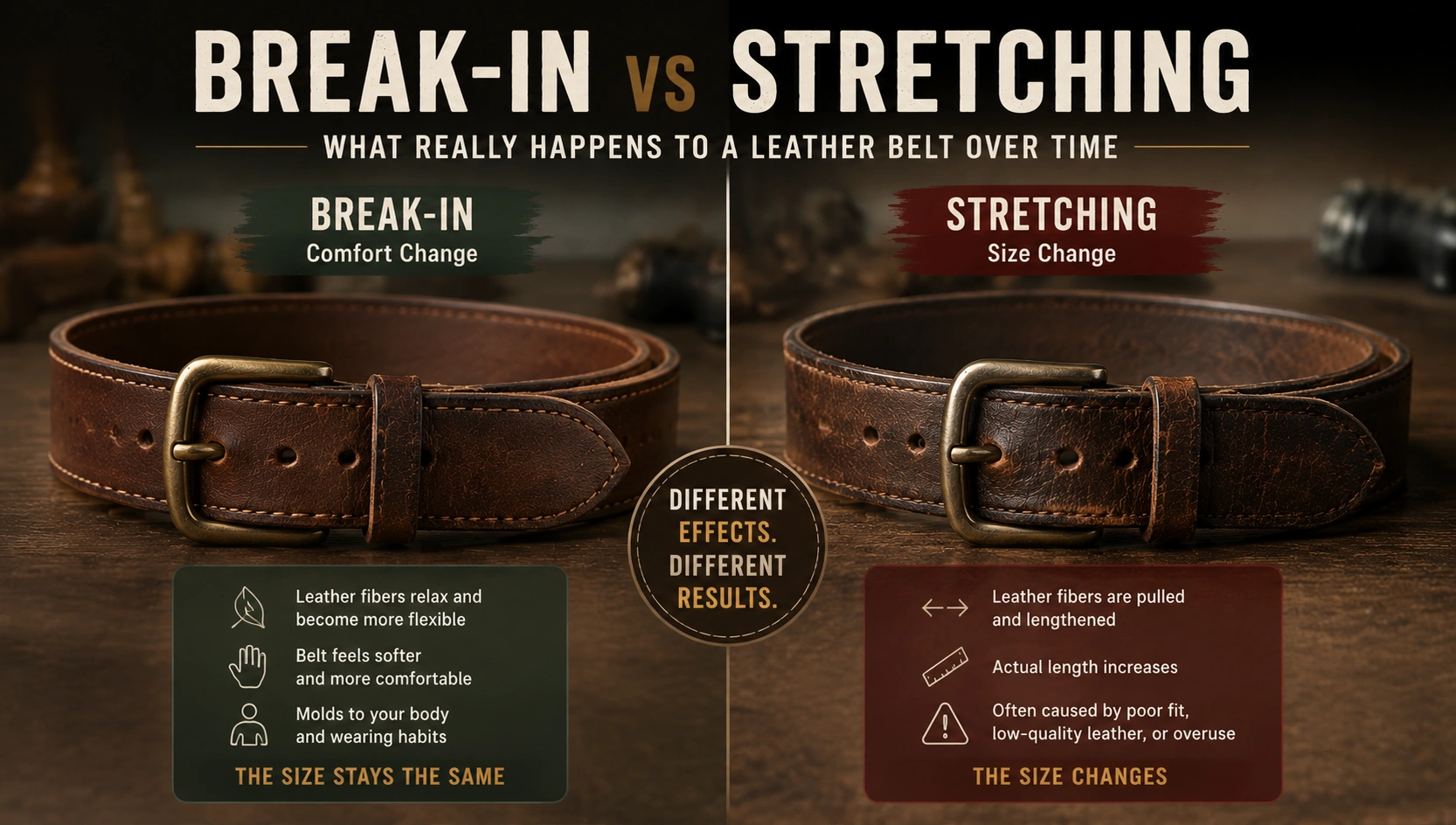
These two terms are often used interchangeably, but they mean very different things.
| Break-In | Stretching |
|---|---|
| Leather becomes softer | Leather becomes physically longer |
| Improves comfort | Changes size |
| Happens naturally | Usually minimal on quality belts |
| Desirable | Often indicates deformation if excessive |
A new belt may feel:
- stiff
- firm
- slightly resistant
After months of use it becomes:
- flexible
- comfortable
- shaped to your body
That is break-in.
Most people who say:
"My belt stretched."
are actually describing break-in.
Understanding this distinction helps prevent one of the most common purchasing mistakes.
Should You Buy a Leather Belt Tight Because It Will Stretch?
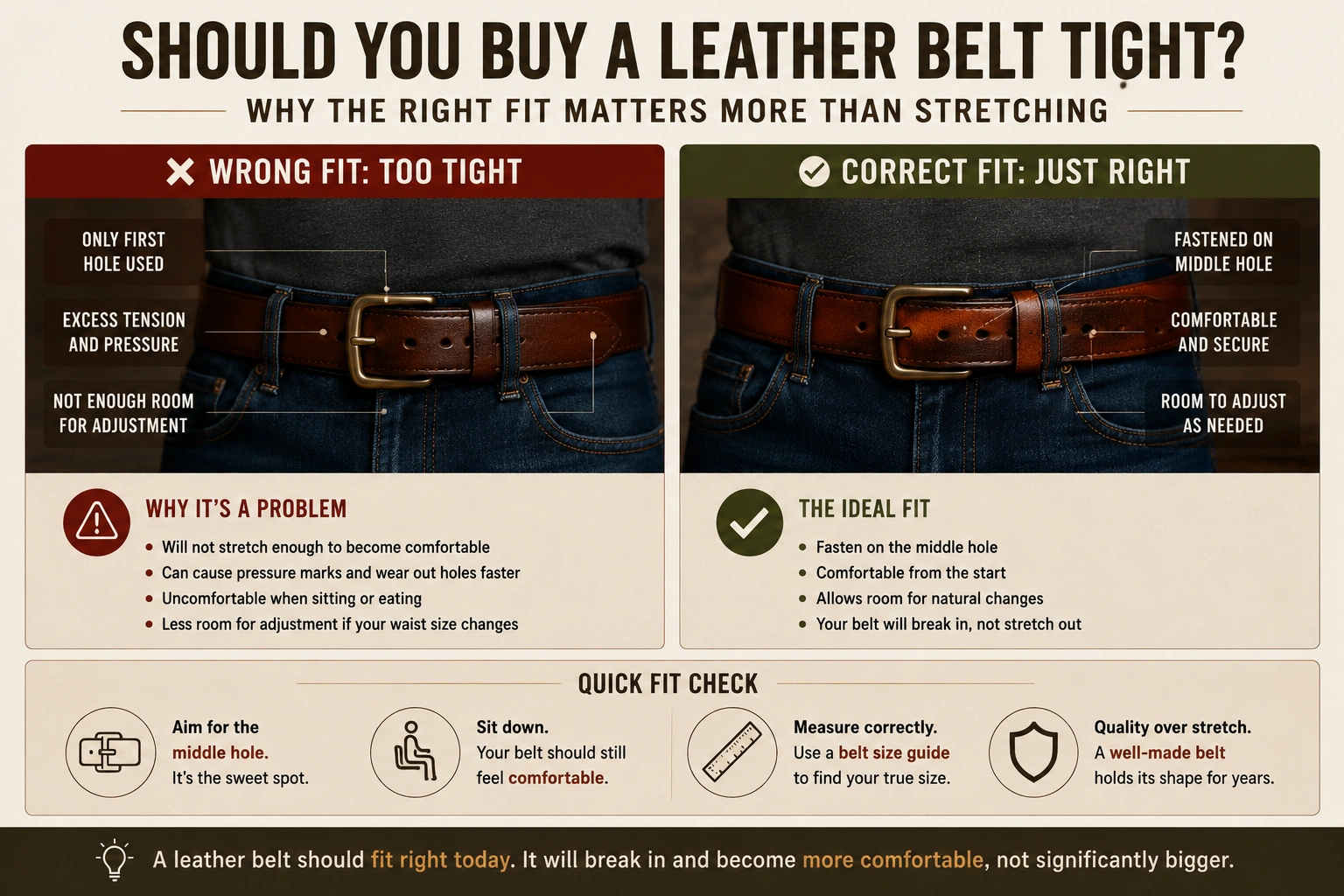
In most cases:
No.
A quality leather belt should fit correctly from day one.
Many buyers intentionally purchase a belt that's too tight because they expect stretching to solve the problem.
Unfortunately, quality leather usually does not stretch enough to correct a sizing mistake.
The safest approach is to choose a belt that fits correctly from the start using a proper belt size guide rather than relying on future stretching.
A correctly sized belt should:
- fasten near the middle hole
- feel comfortable when sitting
- allow room for adjustment
If you consistently fasten on the first hole, the belt is probably too small.
If you consistently fasten on the last hole, it is probably too large.
The middle hole remains the ideal target.
Signs Your Leather Belt Is the Wrong Size
Sometimes a fit problem gets mistaken for a leather problem.
Here are common warning signs.
The Belt Is Too Small
- Only the first hole works
- Sitting feels restrictive
- The tail barely reaches the first keeper
- The buckle feels under constant tension
These problems will not disappear through break-in.
The Belt Is Too Large
- You always use the last hole
- The tail hangs excessively
- The buckle sits off-center
- The belt feels loose even when tightened
A belt that's too large may need resizing.
Depending on the construction, shortening the belt from the buckle end may provide a cleaner solution than adding multiple holes.
Can You Stretch a Leather Belt Yourself?
To a limited degree, yes.
But expectations should be realistic.
The goal is usually:
- softening
- flexibility
- comfort
not major size changes.
What Works
Regular Wear
The most effective method.
Leather responds best to normal use.
Leather Conditioner
A quality leather conditioner can help reduce stiffness and accelerate break-in.
Conditioner does not make a belt dramatically longer.
It simply helps fibers remain healthy and flexible.
Gentle Flexing
Working the leather gently by hand can help a stiff belt become more comfortable.
This is especially useful around the buckle fold.
What to Avoid
Avoid:
- soaking leather in water
- aggressive pulling
- excessive heat
These methods often damage leather more than they help.
The result may be:
- discoloration
- cracking
- weakened fibers
A quality leather belt should not require extreme methods.
What If Your Leather Belt Is Too Small?
If the belt genuinely does not fit, there are better options than waiting for stretch.
Exchange for the Correct Size
This is usually the best solution.
If you're unsure about sizing, use a reliable belt size guide or learn how to measure belt size correctly before reordering.
Add a New Hole
If you're only one position away from a comfortable fit, adding a hole can be a practical solution.
A clean hole punched with the proper tool usually looks professional and functions well.
Review Your Sizing Method
Many people accidentally order:
34-inch pants
=
34-inch belt
This often leads to sizing problems because belt measurements and pants measurements are not identical.
How to Choose a Leather Belt That Holds Its Shape
A leather belt should become more comfortable with age, not lose its structure.
Several factors influence long-term performance.
Full-Grain Leather
The dense fiber structure of full-grain leather helps maintain:
- hole integrity
- shape
- stability
while still allowing the leather to develop character.
Proper Thickness
A belt designed for everyday wear should have enough thickness to resist deformation while remaining comfortable.
Thin belts often show stretching and hole wear sooner.
Strong Holes
Cleanly punched holes resist enlargement better than poorly finished holes.
This detail is often overlooked but makes a major difference over time.
Quality Hardware
The buckle experiences significant stress.
Well-made hardware helps distribute that stress evenly and reduces unnecessary wear on the leather.
Single-Piece Construction
Whenever possible, single-piece leather construction offers better long-term durability than layered designs.
Fewer layers mean fewer potential failure points.
If you're interested in identifying real leather quality before buying, examining the grain, edge structure, and construction details often reveals more than the marketing description.
Frequently Asked Questions
Do leather belts stretch over time?
Yes, slightly.
Most quality leather belts soften and break in rather than stretching significantly.
Will a leather belt loosen up?
Yes.
It typically becomes more comfortable and flexible with use, but usually not dramatically larger.
How much do leather belts stretch?
Most quality belts experience only minimal dimensional change.
Comfort improves far more than size changes.
Should a new leather belt feel tight?
It may feel stiff, but it should not feel painfully tight.
A properly sized belt should fit comfortably near the middle hole.
Does full-grain leather stretch?
Only slightly.
Full-grain leather is one of the most dimensionally stable leather types available.
Do genuine leather belts stretch?
Generally more than full-grain leather, although results depend heavily on construction and leather quality.
Can you stretch a leather belt at home?
You can encourage break-in through regular wear and conditioning.
You cannot reliably turn a wrong-sized belt into the correct size.
What happens if I buy a leather belt too small?
A belt that is genuinely too small will usually remain too small.
Break-in may improve comfort, but it will not create enough stretch to solve a major sizing issue.
Choosing the correct size from the beginning is always the better solution.
Why did my belt hole become bigger?
Repeated tension around the buckle pin gradually compresses fibers around the hole.
This happens more slowly on thick full-grain leather and faster on softer or lower-grade materials.
Final Thoughts
Leather belts do stretch — but usually far less than people expect.
What most owners experience is not true stretching but break-in:
- softer leather
- improved comfort
- better flexibility
- a fit that feels more natural over time
The best approach is not to rely on future stretching.
Instead, choose the correct size from the beginning, understand the type of leather you're buying, and focus on quality construction.
A well-made leather belt should become more enjoyable with age while continuing to hold its shape for years to come.