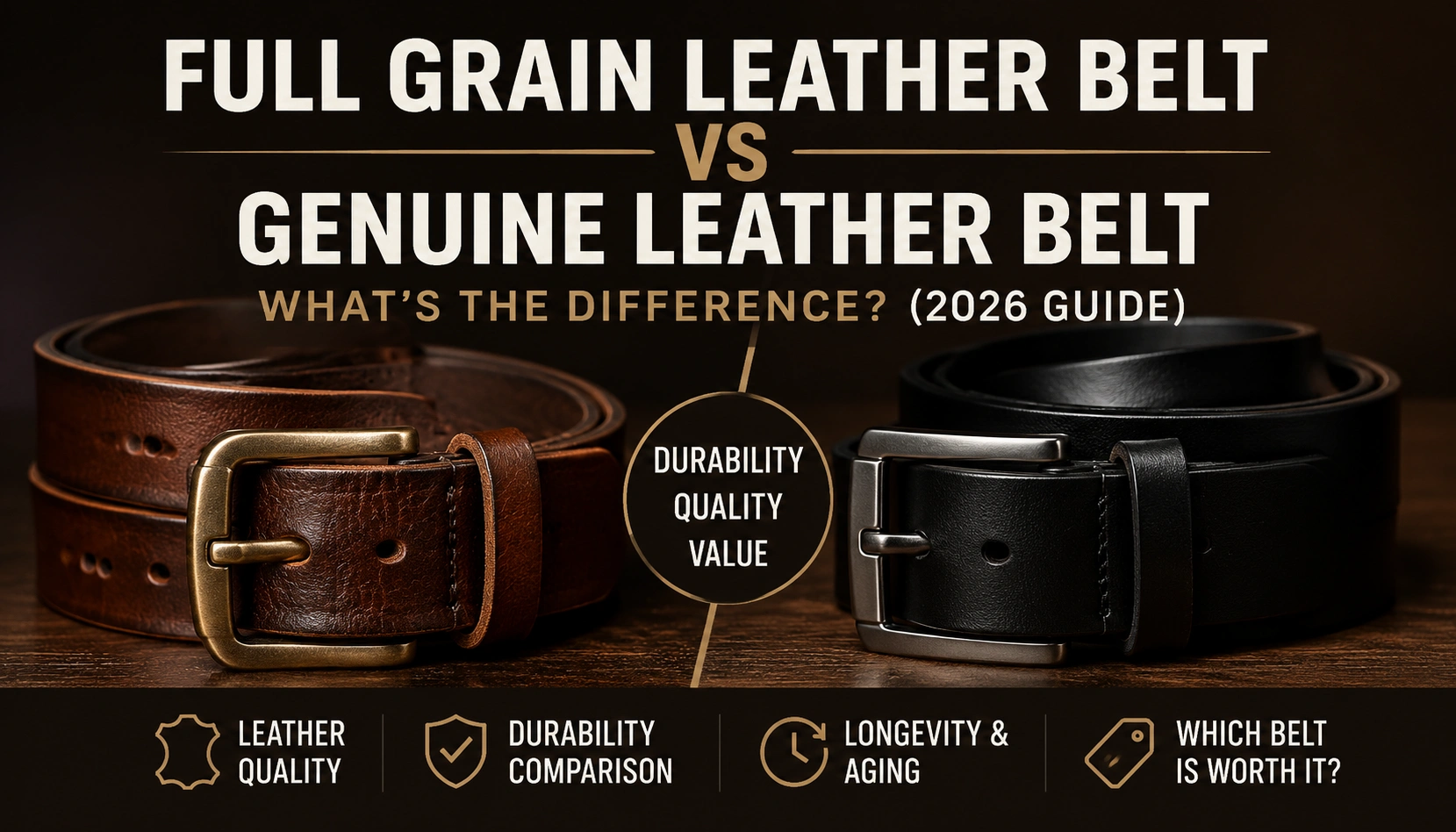
A full grain leather belt is generally considered higher quality than a genuine leather belt because it uses the outermost layer of the hide — the strongest part — with the natural fiber structure left intact. Genuine leather is still real leather, but the term covers a wide range of grades, including processed and lower-grade leather that may look similar to full grain on the shelf and behave very differently after a year of daily wear.
Here's the confusion that sends most people searching for an answer: they bought a belt labeled "100% genuine leather," and within six to eighteen months it started cracking along the fold points, peeling at the surface, or splitting at the holes. The label said real leather, the price wasn't cheap, and the belt still failed. What happened?
The label "real leather" doesn't tell you which layer of the hide the material came from, how it was processed, or whether it can handle years of daily bending, tension, and use. This guide explains the actual differences — not the marketing language — so you can choose a belt that holds up.
What Is a Full Grain Leather Belt?
Full grain leather comes from the outermost layer of the hide, and it's the only leather grade where the natural surface of the hide is left completely intact. Nothing is sanded away. Nothing is buffed out. The tight, interlocked collagen fiber structure that forms the outer skin of the animal — the strongest part of the hide — remains exactly as it was after tanning.
The practical consequences of this are significant:
Fiber density. The outermost layer of a hide has a more tightly packed fiber structure than any layer beneath it. This density is what gives leather its resistance to tearing, stretching under sustained tension, and damage at stress points like belt holes. When you remove that layer — by sanding the surface to correct imperfections, as is done with top-grain and genuine leather — you remove the densest part of the material.
No coating dependency. Full grain leather's surface strength comes from the material itself, not from a coating applied on top. Lower-grade leathers often require a heavy pigment or polyurethane coating to look presentable, because the sanded surface would otherwise appear rough or inconsistent. That coating is doing structural work — and when it fails, the belt fails.
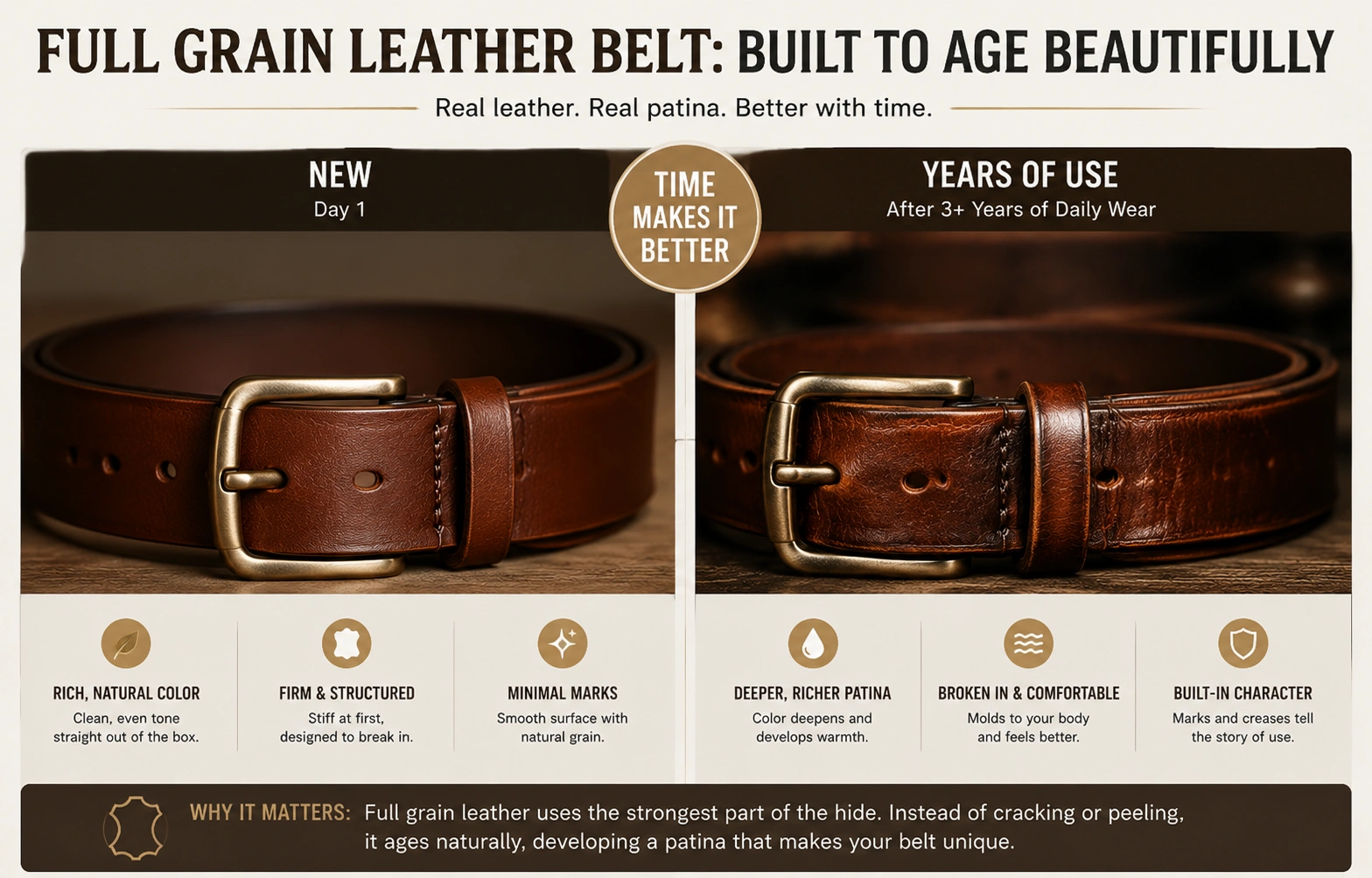
Patina development. Because the surface is open and unsealed, full grain leather responds to use over time. The oils from your hands, light exposure, and daily contact gradually deepen the color and create a surface finish that's unique to how the belt has been worn. This isn't deterioration — it's the leather recording its use. A full grain belt worn daily for five years typically looks better than it did when new.
Natural marks. Full grain leather sometimes shows small variations — a faint scar, a slight tonal difference, a subtle irregularity in the grain. These are evidence that the surface was never sanded. On a production level, they're unavoidable when you commit to using the hide as it actually is. On a quality level, they're reassuring.
What Is a Genuine Leather Belt?
"Genuine leather" is a term that confuses consumers because it sounds like a quality designation. It isn't. It's a description of material origin — the product contains real animal hide — but it says nothing about which part of the hide, how it was processed, or how long it's expected to perform.
In practical terms, genuine leather belts typically fall into one of a few categories:
Corrected grain leather. This is leather from the outer hide layer — the same layer used for full grain — but the surface has been sanded or buffed to remove imperfections, then embossed with an artificial grain pattern and coated with a pigment finish. It looks very uniform and clean in the store. The coating is doing the visual work. The underlying leather may be decent, but the surface finish has a finite lifespan, and once it begins to crack or peel, the belt deteriorates quickly.
Split leather. The hide is thick enough to be split horizontally into multiple layers. The top layer goes toward higher-grade products. The lower layers — the "split" — have a looser, less dense fiber structure. Split leather is weaker than the outer layer, more prone to stretching at stress points, and requires heavy processing to look presentable. Many genuine leather belts sold at accessible price points are made from split leather.
Bonded leather. Not technically a leather grade so much as a composite material — leather scraps and fiber are ground up, mixed with polyurethane binder, and pressed onto a fabric backing. The surface is embossed to look like leather grain. Bonded leather peels reliably within one to two years of regular use, because the binder that holds the surface together has a limited lifespan. Some products labeled "genuine leather" are made from bonded material.
The important nuance: not all genuine leather is poor quality. Corrected grain leather from the outer hide can be a legitimate product that performs reasonably well for occasional or lighter use. The problem is that the label "genuine leather" doesn't let you distinguish between corrected grain from the outer hide, split leather from the inner layers, and bonded composite — three different materials with very different performance profiles.
Many consumers also confuse bonded leather vs genuine leather. While both products may contain leather material, bonded leather is a composite made from leather fibers and binders, while genuine leather is made from actual leather layers.
Full Grain Leather vs. Genuine Leather: Comparison Chart
| Feature | Full Grain Leather | Genuine Leather |
|---|---|---|
| Hide layer | Outermost layer, strongest fibers | Varies — outer to inner layers, or composite |
| Surface treatment | None — natural grain intact | Sanded, buffed, coated, or embossed |
| Fiber density | Highest | Lower, varies by grade |
| Durability | Excellent — typically 10+ years of daily use | Moderate to low — typically 1–5 years depending on grade |
| Aging | Develops genuine patina; improves with use | Surface coating wears; doesn't develop real patina |
| Cracking risk | Low with basic conditioning | Moderate to high, especially at fold points and holes |
| Peeling risk | Very low — no surface coating to delaminate | Present in coated and bonded versions |
| Price | Higher | Lower to mid range |
| Best use case | Daily wear, long-term investment | Occasional use, lower frequency wear |
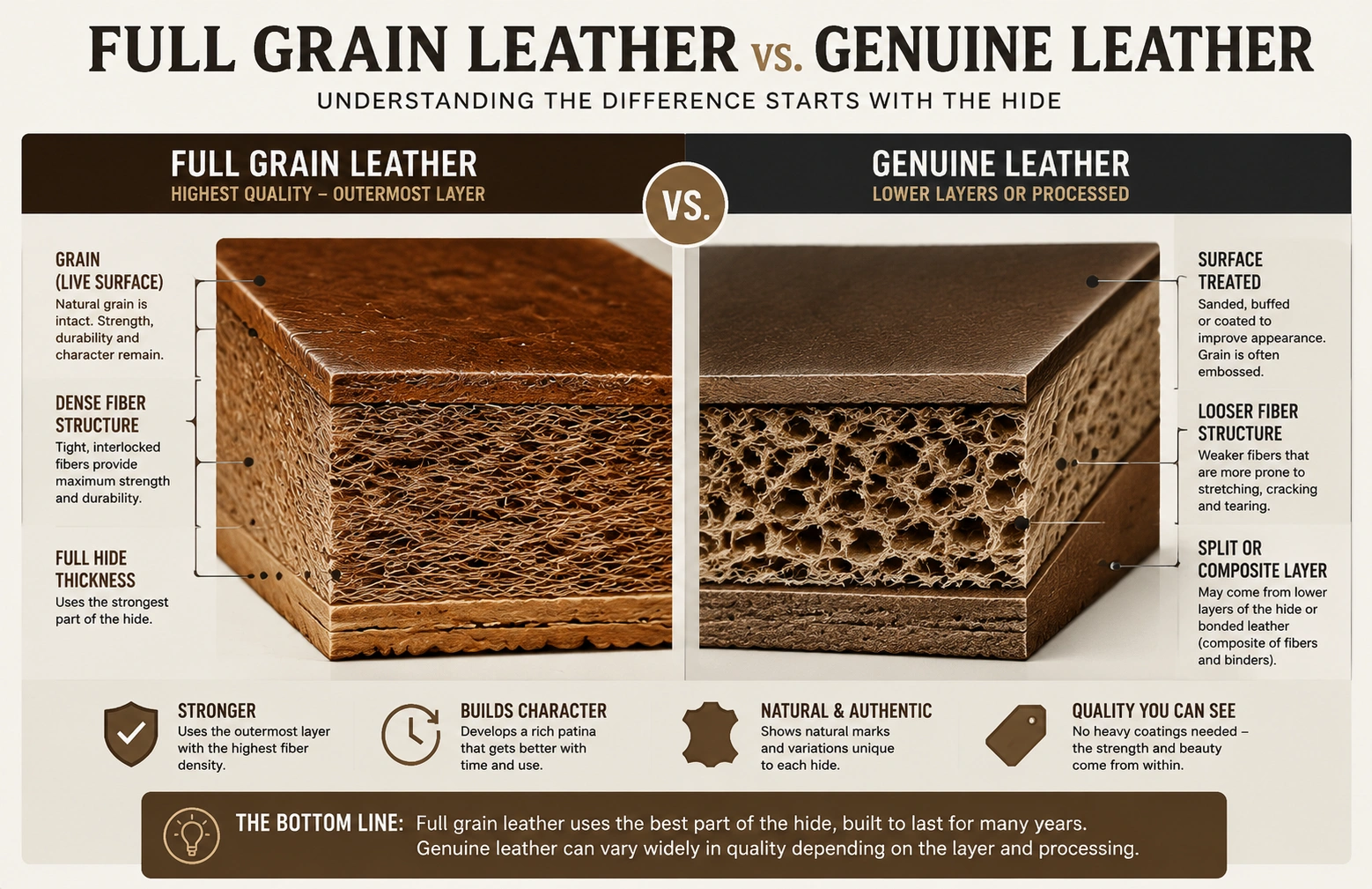
This comparison is a general guide, not a universal rule. A poorly constructed full grain belt can still fail early. A well-made corrected grain belt from quality outer-hide leather can perform adequately for years. The chart reflects tendencies and typical outcomes, not guarantees in either direction.
Why Some Leather Belts Crack or Peel Over Time
Cracking and peeling are the two most common failure modes for leather belts, and they have different causes.
Peeling is almost always a surface coating problem. It's most common in belts made from bonded leather or heavily coated split leather, where a polyurethane finish sits on top of the leather doing cosmetic work. That finish has a service life. Under repeated bending, exposure to moisture and sweat, and the mechanical stress of a buckle flexing against the leather every day, the coating begins to delaminate — first at the high-stress points like the buckle fold and hole edges, then progressively across the surface. Once peeling starts, it cannot be reversed. The underlying material may still be intact, but the surface is gone.
Full grain leather doesn't peel under normal circumstances because there's no coating doing the visual work. The surface you see is the surface of the leather itself.
Cracking has different origins depending on the leather grade. In lower-grade leather — particularly split leather and bonded leather — cracking often happens because the fiber structure of the material isn't dense enough to withstand repeated bending. The fibers separate under mechanical stress, creating visible cracks along flex points. This happens fastest at the buckle fold, which bends every single time the belt is worn or removed.
In higher-grade leather, cracking is most often a maintenance issue. Leather is a natural material that loses oils over time, and without periodic conditioning, the fibers dry out and lose flexibility. A full grain belt that's never conditioned in a dry climate can eventually crack — but the timeline is measured in years and the damage progresses slowly. The same neglect in a lower-grade belt produces damage in months.
The practical takeaway: if a belt peels, the leather grade or construction is the problem. If a belt cracks, it could be grade, construction, or lack of maintenance — and the grade determines how quickly the problem appears.
Does Full Grain Leather Last Longer?
Generally yes, but the honest answer involves understanding what "last longer" actually means in belt terms.
Leather belt longevity depends on four factors working together: leather grade and fiber density, leather thickness, construction quality, and maintenance. Full grain leather addresses the first factor at the highest level. That matters a great deal — but a belt also needs to be thick enough to resist deformation at the holes, constructed without shortcuts, and given basic conditioning care to stay supple.
A properly made full grain belt — 3.5 to 4mm thick, single-piece construction, solid hardware — worn daily with basic periodic conditioning can last well over a decade. The holes stay clean and don't widen significantly. The leather develops character rather than deteriorating. The buckle attachment point stays secure because the dense fiber structure holds hardware without pulling through.
How long do leather belts last by grade, under daily use:
Bonded leather: typically one to two years before surface failure. Genuine leather (split or heavily coated): typically two to four years before meaningful degradation. Corrected grain from outer hide: typically four to seven years depending on construction and maintenance. Full grain leather, properly maintained: typically ten or more years, often considerably longer.
These are general ranges, not guarantees. A well-made corrected grain belt from quality outer-hide leather with good hardware can outlast a poorly constructed full grain belt made with thin leather and cheap buckle attachment. Grade establishes the ceiling. Construction and care determine where within that range the belt actually lands.
Common Customer Mistake: Buying Only by the "Genuine Leather" Label
This is one of the most consistent patterns in how people end up replacing leather belts more frequently than they expected.
A customer needs a new belt, looks for something that feels like quality, and gravitates toward products with "100% genuine leather" or "real leather" on the label. The belt looks and feels convincing in the store or in product photos. The price is reasonable. They buy it.
Somewhere between six and eighteen months later, one of two things happens: the surface starts cracking along the fold where the belt meets the buckle, or the edges begin peeling in thin strips. The customer is frustrated — they thought they bought real leather, and real leather isn't supposed to do this.
The issue is that the label told the truth in a narrow technical sense while omitting the information that would actually predict the belt's performance. "Genuine leather" means the product contains animal hide. It doesn't specify which layer, how it was processed, how thick it is, or how it was constructed. A belt labeled genuine leather could be split leather, bonded composite, or corrected grain — three different products with three different expected lifespans.
Many belt owners in this situation replace the failed belt with another belt at a similar price point, labeled similarly, and encounter the same outcome again. The cycle continues until someone asks the right question: not whether the belt is real leather, but what kind of leather, from which layer, and how it was built.
How to Tell If a Leather Belt Is High Quality
The label is a starting point, not a conclusion. These are the things worth examining directly.
Single-Piece Construction
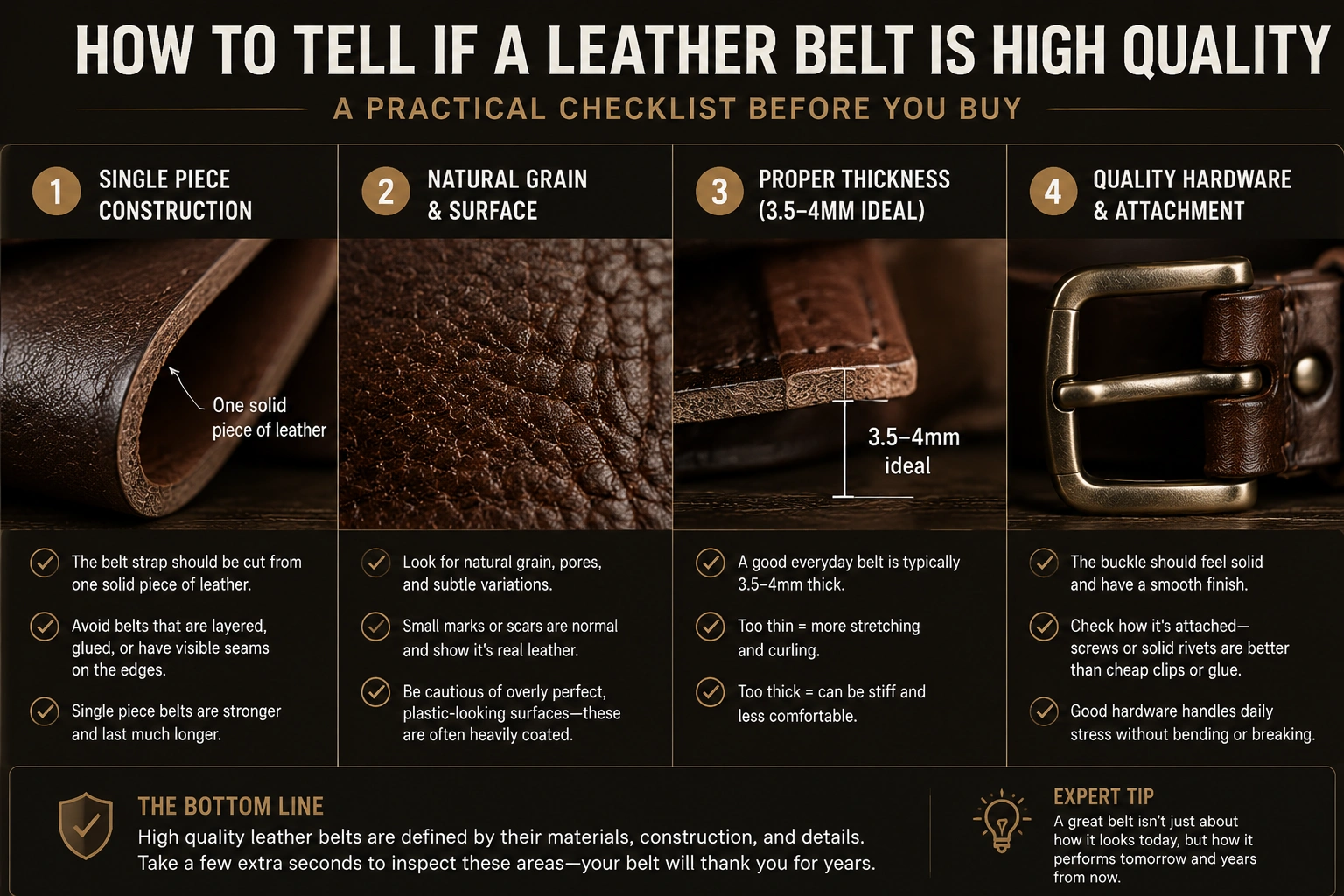
A high-quality leather belt is cut from a single piece of leather running its full length — one continuous strap from tip to buckle end. The cross-section of the belt edge should look uniform: one dense layer of material all the way through.
Layered construction — where two or more thinner pieces of leather are glued together to achieve apparent thickness — is a meaningful quality indicator. The adhesive bond between layers is a failure point that doesn't exist in single-piece construction. Under sustained daily use and exposure to moisture and movement, glued layers eventually separate. The belt starts to feel spongy or uneven, and the edges begin to delaminate. A single-piece belt has no seam to fail.
If you can examine the cut edge of a belt — particularly at the tail end — single-piece construction is visible as a uniform cross-section. Layered construction shows a visible seam or transition between materials.
Natural Grain Surface
Run your eye across the grain surface of the belt. Full grain and high-quality top grain leather show organic irregularity — slight tonal variation, pore structure that doesn't perfectly repeat, occasional natural marks from the animal's life. These are the signs of a surface that hasn't been sanded smooth and stamped with an artificial pattern.
Heavily corrected and embossed leather has a different quality: too uniform, too consistent, with a grain pattern that repeats at regular intervals. It can look impressive in photos, but up close it reads as mechanical rather than natural. The uniformity that makes it look clean is also evidence that the original surface has been removed and replaced.
Appropriate Thickness
For an everyday belt worn daily, 3.5 to 4mm of leather thickness is the working range. At this thickness, the leather has enough material to resist deformation at the holes under the daily cycle of the buckle pin entering and withdrawing. Thinner leather — 2.5 to 3mm — may work for lighter or occasional-use belts, but under daily load it typically shows hole widening and loss of shape faster.
You can get a rough sense of thickness by holding the belt in your hands and bending it slightly. A belt that feels substantial without being rigid, that has a slight resistance to bending while remaining pliable, is generally in the right range. A belt that bends as easily as a piece of card stock is likely too thin for heavy use.
Hardware Quality and Attachment
The buckle bears mechanical load every time the belt is worn and removed. At the attachment point — where the leather folds back over the buckle bar and is secured by a Chicago screw or equivalent hardware — the leather experiences concentrated stress that's higher than anywhere else on the belt.
Solid brass hardware doesn't corrode, doesn't crack under stress, and develops its own surface character over time. Plated zinc alloy hardware looks similar when new and shows its true nature within months: the plating wears through at friction points, the underlying metal corrodes and weakens, and the buckle pin — which bears the full load of the belt at the hole — can eventually fail.
The attachment method matters as much as the hardware itself. A Chicago screw properly installed through dense leather sits flush and secure. A rivet driven through thin leather may hold initially but work loose over time as the leather around it compresses and deforms.
Is Full Grain Leather Worth It?
For a belt worn daily, yes — the case is straightforward.
A belt receives more mechanical stress per day than almost any other leather accessory. It bends at the buckle every time you put it on and take it off. It bears sustained circumferential tension from the weight of your pants and whatever's in your pockets. The buckle pin engages and withdraws from the same hole hundreds of times per year. The fold point at the buckle experiences thousands of flex cycles over a belt's life.
Under these conditions, the fiber density of full grain leather makes a meaningful difference. The tight fiber structure resists hole widening, holds the buckle attachment point secure, and maintains the belt's shape under sustained daily load. Lower-grade leather with looser fiber structure degrades faster at exactly these stress points.
There's also the patina argument, which is practical rather than sentimental. A full grain belt that develops a genuine patina over years of use is providing ongoing value — it continues to improve in appearance while lower-grade alternatives have already failed and been replaced. The total cost of ownership over a decade often favors the more expensive belt purchased once over two or three cheaper belts replaced on a two-to-three-year cycle.
That said, full grain leather is not the right choice for every situation. If you need a belt for very occasional formal use where appearance matters and daily durability doesn't, a well-made corrected grain belt may serve you perfectly well. The value of full grain is most apparent when the belt is being used daily.
Which Leather Belt Should You Choose?
The honest answer depends on how you'll actually use the belt.
For everyday jeans, work pants, and regular daily wear: Full grain leather is the better choice. The daily use case is exactly where the durability difference between full grain and genuine leather shows up most clearly. The higher upfront cost is offset by significantly longer life, and the belt improves rather than deteriorates with use.
For occasional formal wear: A well-made corrected grain belt at 1.25 inches, worn with dress trousers a few times a month, doesn't need the durability of full grain to perform adequately. If the leather is genuine quality and the construction is honest, it can serve this specific purpose well for years. The wear frequency is low enough that the material grade difference doesn't compound into a significant problem.
For gifting or a first quality leather belt: Full grain is worth the investment. A belt purchased with the intention of owning it for a long time should start with material that can actually support that intention. A 58-dollar full grain leather belt purchased once and worn for ten years is a different calculation from a 25-dollar genuine leather belt replaced every two years.
Whatever grade you choose, knowing your belt size and choosing the correct width before buying are as important as the leather grade. A full grain belt that's the wrong size or width serves you no better than a genuine leather belt that fits correctly.
Frequently Asked Questions
Is full grain leather better than genuine leather?
For daily wear and long-term durability, yes. Full grain leather uses the strongest outer layer of the hide with the natural fiber structure intact, which makes it more resistant to the daily stress a belt experiences. Genuine leather is still real leather, but the term covers a wide range of grades — some perform reasonably well, others fail within a year or two of regular use. For everyday belts, full grain is the more reliable investment.
Is genuine leather real leather?
Yes — genuine leather is made from real animal hide. The term describes material origin, not quality grade. The confusion is that "genuine leather" doesn't specify which layer of the hide, how it was processed, or how durable it is. It can refer to quality corrected grain leather, split leather from lower hide layers, or bonded composite material, all of which perform very differently.
Is genuine leather bad quality?
Not automatically. The category includes products ranging from serviceable corrected grain leather to low-quality split leather and bonded composites. The label alone isn't enough to make a quality judgment — the leather grade, thickness, construction, and hardware all matter. A well-made corrected grain belt can perform adequately for occasional use. A poorly made full grain belt can still fail early. Grade is one factor, not the only one.
How long does a full grain leather belt last?
A properly made full grain leather belt worn daily, with basic periodic conditioning, typically lasts ten or more years. The holes remain clean, the leather develops a patina rather than cracking, and the construction holds. Belts made from lower grades of leather under daily use typically fail between one and five years depending on the specific material and construction.
Why do genuine leather belts crack?
Cracking in genuine leather belts usually has one of two causes: the fiber structure of the leather is too loose or the material too thin to withstand repeated bending under daily use, or the surface coating — which is often doing significant structural work on lower-grade leather — has dried out and lost its flexibility. Cracking tends to appear first at the buckle fold point, which undergoes the most frequent flexing.
Does full grain leather peel?
Not under normal circumstances. Full grain leather doesn't peel because there's no polyurethane surface coating to delaminate. The surface is the leather itself. The peeling that people commonly associate with leather belts is a coating failure, not a leather failure — it's specific to belts where a finish coat is doing visual and structural work over a lower-grade base material.
What is the best leather for belts?
For everyday durability and long-term value, full grain leather from the outer hide layer, single-piece construction, with 3.5 to 4mm thickness and solid metal hardware. For formal or occasional use where durability is less critical, well-made corrected grain leather from quality outer-hide material can perform adequately. The determining factors are leather grade, construction method, and intended use frequency — in that order.