
You buy a new leather belt.
It fits — but only on the last hole. Or the first one. And suddenly you're wondering whether the belt is the wrong size, or whether you're supposed to punch another hole, or whether something is off with the design.
At that point, a lot of people start asking a question they'd never thought to ask before:
How many holes should a leather belt actually have? And does it matter which one you use?
The short answer: most belts have five holes, and the middle one is where the belt is designed to fasten. If you're consistently using the first or last, that's useful information — not about the holes, but about whether the belt fits correctly.
Here's the longer version.
A Quick Answer: Most Leather Belts Have Five Holes
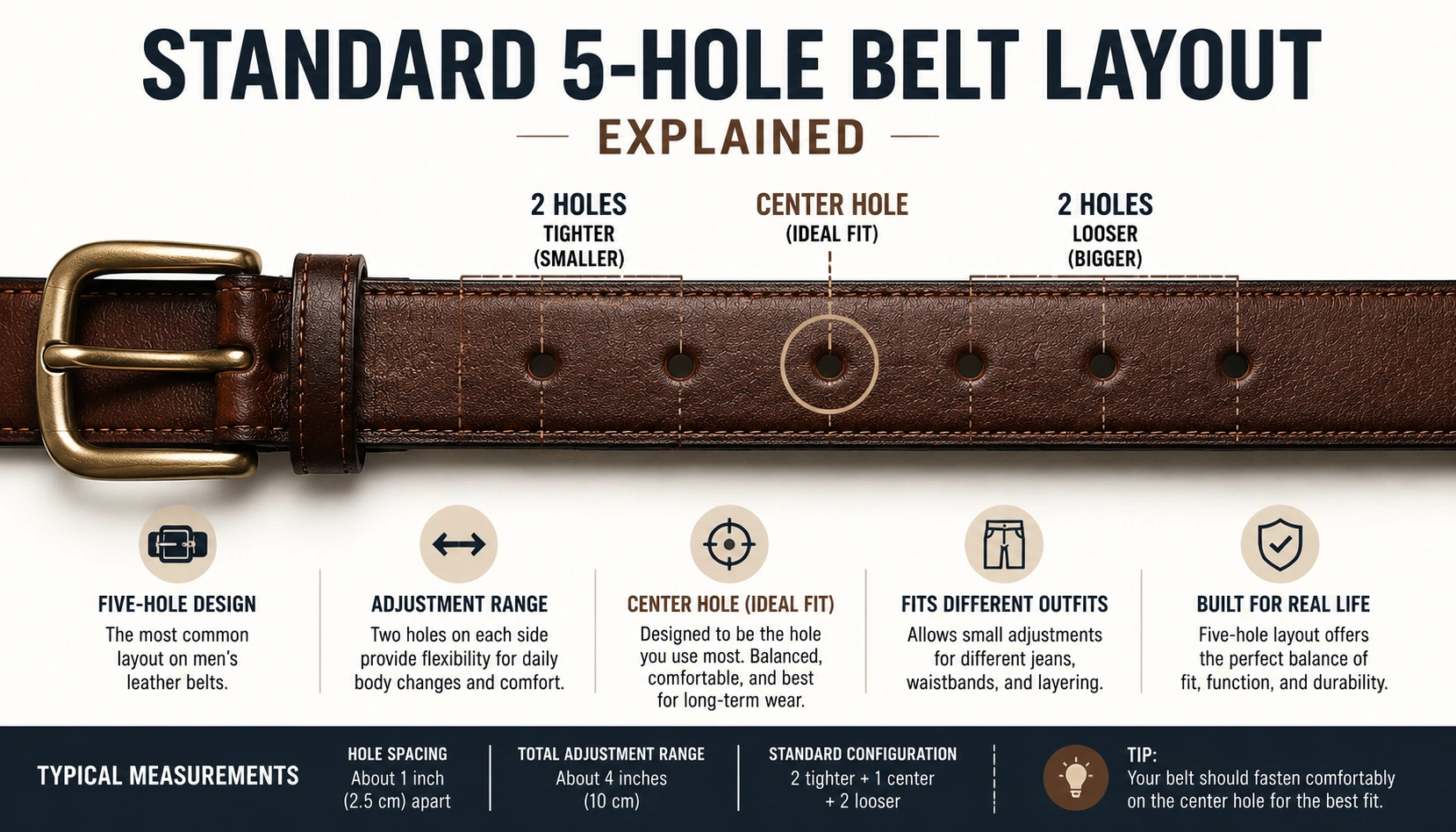
Five holes is the standard in most men's leather belts, spaced roughly one inch apart. This gives the belt a total adjustment range of about four inches — two holes tighter than center and two holes looser.
Some belts have three holes. These are usually dress belts, where the expectation is that you've sized correctly and don't need a wide adjustment range.
Some belts have seven holes, particularly in workwear or heavy-duty contexts where the manufacturer wants to give more range for layered clothing, tool weight, or seasonal variation.
But the number of holes isn't really the point. The point is what those holes are for — and whether the one you're using is the right one.
Why Do Most Belts Have Five Holes?
The five-hole layout isn't arbitrary. It's a practical response to the fact that the same person's waist measurement changes, and the same belt needs to accommodate that variation.
Your weight fluctuates. Not dramatically for most people, but enough that a belt sized to fit perfectly in July might feel slightly snug in December with heavier clothing, or slightly loose during summer months. A belt with no adjustment range would need to fit perfectly under every condition — which, in practice, it never does.
The five-hole range covers most of that variation comfortably. Two holes looser than center handles heavier layers and minor weight gain. Two holes tighter than center handles the other direction. The middle hole is the neutral position — where the belt fits correctly under normal conditions.
Beyond seasonal and weight variation, different trousers sit differently on the body. The same waist measurement on a high-rise trouser and a low-rise jean isn't the same circumference — one sits higher, one sits lower, and the effective measurement at the loop level differs. The five-hole range absorbs most of these differences without requiring a different belt.
There's also daily comfort variation. Many people fasten their belt one hole looser at the end of a long day, or when sitting for an extended period. Having that range available without reaching the edge of the belt's design is exactly what five holes provides.
What Is The Purpose Of The Middle Hole?
The middle hole is the design center of the belt. When a manufacturer sizes a belt as "36 inches" — or any other size — that number refers to the distance from the buckle pin connection point to the middle hole. Not the first hole, not the last hole. The middle one.
This means a 36-inch belt is designed to fasten at the middle hole for someone whose effective belt measurement is 36 inches. The two holes on either side give adjustment room in both directions from that center position.
The middle hole is also where the belt's visual proportions work correctly. When the belt fastens there, the tail extending past the buckle ends up at an appropriate length — roughly passing through the first belt loop and ending cleanly without excessive overhang. Fasten at the last hole and the tail extends further than intended. Fasten at the first hole and the tail is shorter than it should be, sometimes barely reaching the first loop.
From a durability standpoint, the middle hole is the most structurally sound position. It sits in the densest, most consistently manufactured section of the belt — away from either edge of the hole series, where the leather's structural integrity is most consistent.
Should A Belt Fit On The Middle Hole?
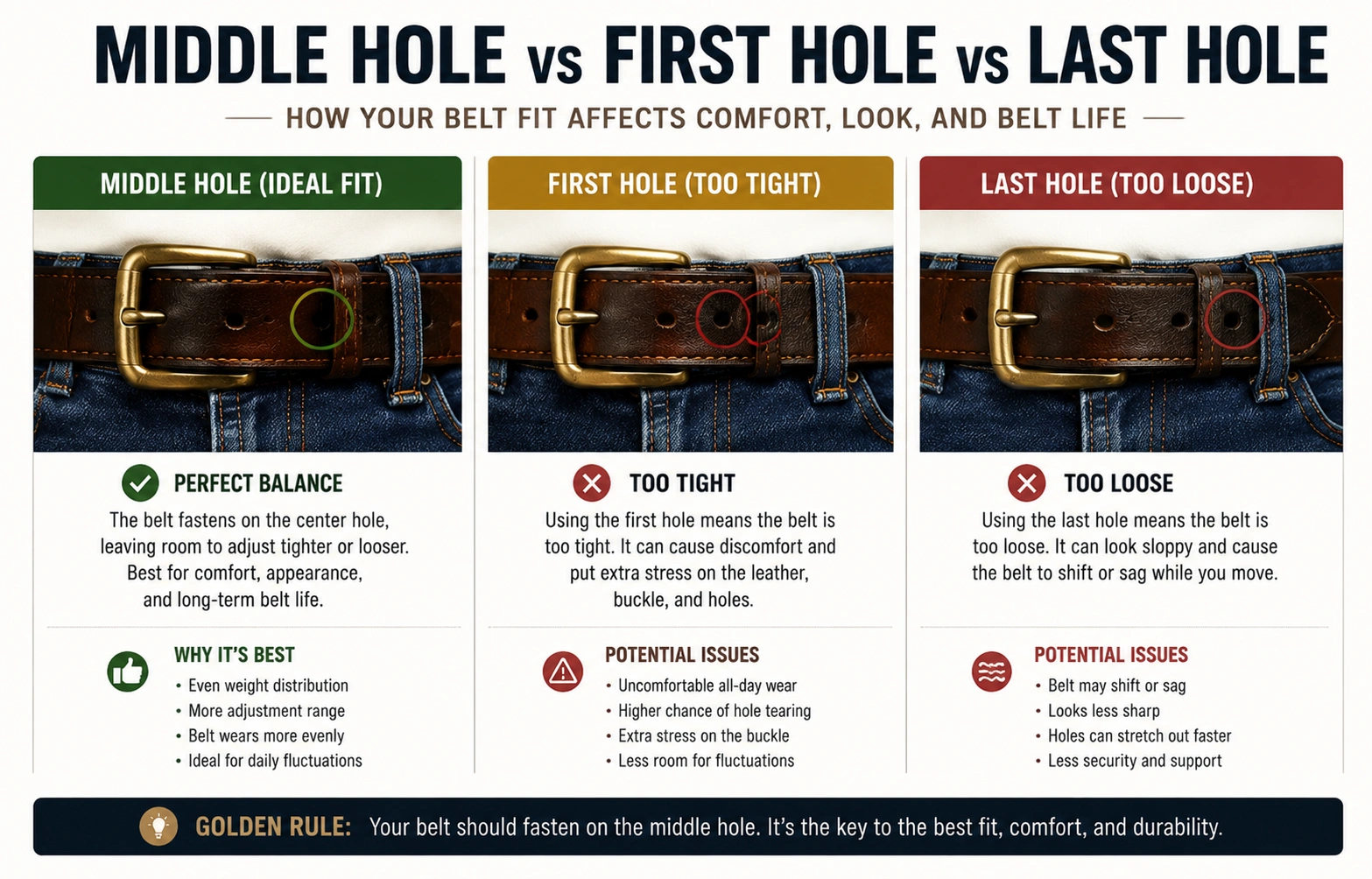
Ideally, yes. This is the position the belt was designed for, and it's the most reliable indicator that the belt is the right size.
In practice, most people don't know this. They size a belt based on their pants size (which, as explained in the belt size chart guide, isn't the same as belt size), receive a belt that only closes on the last hole, and assume that's normal.
It isn't. A belt that only closes on the last hole is a belt that's too large for the person wearing it. The middle hole is the target — it gives you two holes of adjustment in either direction, which is exactly the range you need for normal variation in clothing thickness and fit across seasons.
🔑 The quick test: If your belt fastens at the third of five holes — the middle one — the belt fits correctly. If you're consistently at either extreme, the belt is the wrong size.
What Happens If You Always Use The Last Hole?
You're wearing a belt that's too large for you. And beyond the aesthetic problem — the tail extending too far past the second belt loop, the buckle sitting slightly off-center — there's a structural consequence worth understanding.
A belt fastened at the last hole puts the buckle pin in the wrong mechanical position relative to the leather. The hole at the edge of the belt's range sits near the transition point where the leather was punched, in a zone that's experienced different stress during manufacture than the center section. It also means the overall belt geometry is off — the tail length is wrong, the buckle position is wrong, and the way the belt bears tension from the weight of your pants is subtly different from what the belt was designed for.
Over time, fastening consistently at the edge of the hole range accelerates wear at that specific hole. The leather doesn't distribute the stress the way it would at the center position, and the hole shows deformation faster. This is one of the mechanisms behind the hole-stretching problem covered in why belt holes stretch and tear — wrong size, combined with consistent use at the edge of the range, concentrates stress in a place the belt wasn't optimally built to handle.
⚠️ If you're consistently on the last hole, the belt is too large. The fix isn't to punch another hole at the far end — it's to size down, or to shorten the belt from the buckle end if the belt is otherwise right for you.
Can You Add More Holes To A Belt?
Yes — and for most quality leather belts, it's a clean, practical fix.
If the belt fits correctly everywhere except that the hole you need doesn't exist yet, punching a new hole is a reasonable solution. The keys are using the right tool (a proper leather hole punch, not a knife or screwdriver), matching the spacing of the existing holes, and making sure the new hole isn't too close to the belt edge.
What punching a hole won't fix is a belt that's fundamentally the wrong size. If the belt needs a new hole at the extreme end of the existing range — beyond the last existing hole — the belt is too large and the proportions will still be wrong even with the new hole. A new hole at that position just confirms the problem rather than solving it.
The right situation for punching: the belt fits well, the tail length looks right, and you're one position away from your ideal comfort. That's an adjustment. A belt three holes away from where it should fasten is a sizing problem.
How Far Apart Should Belt Holes Be?
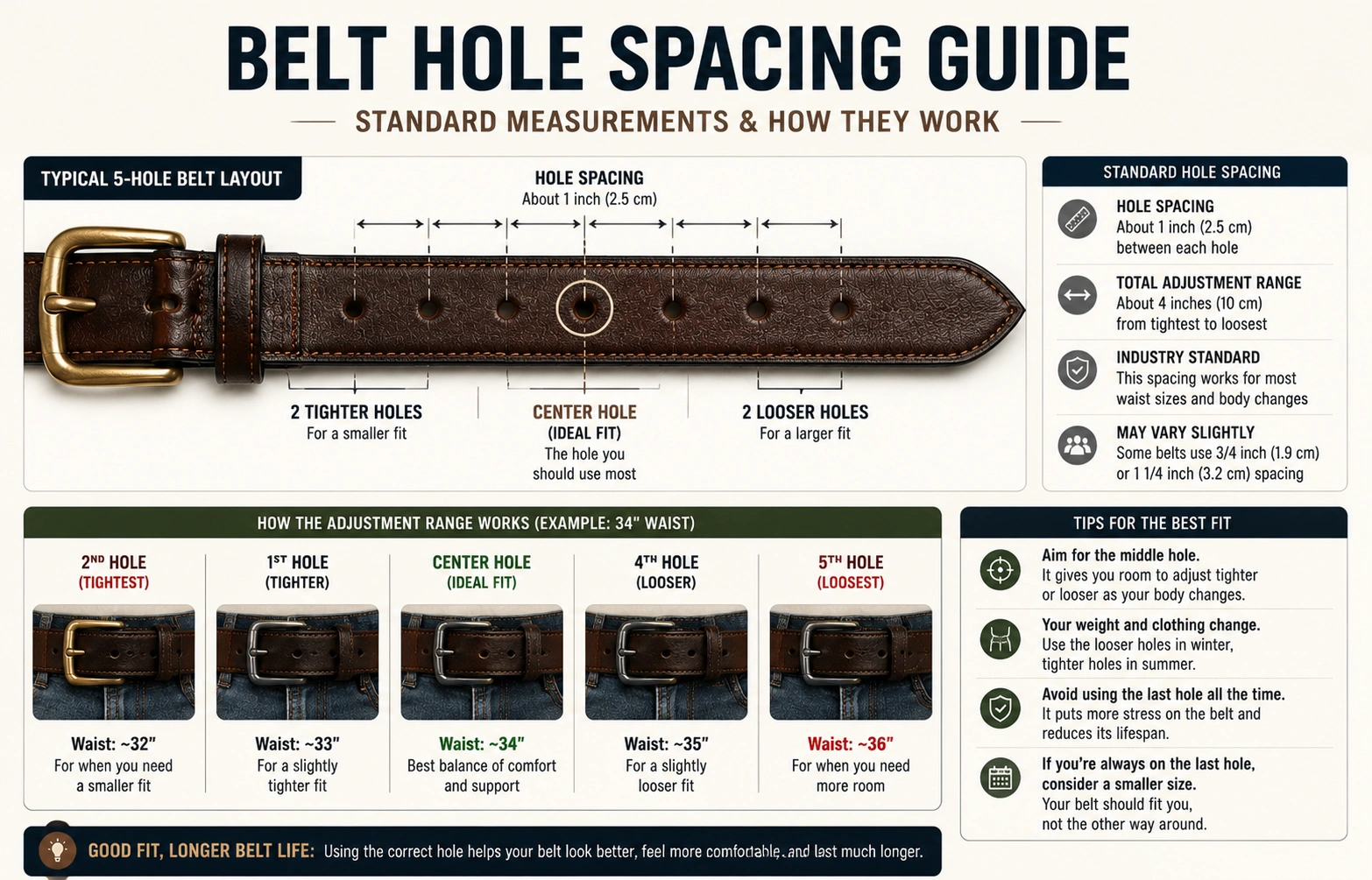
One inch (25mm) is the standard spacing on most men's leather belts. This is consistent enough across manufacturers that when you're adding a hole to an existing belt, measuring the distance between two existing holes and replicating it puts the new hole in the right position without any guessing.
Some dress belts use slightly tighter spacing — around 7/8 inch — to provide finer adjustment. Some casual or workwear belts use wider spacing, particularly if they're sized for heavier use where large adjustment increments are acceptable.
The one-inch standard exists for a practical reason: it gives enough adjustment range across five holes (four inches total) to accommodate meaningful variation, while keeping each hole position specific enough that you can feel the difference between adjacent holes. Half-inch spacing would give more granular adjustment but would produce holes that feel almost identical in fit; two-inch spacing would give a coarser feel and less useful range.
When punching a new hole: Measure the distance between two existing holes before marking anything. Don't assume one inch — measure your specific belt, because some vary. Mark clearly, double-check the position is centered widthwise on the belt, and punch once with confident pressure rather than multiple tentative strikes.
When Is It Better To Buy A New Size Instead Of Adding Holes?
This is the decision point that most people reach eventually, and it's worth being direct about.
Add a hole when: The belt is one position away from where you need it. The tail length looks correct, the buckle sits in the right position, and you just need one more increment of adjustment. The belt is the right size for you in every other respect.
Buy a different size (or shorten the belt) when: You're two or more holes away from a comfortable fit. The tail length is clearly wrong regardless of which hole you use. The buckle sits noticeably off-center. You're at the extreme end of the existing hole range and need to go further.
I've seen people add three or four holes to a belt rather than accepting that the belt is wrong. The result is a belt that technically fastens but never looks right — the proportions are off because the belt was built for a different body. Adding holes at the edge of a range doesn't fix the underlying sizing problem; it just extends it in a direction the belt wasn't designed to go.
The cleaner solutions: size down, or on a quality belt with removable buckle hardware, shorten from the buckle end — which removes the excess material rather than adding more holes to compensate for it. The belt size chart and what size belt do I need guide are worth spending five minutes with before adding holes or ordering a replacement.
Frequently Asked Questions
How many holes should a belt have?
Most standard men's leather belts have five holes, spaced approximately one inch apart. This gives a four-inch adjustment range — two holes on either side of the center position. Some dress belts have three holes; some workwear belts have seven. The number matters less than whether the belt fastens near the middle hole, which is where it's designed to function correctly.
Why do belts usually have five holes?
Five holes provides enough adjustment range to accommodate normal variation in body weight, seasonal clothing thickness, and different trouser styles — without giving so much range that the belt sizing becomes imprecise. The middle hole is the design center; two holes tighter and two holes looser give practical flexibility while keeping the belt proportioned correctly.
Should a belt fit on the middle hole?
Ideally, yes. The middle hole is where the belt was designed to fasten for its labeled size. When the belt fastens there, the tail length is correct, the buckle sits in the right position, and you have adjustment room in both directions for normal variation. If you're consistently at the first or last hole, the belt is the wrong size.
Can I add extra holes to a belt?
Yes, for most quality leather belts. A rotary leather hole punch is the right tool — it produces a clean, round hole that matches the existing ones. Space new holes the same distance apart as the existing holes (usually one inch), and keep them at least half an inch from the belt edge. Adding a hole works well when the belt is one position away from your ideal fit. It doesn't fix a belt that's fundamentally the wrong size.
How far apart should belt holes be?
One inch (25mm) is the standard. Before adding a new hole, measure the distance between two existing holes on your specific belt rather than assuming — spacing varies slightly across manufacturers. Replicating the existing spacing puts the new hole in exactly the right position.
What if I use the last hole all the time?
The belt is too large for you. Using the last hole consistently means the belt fastens in a position that puts the buckle off-center, leaves the tail too long, and concentrates stress at the edge of the hole range rather than the center — which accelerates hole wear over time. The right solution is sizing down or shortening the belt from the buckle end, not adding another hole at the far edge.