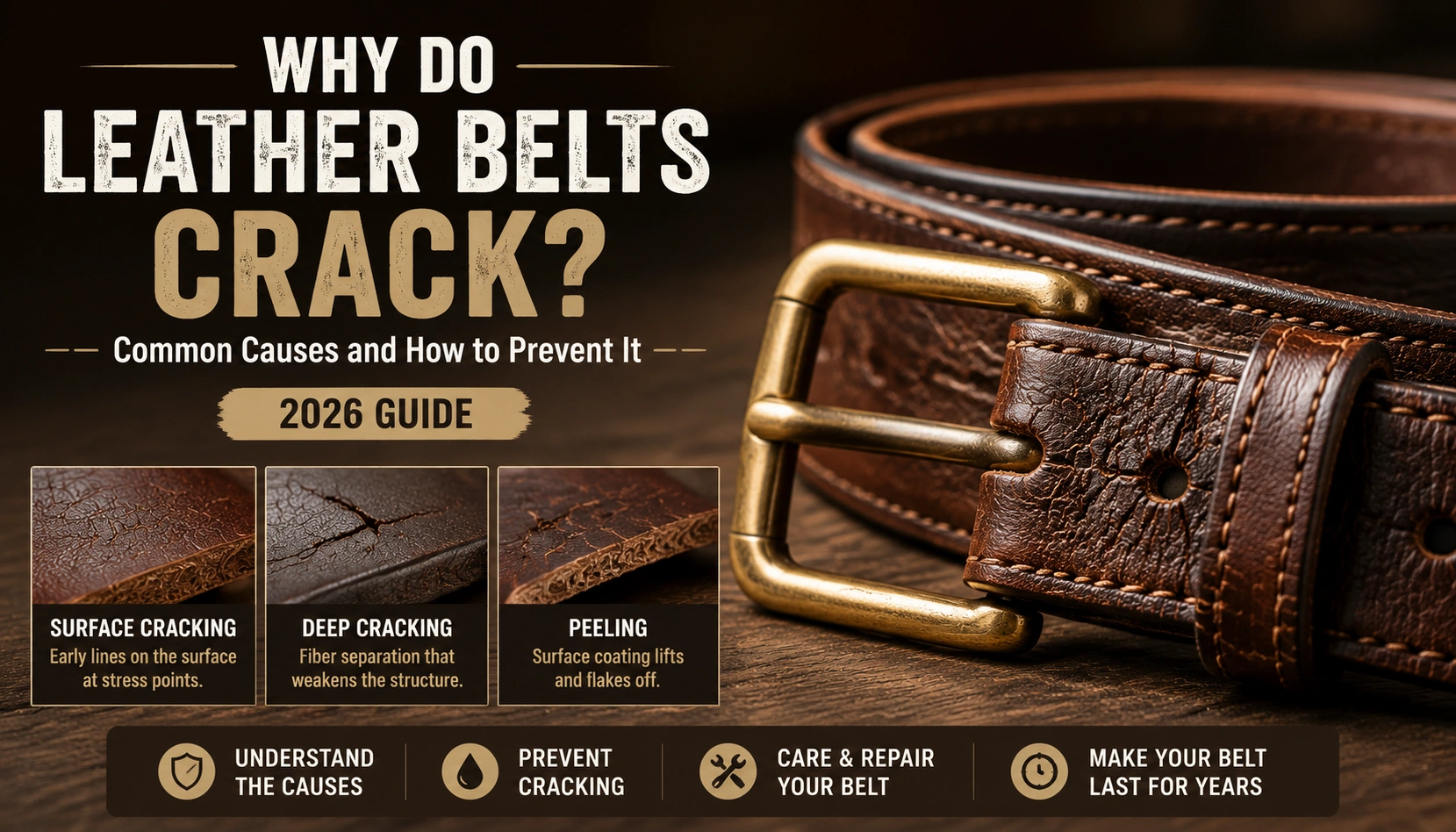
Leather belts usually crack because of low-quality leather, excessive dryness, repeated stress at the buckle fold and belt holes, or a surface coating that's reached the end of its lifespan. In most cases, more than one of these is happening at once.
If you're looking at a crack on your belt right now, you've probably already had one of two thoughts: either the belt is just old and this is normal, or something went wrong and the belt was never any good to begin with. Neither of those framings is quite right, and the difference matters — because it determines whether what you're seeing is something you can manage, something that's already done, or something that was actually decided before the belt ever left the factory.
This guide walks through what leather cracking actually looks like (because "cracking" describes more than one thing), the five most common underlying causes, whether full-grain leather is immune to it, what can realistically be done once cracking starts, and how to prevent it from happening to your next belt.
What Does Leather Belt Cracking Actually Look Like?
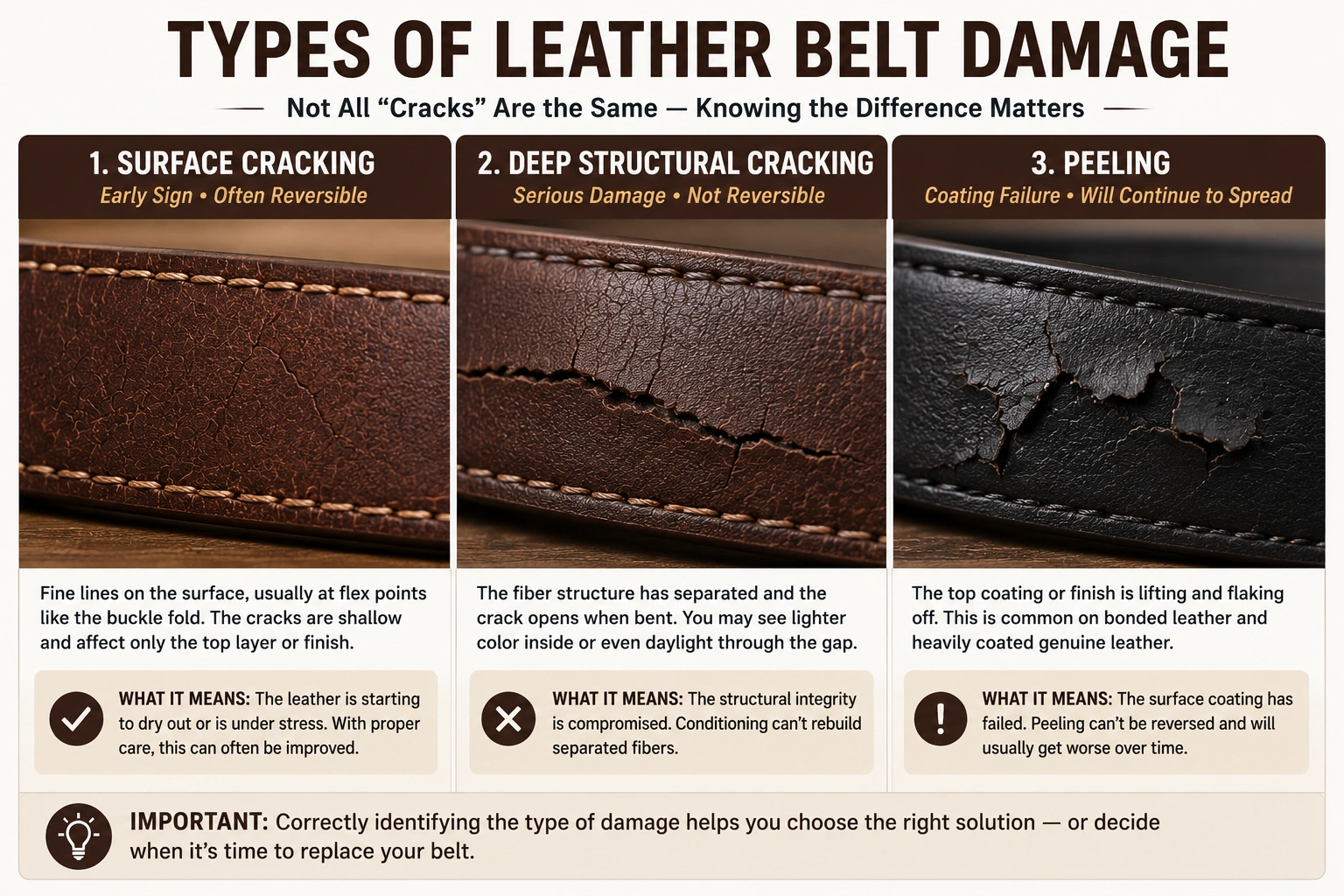
Before getting into causes, it's worth being precise about what you're looking at — because the word "crack" gets used for at least three different things, and they have very different implications.
Surface Cracking
This is the earliest and most common form: fine lines appearing in the surface of the leather, usually concentrated at flex points — most often the fold where the belt bends through the buckle. At this stage, the lines are typically shallow, affecting only the top layer or finish of the leather rather than the structural fibers underneath. Surface cracking is often the first visible sign that something is wrong, and it's also the stage where intervention can still make a meaningful difference.
Deep Structural Cracking
This is a different order of problem. Deep cracking means the fiber structure of the leather itself has separated — not just the surface finish, but the material underneath. Visually, you may see the crack open slightly when the belt flexes, sometimes showing a lighter color or even daylight through the gap. Once leather has cracked at this level, the structural integrity at that point is compromised permanently. Conditioning can soften the surrounding leather, but it cannot rebuild fibers that have already separated.
Peeling
Peeling is often described as "cracking" by people experiencing it, but it's mechanically a different process. Peeling happens when a surface coating — a pigmented finish applied over the leather to create a uniform color and texture — begins to separate from the material underneath. It typically starts as small flakes lifting at the edges or at stress points, and it spreads from there. This is most common on bonded leather and heavily coated genuine leather, where the coating is doing significant visual work over a base material that doesn't look finished on its own.
The distinction matters because the causes — and the outlook — are different for each. Surface cracking from dryness can sometimes be improved. Deep structural cracking cannot be reversed. Peeling cannot be reversed and tends to spread once it starts. Knowing which one you're looking at is the first step to understanding what happens next.
Why Do Leather Belts Crack? 5 Common Causes
Most leather belt cracking traces back to one or a combination of five factors. Often it's not a single cause acting alone — a belt made from thinner leather that's also been allowed to dry out will crack faster than either factor would on its own.
Cause #1: Low-Quality Leather
This is the foundational issue, and it's the one that's hardest to detect at the point of purchase.
Bonded leather, split leather, and heavily corrected leather all have one thing in common: a fiber structure that's looser, thinner, or supplemented by adhesives and coatings compared to full-grain leather. That looser structure simply can't withstand repeated flexing the way dense, intact fibers can. Under the same conditions — the same climate, the same wear frequency, the same care routine — a belt made from lower-grade leather will develop cracks sooner than one made from full-grain leather, often considerably sooner.
Many belt owners discover this only after the cracking begins — usually around the most-used hole or at the buckle fold — at which point the belt has often been worn for months without any indication that something was different about this one. The leather looked fine. It felt reasonable in the hand. The problem was structural from the start; it just hadn't become visible yet.
For a closer look at how full-grain and genuine leather actually compare in terms of durability and aging, see our full breakdown of full-grain vs. genuine leather belts.
Cause #2: Leather That Has Dried Out
Leather is a natural material that contains oils as part of its structure — oils that keep the fibers flexible and able to move against each other without breaking. Over time, and especially in certain conditions, those oils diminish. The leather that's left behind is technically the same material, but it's stiffer, less able to flex, and considerably more prone to cracking under stress.
A few conditions accelerate this process specifically: very dry climates, indoor heating in winter (which dramatically lowers humidity), direct and prolonged sun exposure, and simply going long stretches without any conditioning at all. Dryness doesn't announce itself with a crack right away — the leather usually becomes noticeably stiffer and slightly duller in appearance first. That stiffness is the precursor. By the time cracks appear, the leather has often been dry for a while.
This affects every grade of leather eventually — even full-grain leather will crack if it's allowed to dry out completely and stay that way. The difference is timeline. Full-grain leather's denser fiber structure means it takes longer to reach the point where dryness becomes structural damage, and it gives you a longer window to catch the early signs (stiffness, dullness) before cracking actually begins.
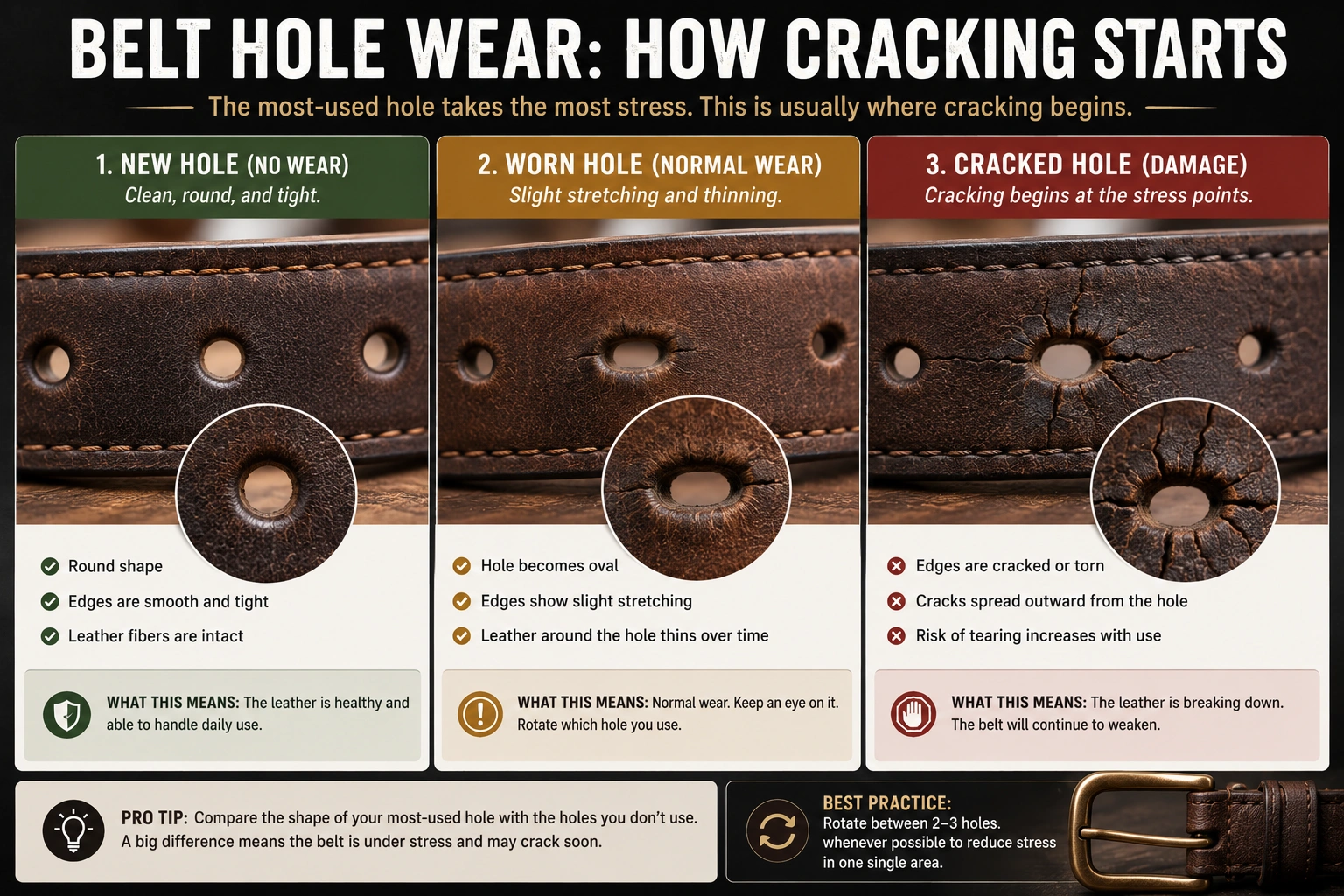
Cause #3: Stress Around the Belt Holes
Every time you fasten a belt, the buckle pin pushes through a hole and the leather around that hole bears the load of holding the belt closed for the rest of the day. Multiply that by daily wear, and the hole you use most is absorbing more concentrated mechanical stress than almost any other point on the belt.
The hole used every day usually becomes the first place where cracking appears — often before any other part of the belt shows visible wear. This is partly about repetition (that one hole is used far more often than any other) and partly about geometry (a hole is inherently a stress concentration point — the leather around it has less material to distribute the load across than a solid section of the belt does).
This is also where leather density and thickness — covered in more detail in our guide on what makes a good leather belt — make a direct, visible difference. Dense, appropriately thick leather distributes that daily stress across more fiber material and resists cracking at the hole far longer than thin or loosely structured leather does.
Leather movement and tension can also affect fit over time — learn more about whether leather belts stretch with regular use.
Cause #4: Repeated Folding Near the Buckle
If the holes take the most concentrated stress from fastening, the buckle fold takes the most repeated stress from simple use. Every time you put the belt on or take it off, the leather bends at the same point, in the same direction, through roughly the same angle. Over a year of daily wear, that's hundreds of flex cycles concentrated on a single fold line.
This is mechanically similar to repeatedly folding a piece of paper along the same crease — eventually, that crease becomes a weak point regardless of how strong the paper was originally. Leather is far more resilient than paper, but the same principle of concentrated, repeated stress at one location applies. If the leather at that point is dry, thin, or structurally weaker to begin with, the buckle fold is often where the first visible crack appears — sometimes even before the holes show any sign of wear, depending on the belt's specific construction and how it's worn.
Cause #5: Surface Coatings and Bonded Leather
This cause connects back to the peeling-versus-cracking distinction from earlier, because the two are often linked in lower-grade belts.
Many genuine leather belts achieve their uniform color and smooth appearance through a pigmented surface coating applied over leather that wouldn't look as consistent on its own — often because it's been sanded or comes from a less consistent layer of the hide. That coating is flexible when new, but it has its own lifespan, separate from the leather underneath. As the coating ages — particularly if the belt is also experiencing the dryness and stress factors covered above — it can begin to crack on its own, independent of what's happening to the leather beneath it. Once the coating cracks, it often begins to peel at those crack lines, because the cracking creates an edge for the coating to lift from.
Bonded leather takes this a step further. Because bonded leather is made from leather fiber and scraps held together with a polyurethane binder, the entire surface is essentially a manufactured coating over a non-continuous base material. Bonded leather cracking tends to happen faster and more extensively than coating failure on genuine leather, because there's no continuous leather structure underneath to hold things together once the binder starts to fail. What looks like one continuous crack is often the binder layer failing across a wider area all at once.
Do Full-Grain Leather Belts Crack?
Yes — but the honest answer comes with two important qualifiers: it's considerably less common, and when it does happen, it's almost always traceable to maintenance rather than the material itself.
Full-grain leather's dense, intact fiber structure is specifically what resists the structural cracking that affects lower grades. The fibers are tightly interlocked from the original hide, with nothing sanded away or supplemented with adhesives, which means the material can flex repeatedly at the buckle fold and absorb stress at the holes far longer before showing any sign of fatigue.
What full-grain leather isn't immune to is dryness. If a full-grain belt goes years without any conditioning — particularly in a dry climate, or stored somewhere that gets direct sun — the oils that keep the fiber structure flexible will eventually diminish, and the leather will stiffen. Left in that state long enough, even full-grain leather can develop surface cracking, typically at the buckle fold first.
The practical difference is timeline and cause. A bonded or split-leather belt might develop cracking within the first year of use regardless of how it's cared for, because the structural deficiency is built in. A full-grain belt that develops cracking after a decade of use, having never been conditioned, is showing a maintenance issue on top of an otherwise sound material — and that's a very different situation. For more on what full-grain leather actually is and why its structure behaves this way, see our full-grain leather guide.
Can a Cracked Leather Belt Be Repaired?
The honest answer depends entirely on which type of cracking you're dealing with — and managing expectations here matters more than almost anything else in this guide.
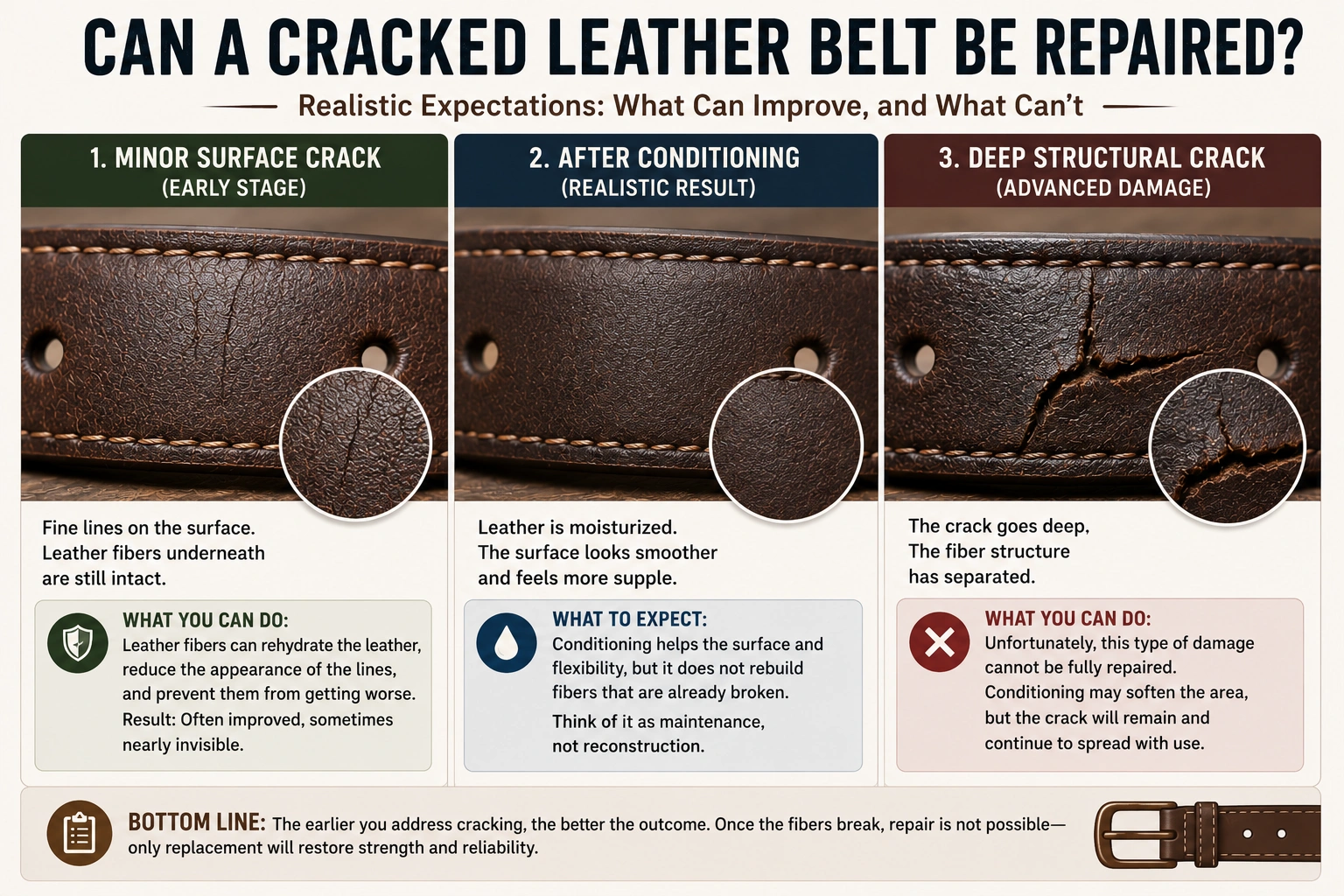
Surface cracking caused by dryness, caught reasonably early, often responds well to conditioning. Applying a quality leather conditioner restores some of the oils the leather has lost, which can soften the material, reduce stiffness, and in some cases visibly reduce the appearance of fine surface lines as the leather becomes more pliable again. This won't make the leather look brand new, and any lines that have already formed as actual breaks in the surface won't fully disappear — but conditioning can meaningfully improve both the look and the feel, and more importantly, it can stop the problem from progressing further.
Deep structural cracking is a different story. Once the fiber structure itself has separated — not just the surface, but the material underneath — there's no conditioner or treatment that rebuilds those fibers. Conditioning the surrounding leather can keep the rest of the belt from deteriorating further, but the crack itself is permanent. The belt may remain functional depending on where the crack is located, but it won't heal.
Peeling falls into the same category as deep cracking in terms of repairability: once a surface coating has separated from the base material, it cannot be reattached, and the peeling will continue to spread from that point, particularly with continued flexing. There's no conditioner or product that restores adhesion between a coating and the leather beneath it.
So, can a cracked leather belt be repaired? For early-stage, dryness-related surface cracking — partially, yes, and conditioning is worth doing both for the improvement and to prevent further progression. For deep structural cracks or peeling — no, not in the sense of reversing what's already happened. At that point, the relevant question shifts from "can this be fixed" to "is this belt still doing its job, and for how much longer."
How to Prevent Leather Belt Cracking
Prevention is considerably more effective than repair, and most of it comes down to a handful of straightforward habits.
Start with better leather. This is the highest-leverage decision, and it's made once, at purchase. Full-grain leather with a dense fiber structure and single-piece construction resists every cause of cracking covered in this guide — low-quality material, hole stress, buckle-fold stress — more effectively than any care routine can compensate for in a lower-grade belt. Our guide on what makes a good leather belt covers exactly what to look for.
Avoid excessive dryness. Don't store belts near direct heat sources — radiators, heating vents, car dashboards in summer — and avoid leaving leather in direct sunlight for extended periods. Both accelerate the oil loss that leads to stiffness and eventually cracking.
Condition periodically. Leather conditioner replenishes the oils that natural wear and environmental exposure gradually remove. For most belts in normal use, conditioning every few months is enough to keep the leather flexible and to catch early dryness before it becomes a structural problem. The right frequency depends on climate and how often the belt is worn — drier climates and heavier daily use both call for more frequent conditioning.
Store properly. Avoid coiling a belt tightly around its buckle for long periods, which can create a sharp, permanent fold at a point the belt wasn't designed to bend at. Hanging the belt or laying it flat in a loose loop is better for the leather over time.
Rotate belts if you can. If you wear the same belt every single day, the same hole and the same buckle fold are absorbing all of the daily stress, every day, indefinitely. Alternating between two belts — even just a couple of times a week — effectively halves the number of flex cycles each belt experiences at its highest-stress points, which meaningfully extends the time before cracking becomes a concern at either location.
When Is It Time to Replace a Belt?
Not every change in a leather belt's appearance is a problem, and it's worth being clear about the difference — because confusing cosmetic aging with damage leads people to replace belts that are still doing their job perfectly well.
Cosmetic aging — darkening at the contact points, a softer and more supple feel than when new, subtle surface texture changes, slight rounding at the edges — is not damage. On full-grain and vegetable-tanned leather in particular, these changes are patina: evidence that the leather is responding to use exactly as it's supposed to. None of this is a reason to replace a belt. If anything, it's the leather doing what good leather does.
Actual replacement signals look different: deep structural cracking that's visibly opening when the belt flexes, holes that have stretched into ovals and no longer hold the buckle pin securely (meaning the belt won't stay fastened reliably), peeling that's spread across a significant portion of the surface, or hardware that's corroded, bent, or broken at the buckle pin.
The distinction comes down to function versus appearance. A belt that looks different from when it was new — richer in color, softer, slightly textured from use — is aging well. A belt that no longer holds its fastening position reliably, or where the structural integrity at a key point has visibly failed, has reached the end of its functional life regardless of how it looks.
Frequently Asked Questions
Why is my leather belt cracking?
Leather belt cracking is most often caused by one or a combination of five factors: lower-grade leather with a looser fiber structure, the leather drying out from lack of conditioning or environmental exposure, concentrated stress around the most-used hole, repeated flexing at the buckle fold, or a surface coating that's reached the end of its lifespan. The location of the cracking — at a hole, at the buckle fold, or across the surface generally — often points toward which of these is the primary cause.
Why do leather belts crack at the holes?
The hole you use most absorbs more repeated mechanical stress than any other point on the belt, because the buckle pin pushes through it every time the belt is fastened. A hole is also a natural stress concentration point — there's less surrounding material to distribute the load compared to a solid section of leather. Combine daily repetition with that geometry, and the most-used hole is often where cracking becomes visible first, particularly on thinner or lower-density leather.
Can a cracked leather belt be repaired?
It depends on the type of cracking. Early-stage surface cracking caused by dryness often improves with conditioning — the leather becomes more flexible and the appearance can improve, though existing lines won't fully disappear. Deep structural cracking, where the fiber structure itself has separated, cannot be reversed. Peeling, which is a coating failure rather than true cracking, also cannot be repaired and tends to spread with continued use.
Why does bonded leather crack?
Bonded leather is made from leather fiber and scraps held together with a polyurethane binder rather than being a continuous piece of hide. The binder has its own lifespan, and once it begins to break down — especially under repeated flexing — the surface can crack and flake across wider areas than you'd see with genuine leather, because there's no continuous fiber structure underneath holding things together. This is typically the fastest-developing form of leather belt cracking.
Does full-grain leather crack?
It can, but considerably less often and usually for different reasons than lower grades. Full-grain leather's dense, intact fiber structure resists the structural cracking that affects bonded and split leather. When full-grain leather does crack, it's most often the result of long-term dryness — years without conditioning, particularly in dry climates or with sun exposure — rather than a structural deficiency in the material itself.
How can I prevent leather cracking?
Start with quality leather — full-grain, single-piece construction, appropriate thickness — since this addresses most causes before they become a problem. Beyond that: avoid storing belts near heat sources or in direct sunlight, condition the leather periodically to replace lost oils, store the belt without tight coiling around the buckle, and if practical, rotate between two belts so neither one absorbs all the daily stress at the same hole and fold point.
Why does leather peel?
Peeling happens when a surface coating — applied over the leather to create a uniform color and finish — separates from the material underneath. It's most common on bonded leather, where the entire surface is essentially a manufactured layer with no continuous leather structure beneath it, and on heavily coated genuine leather, where the coating is doing significant visual work over a less consistent base material. Peeling is a finish failure rather than the leather itself cracking, and once it starts, it typically spreads rather than stopping on its own.