If you've ever had one leather belt last a decade while another started cracking after a year or two, you've probably wondered: how long is a leather belt actually supposed to last?
Most people assume the answer is a number. Five years. Ten years. Maybe a lifetime, if the marketing copy is feeling ambitious.
The reality is messier than that. A leather belt's lifespan depends far less on age and far more on what it's made from, how it's built, how it's worn, and whether anyone ever bothers to take care of it.
So here's the honest short version: a well-made leather belt can often last many years — sometimes well over a decade — while a poorly made one may show real wear within the first year or two. Same product category. Same general appearance on day one. Completely different outcomes.
Here's the problem: nothing about that difference is visible on day one.
Why? That's the actual interesting question, and it's worth working through properly.
The Question Most People Are Actually Asking
Nobody really cares about belt age for its own sake. That's not what's driving the search.
What people actually want to know is one of three things: did I buy a good belt, is what I'm seeing normal, or is it time to let this one go?
Those are three very different questions, and "how long do leather belts last" doesn't quite capture any of them on its own. A five-year-old belt that's darkened and softened with use might be in better shape than a two-year-old one that's already cracking at the buckle fold. Age tells you almost nothing in isolation.
In practice, most people don't even realize they're asking about quality rather than time until someone points it out.
So instead of chasing a number, it helps to understand what's actually driving the outcome. Once you see that, the "how long" question mostly answers itself — for your specific belt, not just in the abstract.
Why Two Leather Belts Can Age Completely Differently
Here's a scenario worth sitting with for a second.
Two people buy a leather belt on the same day. Both belts are labeled "genuine leather." Both look reasonable in photos. Both cost a similar amount.
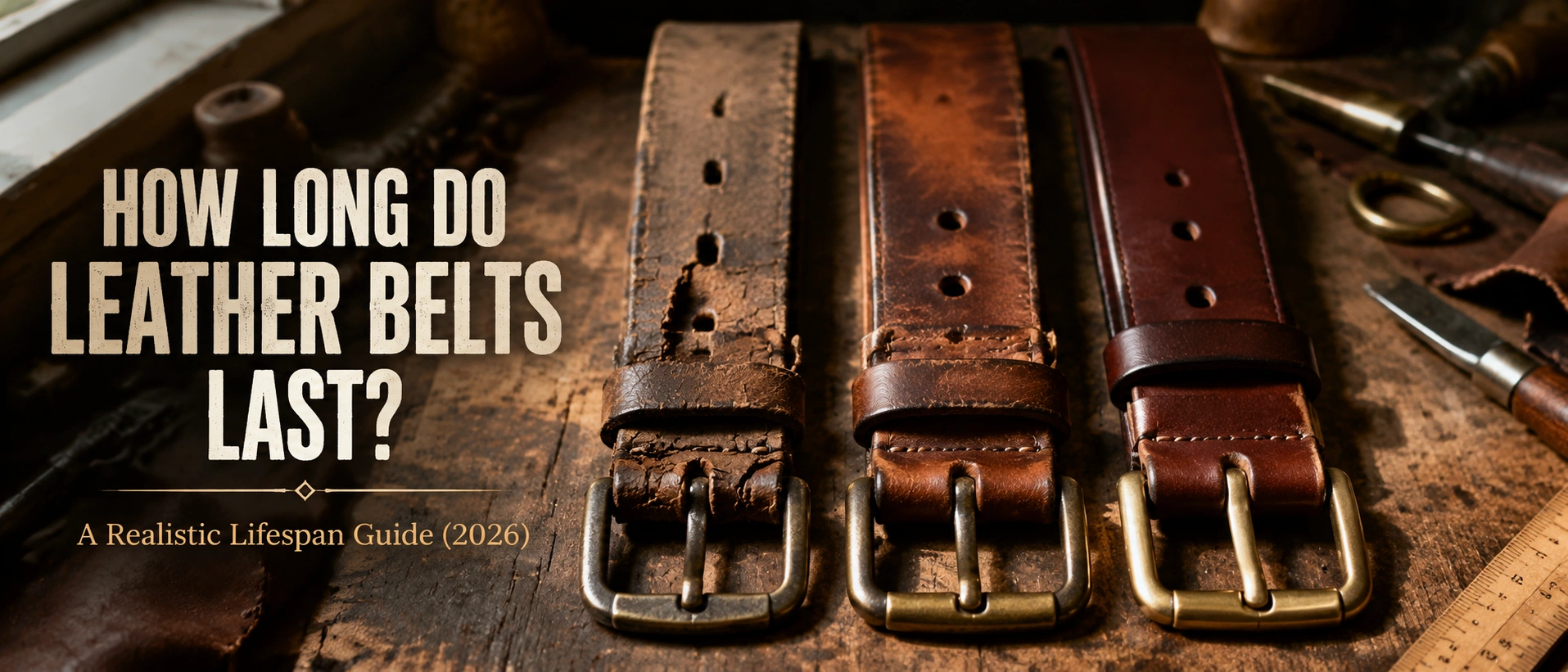
Three years later, one belt looks better than it did when new — darker, softer, a little more character at the edges. The other has a crack running through the buckle fold and the most-used hole has stretched into something closer to an oval.
Many people assume all leather belts age more or less the same way, just on slightly different timelines. They don't. The gap between those two outcomes isn't random, and it isn't really about luck either.
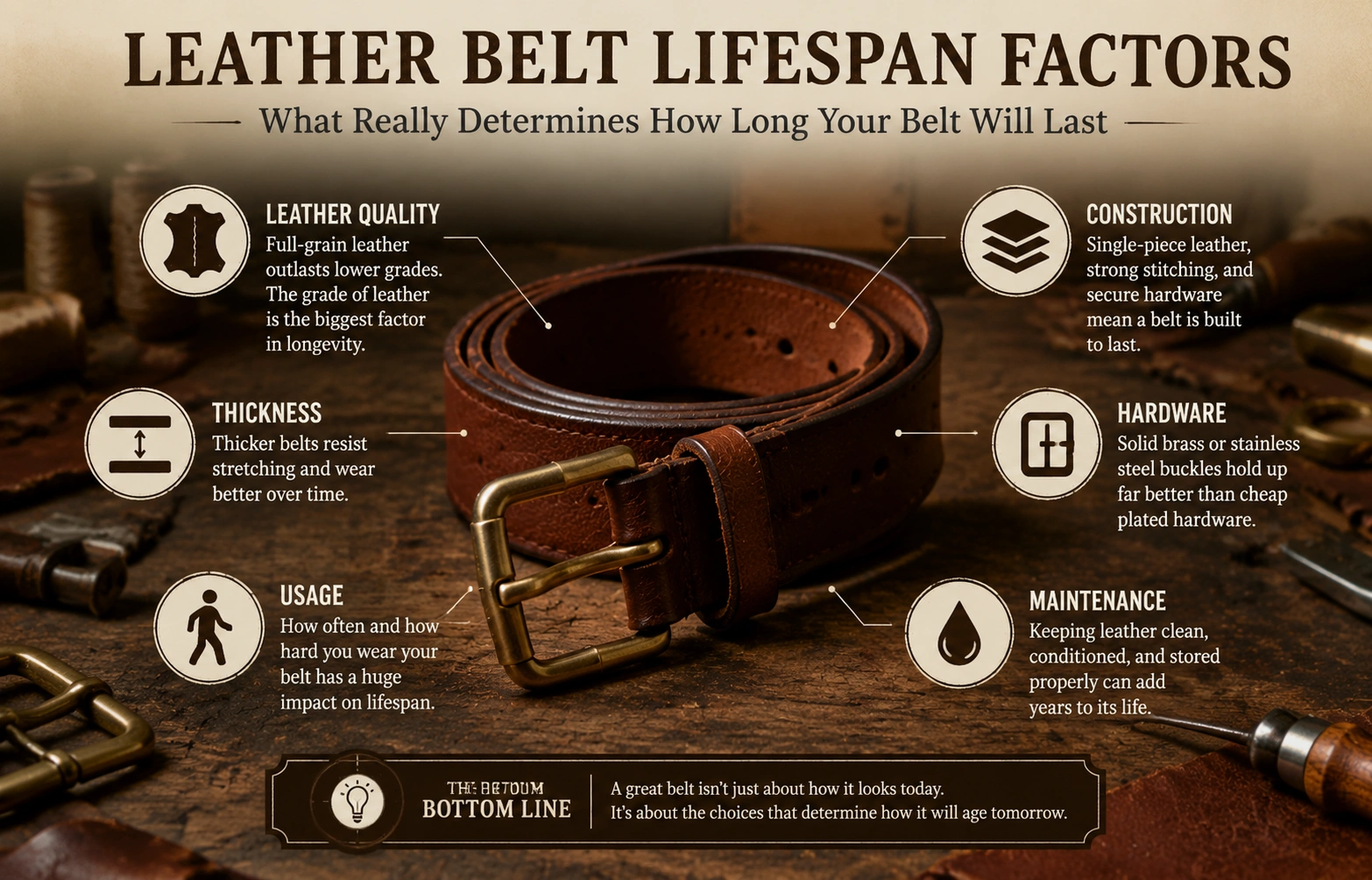
It comes down to a handful of factors stacking on top of each other: what layer of the hide the leather came from, how thick it is, whether it was built as a single piece or glued together from layers, what the hardware is actually made of, and — to a smaller but real degree — the environment the belt lives in.
None of these show up clearly in a product photo. That's part of the problem.
One thing many belt owners notice, usually too late, is that the differences were there from the start. They just weren't visible yet.
Leather Grade Matters More Than Most People Realize
This is the factor that does the most heavy lifting, and it's also the one that's hardest to evaluate at the point of sale.
Bonded leather is leather fiber and scraps held together with a polyurethane binder — not really a continuous piece of hide at all. It can look fine for a while.
The binder, though, has its own clock running. And once it starts to fail, the surface tends to go quickly and across a wide area rather than developing one isolated crack.
Genuine leather is a term that covers a lot of ground, and that's the problem with it. It might mean leather from a lower layer of the hide with a looser fiber structure, or corrected leather with a heavy coating doing most of the visual work. The label confirms it's real leather. It doesn't tell you much else.
That's where things get interesting, actually — two belts can both say "genuine leather" on the tag and behave nothing like each other.
Corrected grain leather comes from the outer hide but has been sanded and refinished. It tends to hold up reasonably well — better than genuine leather generally, not quite as well as the layer below.
Full-grain leather is the outer layer of the hide left completely intact. Nothing sanded away, nothing supplemented. The fiber structure is at its densest here, and that density is what resists stretching, cracking, and general fatigue over years of daily flexing.
Here's roughly how that tends to play out in practice:
| Leather Grade | General Lifespan Pattern |
|---|---|
| Bonded leather | Often the shortest — visible failure within 1–2 years of regular use is common |
| Genuine leather | Moderate — typically holds up for a few years before showing real wear |
| Corrected grain | Longer — often performs well for several years with reasonable care |
| Full-grain leather | Often the longest — frequently a decade or more with basic maintenance |
These aren't guarantees in either direction. A poorly constructed full-grain belt can still disappoint. A well-made corrected grain belt can outperform expectations.
But as a starting point — before you even get into thickness, construction, or hardware — leather grade sets the range you're working within. (We go deeper on this in our full-grain vs. genuine leather comparison, if you want the full picture.)
The Real Enemies of Belt Longevity
Age isn't really the enemy here. A belt sitting unused in a drawer for twenty years isn't necessarily worse off than one worn hard for two.
What actually shortens a belt's life is a fairly short list, and it's worth naming directly: dryness, concentrated stress at the holes, repeated folding at the buckle, surface coatings that eventually fail, and — underneath all of it — construction that wasn't built to handle any of the above in the first place.
Dryness sneaks up on leather. The oils that keep the fibers flexible diminish over time, faster in dry climates or with sun exposure, and the leather gets stiffer before it gets visibly damaged.
The holes take a beating nobody thinks about. Every single fastening pushes the buckle pin through the same spot, day after day, and that's concentrated mechanical stress in a small area with comparatively little material to absorb it.
The buckle fold is doing its own version of the same thing — the same crease, bent the same way, hundreds of times a year.
And coatings, where they exist, are essentially running on a separate timer from the leather underneath. When that timer runs out, the surface can crack or peel independent of how the leather itself is doing.
Not necessarily all at once, though. Usually it's one of these getting slightly worse for a long time before anything becomes visible.
If any of this sounds familiar, it's because we've covered the mechanics of it in detail in why leather belts crack — that piece goes into exactly how these factors interact and what each type of damage actually looks like.
Signs Your Belt Is Aging Normally
This is the section most lifespan guides skip, and it's honestly one of the more important ones.
A leather belt that's a few years into regular use should look different from a new one. That's not a problem. That's the leather doing what it's supposed to do.
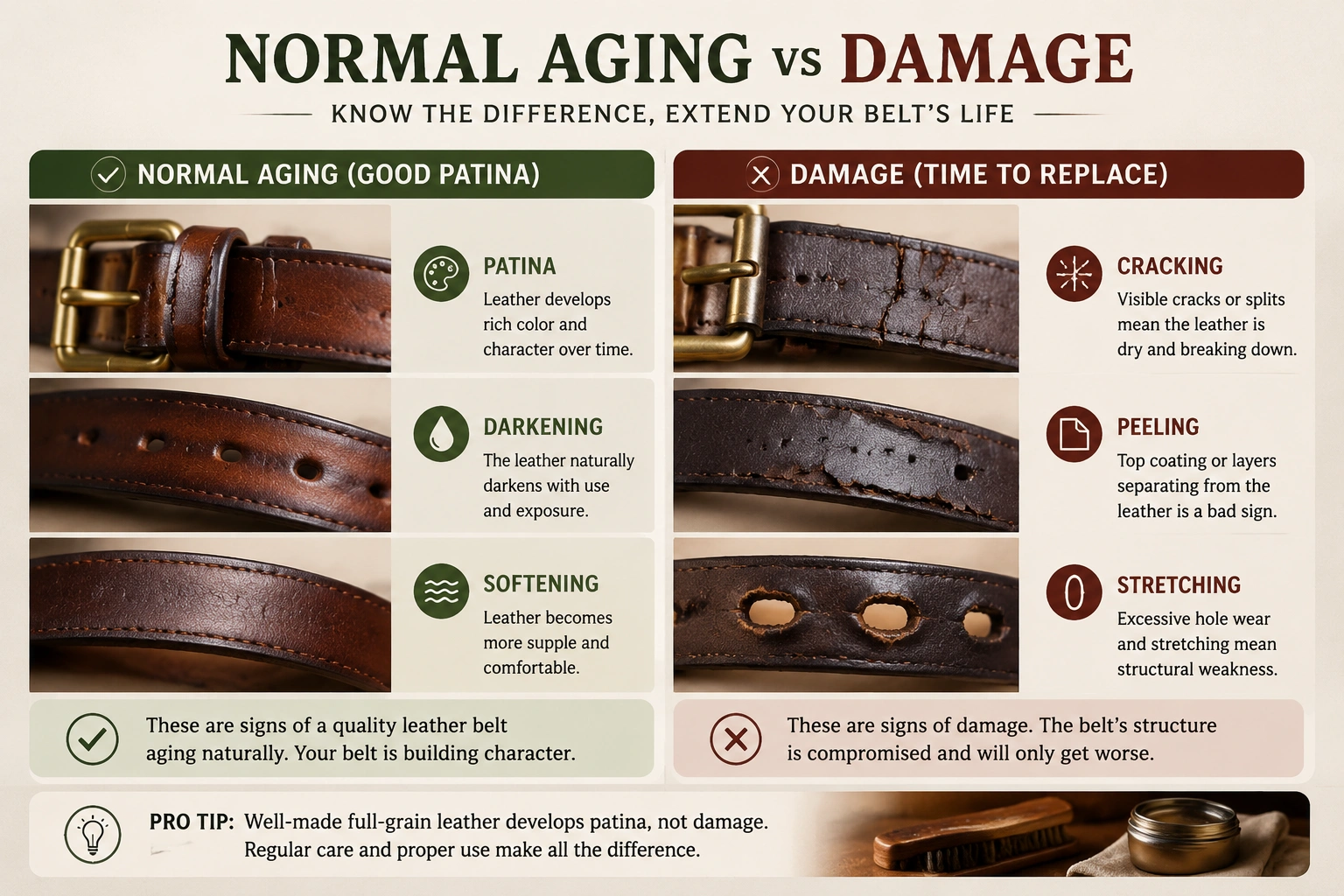
Patina is the big one — a gradual deepening and shifting of color, especially at the points that get the most contact. The belt darkens. It develops a kind of depth that a new belt simply doesn't have.
The leather also gets softer. Not floppy, not weak — just more pliable, more responsive, less stiff than it was on day one.
Edges round off slightly. Surfaces that were once perfectly flat develop a subtle texture from handling. The whole thing starts to feel less like an object and more like something that's been lived with.
A good way to check this is to compare a high-contact area — say, near the buckle — against a section of the belt that rarely gets touched. If the high-contact area is darker, smoother, and slightly more supple, that's patina doing exactly what it does.
Here's the thing: many people mistake this for damage. They see a belt that looks "worn" compared to when they bought it and assume something's going wrong.
Often it's the opposite. A belt that's darkening, softening, and developing character is frequently a belt that's aging exactly the way good leather is supposed to age. The mistake isn't that the belt changed — it's expecting it not to.
Signs Your Belt Is Reaching the End of Its Life
This is the part people usually search for after the fact — once something's already visibly wrong and they're trying to figure out whether it's serious.
Deep cracking is the clearest signal. Not fine surface lines, but cracks that open up when the belt flexes, sometimes showing a lighter color or even a gap beneath the surface. That's structural, and it doesn't reverse.
Peeling is its own category — a surface coating lifting away from the leather underneath, usually starting at an edge or a stress point and spreading from there. Once it starts, it tends to keep going.
Holes that have stretched into ovals are a quieter problem but a real one. If the buckle pin no longer sits snugly, the belt isn't holding its fastening position reliably anymore — which is, after all, the entire job of a belt.
Normal stretching and structural wear are not always the same thing. Learn more about whether leather belts stretch over time.
Hardware that's loose, corroded, or visibly worn through its plating is another marker. A buckle that's lost structural integrity at the pin is a different problem from a buckle that's just lost its shine.
The common thread across all of these: they're functional failures, not cosmetic changes.
A belt that looks different is aging. A belt that doesn't work the way a belt is supposed to work is done.
How Often Should You Replace a Leather Belt?
The honest answer is: it depends. Not in a vague, dodge-the-question way — in a genuinely "this varies by situation" way.
Someone wearing the same belt every single day, through every season, with a phone and keys and a wallet putting weight on it constantly, is putting that belt through a lot more flex cycles per year than someone who wears it twice a week with dress pants.
Office wear is comparatively gentle. The belt goes on in the morning, comes off in the evening, doesn't experience much beyond sitting and standing.
Daily casual wear — jeans, every day, all day — is harder on a belt. More movement, more variation in posture, more cumulative stress at the buckle fold.
Workwear is harder still, especially if there's any load involved — tools, equipment, anything that adds tension to the belt throughout the day.
And occasional wear is exactly what it sounds like: a belt that's barely used will barely age, regardless of what it's made from.
There's no single replacement interval that makes sense across all of these.
What's more useful is checking in periodically — does the belt still fasten securely? Does the leather still feel flexible rather than stiff? Are the holes still round? If yes across the board, there's no clock you need to be watching.
Can a Leather Belt Last 10 Years?
People search this specific question a lot, and it deserves a straight answer rather than a marketing one.
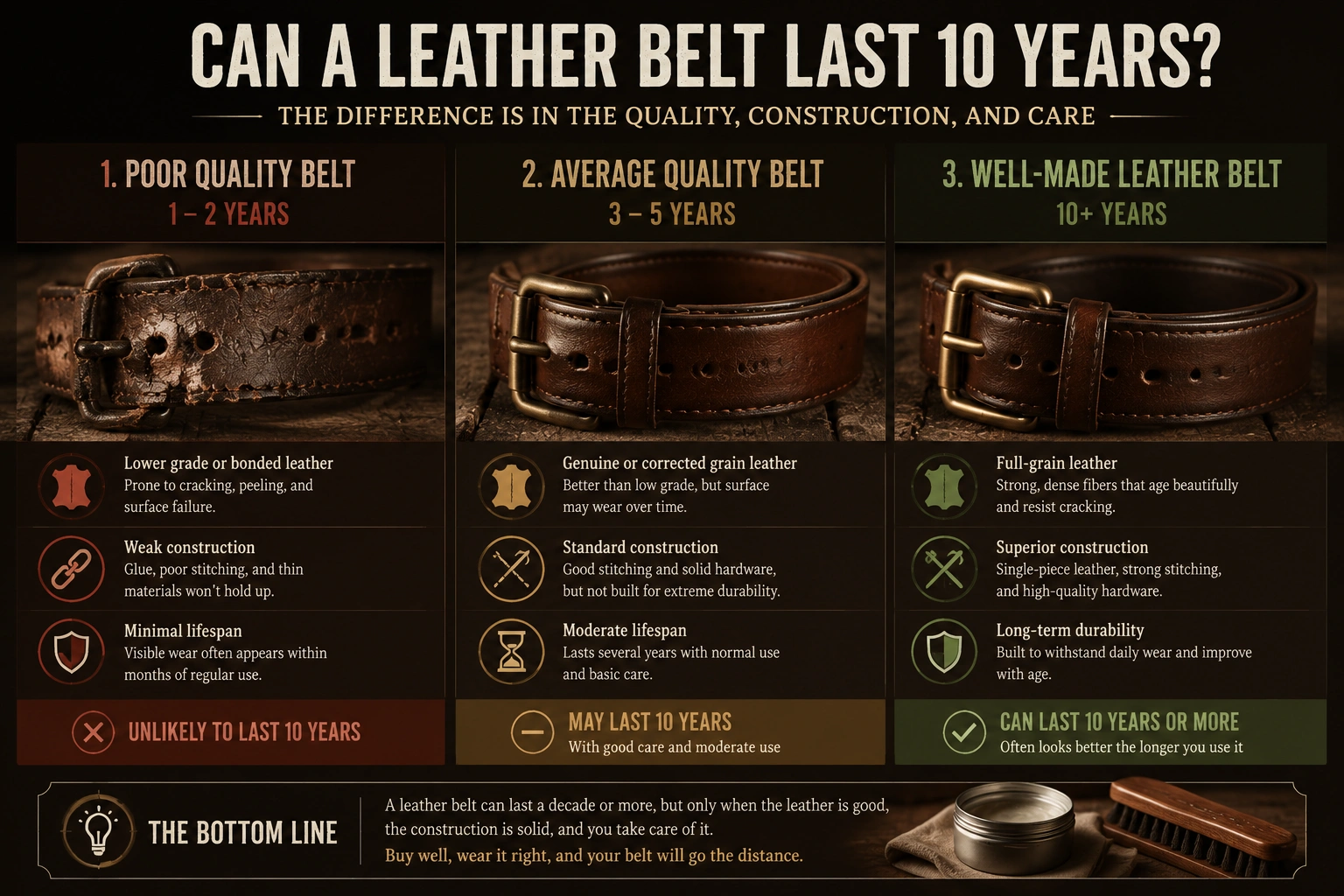
Yes. Some leather belts absolutely last ten years and beyond — and not as some rare exception, either. A well-made full-grain belt, given basic periodic conditioning, regularly outlasts a decade of daily wear while continuing to look better rather than worse.
But also: no, not all of them. A lot of belts don't make it anywhere close to ten years, and the reason usually isn't bad luck.
What separates the ten-year belt from the two-year belt is almost always some combination of leather grade, construction quality, and whether anyone ever conditioned it. Take any one of those away and the odds shift considerably.
In practice, it's rarely just one factor doing all the work — it's usually two or three of them lining up, in either direction.
| Belt Type | Likely Outcome at 10 Years |
|---|---|
| Poor construction (bonded/thin leather, layered, plated hardware) | Likely replaced multiple times already |
| Average construction (genuine or corrected leather, moderate care) | May still be functional, but showing significant wear |
| Well-made full-grain belt with basic care | Often still in regular use, frequently looking better than at purchase |
So can a leather belt last ten years? Yes — but it's not really a question about the belt's age potential in the abstract. It's a question about what that specific belt was made from and whether it's been given the bare minimum of care along the way.
How to Make a Leather Belt Last Longer
Most of this isn't complicated. It's mostly about not letting small, manageable issues turn into big, permanent ones.
Avoid excessive dryness. Keep belts away from direct heat sources and prolonged direct sunlight. Both accelerate the oil loss that eventually leads to stiffness and cracking.
Condition periodically. A quality leather conditioner replaces oils that wear and environmental exposure gradually remove. Every few months is a reasonable baseline for most belts in regular use — more often in dry climates, less often if the belt sees light use.
In practice, this is the step most people skip — not because it's hard, but because nothing bad happens immediately when you don't.
Store it properly. Avoid coiling a belt tightly around its buckle for long stretches, which can create a sharp permanent fold somewhere the leather wasn't designed to bend. Hanging it or laying it in a loose loop is gentler.
Rotate between belts if you can. Wearing the same belt every single day means the same hole and the same buckle fold absorb every flex cycle, every day, indefinitely. Even alternating between two belts a few times a week roughly halves the cumulative stress at those specific points.
Buy better leather in the first place. This one's a bit of a cheat, because it's not really an ongoing habit — it's a single decision made once, at purchase. But it's also the highest-leverage decision on this list by a wide margin. Full-grain leather, dense fiber structure, single-piece construction, solid hardware — these address most of the longevity factors before they ever become a problem. Our guide on what makes a good leather belt covers exactly what to look for if you're shopping for one.
Final Thoughts
So — how long do leather belts last?
Honestly, that's probably not the most useful question to be asking.
The better question is: how well was this belt made in the first place?
Because by the time a crack appears, or a hole stretches into an oval, or a coating starts to peel — the outcome was usually decided years earlier, in decisions about leather grade, thickness, and construction that nobody ever sees on the surface.
A belt that's built right doesn't just survive longer. It tends to look better the longer it's around — which is, when you think about it, a fairly rare thing for an object to do. Most things just wear out. A good leather belt, given a little bit of basic care, does the opposite.
That's really the whole answer. Not a number. A starting point.
Frequently Asked Questions
How long do leather belts usually last?
It varies considerably by leather grade and construction. Bonded leather often shows real wear within one to two years. Genuine leather typically holds up moderately well for a few years. Corrected grain leather tends to perform longer with reasonable care. Full-grain leather, given basic conditioning, frequently lasts a decade or more — sometimes considerably longer.
Can a leather belt last 10 years?
Yes, and it's not unusual for a well-made full-grain leather belt with basic periodic conditioning. What determines whether a specific belt reaches that point is mostly leather grade, construction quality, and whether it's ever been conditioned — not age or luck.
Why do some leather belts crack so quickly?
Usually a combination of factors: lower-grade leather with a looser fiber structure, dryness from lack of conditioning, and concentrated stress at the most-used hole or the buckle fold. Bonded leather and heavily coated genuine leather are especially prone to early cracking and peeling because the surface isn't a continuous, dense piece of hide to begin with.
How often should you replace a leather belt?
There's no fixed interval — it depends on how the belt is worn and what condition it's in. Daily heavy use puts more cumulative stress on a belt than occasional wear. Rather than replacing on a schedule, check whether the belt still fastens securely, the leather still feels flexible, and the holes are still round. If those hold up, there's no need to replace based on age alone.
Does full-grain leather last longer?
Generally, yes. Full-grain leather retains the densest, most intact fiber structure of any leather grade, which resists the stretching, cracking, and fatigue that affect lower grades sooner. It's not a guarantee on its own — construction and basic care still matter — but it sets a meaningfully higher ceiling for how long a belt can realistically last.
What are signs a belt should be replaced?
Deep structural cracking that opens when the belt flexes, peeling that's spreading across the surface, belt holes that have stretched into ovals and no longer hold the buckle pin securely, and hardware that's corroded, loose, or structurally compromised. These are functional failures rather than cosmetic changes — a belt that looks different from when it was new but still works reliably is aging normally, not failing.