A leather belt that is too long doesn't always need to be replaced. In many cases, you can shorten a leather belt at home by removing the buckle, trimming the extra length, and reinstalling the hardware — no leather shop required.
Here's the situation that usually brings people to this guide: you found a belt worth buying. The leather feels substantial — dense, firm, with the kind of surface that tells you immediately it's the real thing. The buckle is solid brass, weight in hand. The color is exactly right. You put it on and the fit feels promising.
Then you look in the mirror.
There's four inches of leather tail hanging past the first belt loop, flopping against your hip. The buckle isn't centered the way it should be. The whole thing looks slightly wrong — not because the belt is bad, but because it's too long for your body.
The instinct most people have at this point is to punch more holes. Keep the belt as-is, just move where it fastens. And for some situations, that works fine. But if the belt is genuinely too long, adding holes doesn't solve the underlying problem. The extra leather is still there, the tail is still too long, and the proportions still look off.
The right fix is shortening the belt from the buckle end. It's less intimidating than it sounds, and this guide walks through every step — including how to tell which method you need before you cut anything.
Can You Shorten a Leather Belt?
Yes — but how easily depends almost entirely on how the buckle is attached.
Removable buckle construction is the most common design in quality leather belts, and it's the one that makes shortening straightforward. The buckle attaches at the non-tail end of the belt, typically held in place by a Chicago screw, a screw-post, or a folded leather keeper with a pin. Removing the buckle exposes the leather end, which can be trimmed, punched with a new hole if needed, and reassembled. The whole process takes fifteen to thirty minutes and requires no specialized skill.
Fixed buckle construction is found on some fashion belts and certain specialty designs, where the buckle is permanently riveted, stitched, or glued to the leather with no intention of removal. Shortening this type from the buckle end requires either destructive removal of the hardware — risking damage to both the buckle and the leather — or professional work at a leather shop. In most cases, if a fixed-buckle belt is too long, replacement is the better decision.
Before doing anything else, identify which type you have. Examine the buckle end of the belt. If you can see a screw post or a folded tab with a visible fastener, it's removable. If the buckle appears integrated into the leather with no obvious mechanism, it's likely fixed.
Can You Cut a Leather Belt?
Yes — and cutting from the correct end is the key to doing it cleanly.
The safest method is always to cut from the buckle side of the belt, not the tail end. The tail has a finished shape — usually tapered or with a rounded tip — that you want to preserve. Cutting from the buckle end removes excess material from where it belongs, allows the buckle to be reinstalled at the correct position, and leaves the tail proportionally correct.
The leather at the cut end will be raw and exposed. Finishing it with a small amount of edge paint, beeswax, or leather conditioner protects the fiber and keeps the edge from fraying. On full-grain leather especially, a clean cut finished this way looks as intentional as the original construction.
-4.webp?w=1536&h=1024)
Which Side of a Leather Belt Should You Cut?
Always the buckle end. Never the tail end.
This is the single most important thing to get right before picking up any tool.
The tail end of a belt is shaped and finished — it's the decorative tip that slides through the loops. Once cut, that profile is gone and cannot be restored without specialized tools. The buckle end, by contrast, is hidden inside the buckle frame once reassembled. A clean cut there is invisible in use.
The logic is simple: the excess length exists at the buckle end, because that's the end that determines where the buckle sits on your body. Remove material from there, reinstall the buckle, and the belt fits. Remove material from the tail and you've shortened the decorative end of a belt that still fastens in the wrong position.
Real Customer Question: "My New Leather Belt Is Too Long — Should I Add More Holes?"
This question comes up regularly, and the answer depends on how much too long the belt actually is.
Here's a common scenario: someone measures their waist at 34 inches, buys a belt labeled size 34, and finds it sitting at the second or third hole from the end — meaning the middle hole is nowhere near where their body is. There are six inches of leather tail hanging past the front loop. Adding a hole or two on the tighter end might move the buckle position, but it doesn't shorten the tail. The proportional problem remains.
The issue is usually a sizing misunderstanding. Belt sizing conventions vary by brand — some size by total length, others by the distance from the buckle pin to the middle hole, others by the intended waist size. A "34" from one brand may be several inches longer than a "34" from another.
The general guideline: if you need to add more than two holes to get a comfortable fit, you're probably dealing with a belt that's the wrong size, and shortening it is worth considering. If you're one hole away from your ideal fit, just punch the hole.
How Much Belt Length Should You Remove?
Before cutting anything, use this simple framework to decide the right approach:
| Fit Problem | Best Solution |
|---|---|
| 1 hole too loose or too tight | Punch a new hole — no cutting needed |
| 2–3 inches too long | Shorten from the buckle end |
| 4+ inches too long | Consider whether a different size is more appropriate |
| Belt fastens at last hole | Shorten — the belt is definitively too long |
| Belt fastens at first hole | Different size needed — shortening won't help |
For the 2–3 inch range, shortening is straightforward. For larger discrepancies, it's worth asking whether the belt was simply the wrong size to begin with — modifying a belt that's four-plus inches too long is possible but approaches the territory where a different size would serve you better.
Before Cutting: How Much Should You Shorten?
This is the step most people rush, and rushing it is how irreversible mistakes happen.
Step one: Find your correct fastening position. Put the belt on and identify the hole where it fastens comfortably. The middle hole of the belt's existing five-hole series is where a correctly sized belt should fasten — you should have roughly equal adjustment range on either side. If you're currently on the very last hole, the belt is too long.
Step two: Calculate the excess. With the belt at your comfortable fastening position, measure from the buckle end of the belt to where the leather enters the buckle frame. That distance is the excess material to remove — minus the fold-back length needed to reattach the buckle (typically 1–1.5 inches).
Step three: Mark and double-check. Mark your cut line clearly with a pen or chalk marker. Check the measurement twice before proceeding. The leather cannot be put back once it's cut.
Tools You Need to Cut and Punch a Leather Belt
You don't need a workshop or specialized equipment. Here's what's required:
- Flat-head or Phillips screwdriver for removing the Chicago screw or buckle post
- Metal ruler for accurate measurement and guiding straight cuts
- Sharp leather knife or heavy scissors — a utility knife with a fresh blade produces a clean cut; dull scissors crush the edge rather than cutting it
- Leather hole punch — a rotary punch with multiple tip sizes is ideal for both the attachment hole and any new fastening holes; a single-post punch and hammer also works
- Ballpoint pen or chalk marker for marking cut lines and hole positions
- Cutting board or scrap wood to protect your surface and back the leather during punching
Optional but worth having:
- Leather edge beveler or 220-grit sandpaper for finishing the cut edge
- Edge paint or leather conditioner to seal the newly exposed leather end
If you don't own a leather hole punch, they're available for under $15 and useful for belt adjustments over the long life of any quality leather belt.
-6.webp?w=1568&h=1003)
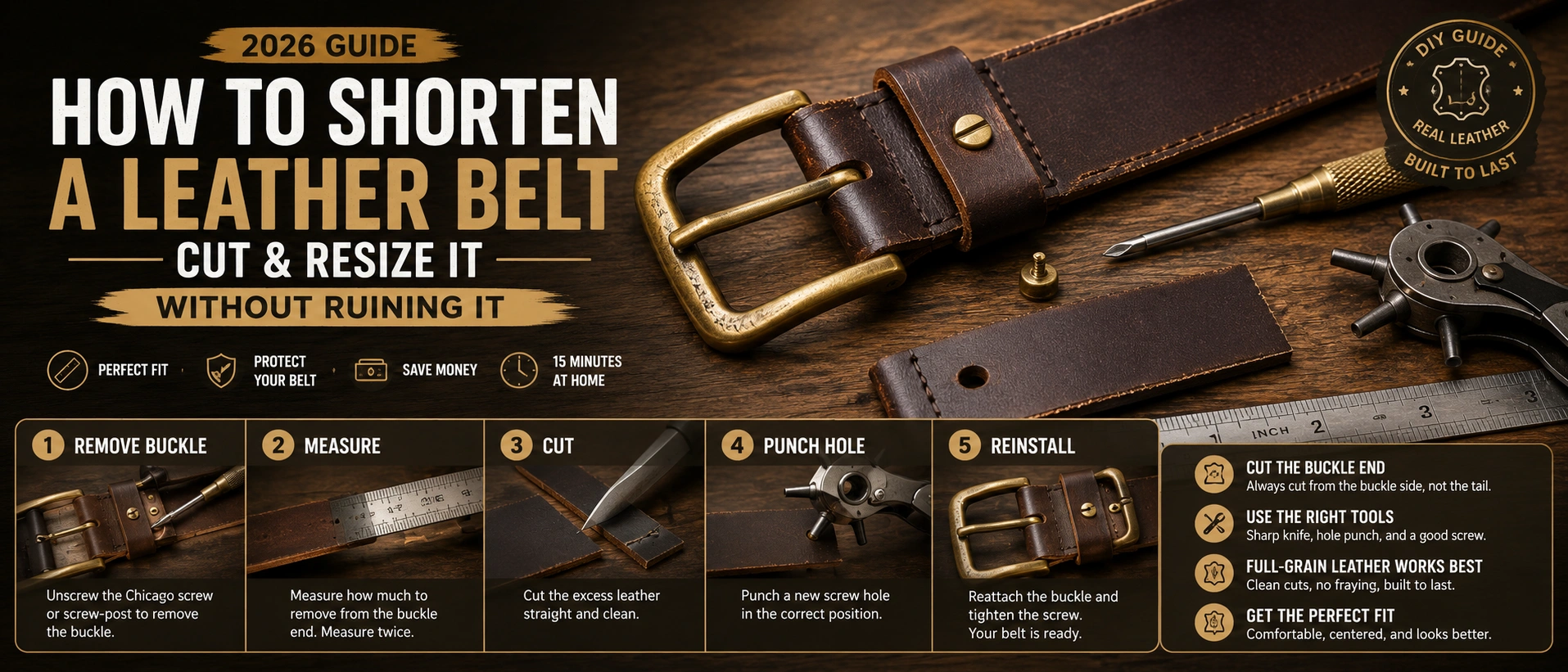
How to Shorten a Leather Belt: Step by Step
Step 1: Remove the Buckle
Examine the buckle end of the belt. Most quality belts use a Chicago screw — a two-part fastener with a slotted post that unscrews from a barrel. Hold the back post steady with one blade of your screwdriver while unscrewing the front piece. Set both parts aside where they won't roll away.
With the Chicago screw removed, the buckle and any leather keeper or loop will slide free. Note how much leather was folded back to accommodate the buckle attachment — this fold-back length (typically 1–1.5 inches) must be preserved on your trimmed end for reassembly.
Step 2: Measure and Mark Your Cut Line
Lay the belt flat on a hard surface. Mark the cut line on the buckle end, accounting for the fold-back length. If your original fold-back was 1.5 inches, your cut line should leave 1.5 inches of material beyond the new buckle position.
Use your ruler to draw a clean, straight line across the full width of the belt. Confirm it's perpendicular to the belt edges — a slightly angled cut will be visible in the finished product.
Step 3: Cut the Leather
Place the belt on your cutting board. Press the ruler firmly along the "keep" side of the marked line and draw your knife in a single, confident stroke. Hesitant, multi-pass cuts produce rough edges. One decisive cut gives you a clean result.
After cutting, examine the edge. If slightly rough, smooth it with fine sandpaper or a leather edge beveler. Apply a small amount of edge paint, beeswax, or leather conditioner to the cut end to protect the exposed fiber.
Step 4: Punch the New Attachment Hole
Mark the new hole position on your trimmed end at the same relative location as the original — typically centered across the belt width at the fold-back point. Select a punch tip that matches the diameter of the Chicago screw post. Place your cutting board under the belt, position the punch, and apply firm pressure or a single hammer strike. The hole should be clean and round.
Step 5: Reattach the Buckle
Fold the trimmed end back over the buckle bar as the original was configured, threading any keeper or loop back into position. Align the new hole with the buckle post. Insert the Chicago screw from the back, thread the front piece from the front, and tighten until snug.
Put the belt on and check the fit. The buckle should sit centered, the tail should extend approximately two to three inches past the front loop, and the belt should fasten at a position giving equal adjustment range on either side.
Common Mistakes When Cutting a Leather Belt
Cutting from the tail end instead of the buckle end. This is the most consequential mistake. Once the shaped tip is removed, the belt looks wrong and the underlying fit problem isn't solved. Always cut from the buckle end.
Cutting too much. Once cut, leather cannot be extended. Measure carefully, account for the buckle attachment fold-back, and cut conservatively. You can always remove more. You cannot add back what's gone.
Using dull or inappropriate tools. A dull blade tears leather fibers rather than cutting them, leaving a rough, compressed edge that frays over time. A proper leather punch produces a clean, round hole — a nail or push pin produces a stressed, irregular hole that widens with use. The right tools make a meaningful difference in the quality of the result.
Not accounting for buckle reattachment length. This is the most common measurement error. If you remove the measured excess without adding back the fold-back length, the trimmed belt will be too short to reassemble. Always include the fold-back in your calculations before marking the cut line.
-4.webp?w=1536&h=1024)
Can You Shorten a Full-Grain Leather Belt?
Yes — and full-grain leather handles this modification better than most other leather types.
The way a belt reacts after cutting often depends on leather quality. Understanding how to tell if a belt is real leather can help you avoid bonded materials that separate over time.
The structural advantage is that full-grain leather is a single, coherent piece of material from surface to back. There are no glued layers, no fabric backing, no bonded composite construction. When you cut full-grain leather cleanly, the edge reveals a dense, uniform fiber structure that holds together well and responds positively to edge finishing.
Bonded leather and heavily layered genuine leather constructions present a different situation. The glued layers that create apparent thickness can separate at a cut edge, particularly if the cut isn't perfectly clean. The surface coating may also delaminate at the cut point over time. Shortening these belts is possible, but the result is less clean and less durable than the same operation on solid full-grain leather.
For a full-grain leather belt with removable buckle construction, shortening is a confident modification. The material handles it well, the hardware reassembles cleanly, and the result looks like a properly sized belt because it now is one.
Should You Shorten a Belt or Buy a Smaller Size?
Shortening makes sense when:
- The belt has removable buckle hardware (Chicago screw or similar)
- It's a quality piece — good leather, solid hardware, construction worth preserving
- The adjustment needed is two to three inches, not dramatically more
- Width and style are correct; only the length is wrong
Replacing makes more sense when:
- The buckle is fixed and removal would damage the hardware or leather
- The belt is lower-quality to begin with — shortening it doesn't improve the material
- Something else is wrong beyond length: wrong width, wrong style, material you're not satisfied with
- The excess is four-plus inches, which suggests the belt is fundamentally the wrong size
The honest calculus: if you're holding a well-made full-grain leather belt with solid brass hardware that fits perfectly except for length, shortening it is clearly the right choice. If you're holding a mediocre belt that also happens to be too long, fixing the length doesn't fix the belt.
How to Avoid Buying the Wrong Belt Size Next Time
Most belt sizing confusion comes from inconsistent industry conventions.
For a more detailed fit breakdown, use a leather belt size guide to compare your trouser waist, belt length, and ideal middle-hole position before buying.
The most reliable rule: your belt size should be approximately two inches larger than your trouser waist size. A 32-inch trouser waist means a 34-inch belt. This accounts for pants thickness and allows the belt to fasten at the middle hole with adjustment range in both directions.
When a brand sizes belts by total length rather than waist-equivalent, add a few inches of margin — total length includes the tail past the last hole and doesn't tell you directly where the belt will fasten on your body.
When in doubt, size up rather than down. A belt that's slightly too long can be shortened by the method in this guide. A belt that's too short cannot be extended.
Frequently Asked Questions
How do you shorten a belt that is too long?
Remove the buckle by unscrewing the Chicago screw. Measure and mark how much to trim from the buckle end, accounting for the fold-back length needed to reattach the hardware. Cut cleanly with a sharp blade. Punch a new attachment hole if required. Fold the trimmed end back over the buckle bar and reinstall the Chicago screw. The entire process takes fifteen to thirty minutes with basic tools.
Can a leather belt be resized?
Yes. A leather belt with removable buckle construction can be resized by trimming from the buckle end and reinstalling the hardware. This works cleanly on full-grain leather and most quality genuine leather belts. Fixed-buckle belts are more difficult to resize at home and may require professional help or replacement.
Is it better to cut a belt or add holes?
If your belt only needs a small adjustment, learning how to add holes to a leather belt may be a better solution than cutting.
For small adjustments — one hole off from your ideal fit — punching a new hole is the faster and simpler solution. For larger adjustments — two or more inches of excess length — shortening from the buckle end is the cleaner approach. Adding holes doesn't remove excess tail length; it only changes where the belt fastens. If the tail is proportionally too long, cutting is the correct fix.
Can I cut a leather belt myself?
Yes, if the belt has a removable buckle. The process requires a screwdriver, a sharp blade or scissors, and a leather hole punch. It takes fifteen to thirty minutes and produces a professional result when done carefully. Fixed-buckle belts are significantly more difficult to modify at home.
Which end of a leather belt should you cut?
Always the buckle end, not the tail end. The tail has a finished, shaped tip you want to preserve. Cutting the buckle end removes excess material from the right place, and the cut is hidden inside the buckle frame once reassembled.
Can all leather belts be shortened?
No. Belts with removable buckle hardware can be shortened at home with basic tools. Belts with permanently fixed, riveted, or stitched buckles are significantly more difficult to shorten without damaging the construction.
Will cutting leather cause it to crack?
A clean cut on quality leather, properly finished at the edge, should not cause cracking. Applying edge paint, beeswax, or leather conditioner to the cut end protects the exposed fiber. Poor cuts with dull tools on low-quality leather are more likely to cause edge problems over time.
Final Thoughts
A leather belt that fits correctly is a completely different object from one that doesn't — same leather, same hardware, same design, but the proportions work with your body instead of against it. That difference is worth the thirty minutes and basic tools the modification requires.
A well-made leather belt is not a disposable accessory. With the right construction, it can be adjusted, maintained, and carried for years — fitting better as it breaks in, looking better as it ages, and asking very little in return.