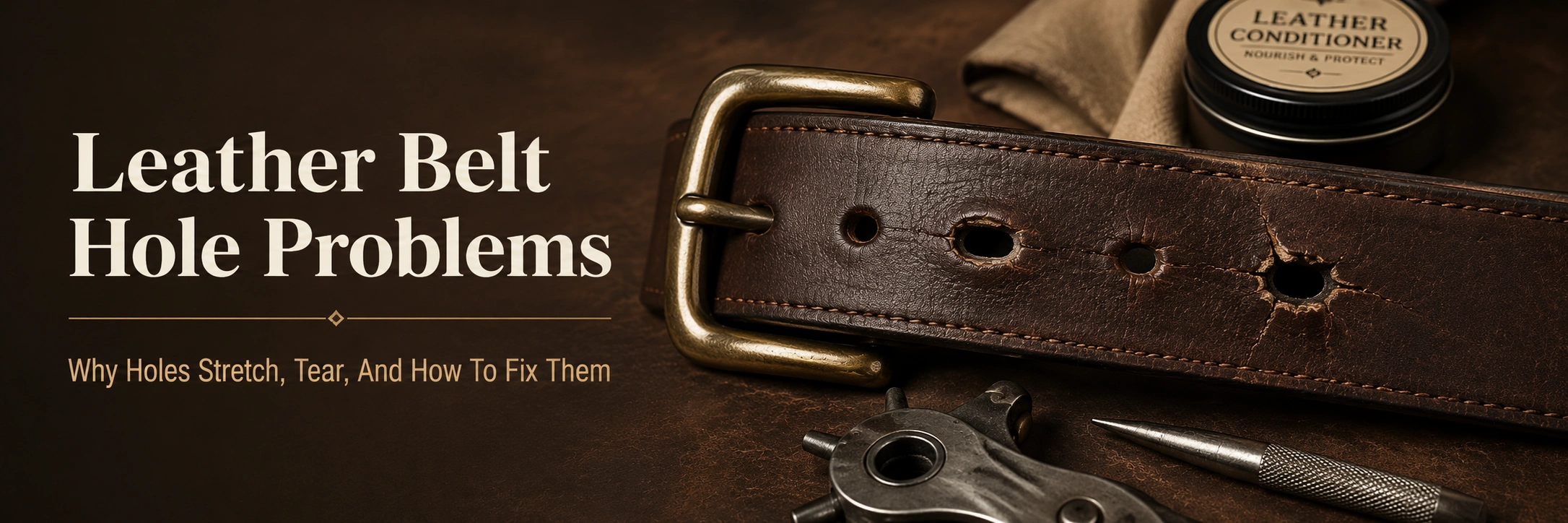
A stretched belt hole is usually a warning sign. A torn one is a bigger problem.
Most people don't think about belt holes until something goes wrong with one. The buckle starts feeling less secure than it used to. The hole you've been using looks slightly oval instead of round. Maybe there's a small split forming at one edge. And the natural reaction is to wonder whether the belt is just old, or whether you did something to it.
The more useful question isn't why it happened — it's what to do about it now. A stretched hole and a torn hole call for completely different responses, and the gap between "keep wearing it" and "replace it" usually comes down to which one you're actually looking at.
Here's the thing worth understanding first: the holes are where a belt works hardest. Every time you fasten it, the buckle pin drives into the same spot and holds the full tension of the belt for the rest of the day. That one small circle of leather is carrying more concentrated stress than anywhere else on the strap.
So when a hole stretches or tears, it's not a cosmetic footnote. It's the belt telling you something about its condition — and often, about whether its best years are ahead of it or behind it.
This guide is built to help you make one decision: keep wearing it, punch a new hole, shorten it, or replace it.
Why Belt Holes Matter More Than You Think
Belts rarely fail in the middle of the strap. They fail at the pressure points — and the hole is the biggest one.
Think about what actually happens at that spot. The buckle pin pushes through the same hole every single time you put the belt on. The leather around it absorbs the tension of holding your pants up, all day, every day. When you sit, the belt flexes and that hole takes the movement. When you tighten a notch for a long day or loosen one after lunch, the hole takes another loading cycle.
Stretch that over a few hundred wearings and one of two things happens. Either the hole shows slow, manageable wear — or it crosses into structural failure that makes the belt unreliable.
And "unreliable" isn't an exaggeration here. A hole that can no longer grip the buckle pin means the belt can loosen on its own during the day. In the worst case, the pin works its way through the leather entirely. That's the difference between a hole that looks a little worn and a hole that's actually failing — and it's why this is worth paying attention to rather than ignoring until the belt gives out at a bad moment.
Why Do Leather Belt Holes Stretch Over Time?
Wearing The Same Hole Every Day
This is the simplest explanation, and the most common. The same patch of leather takes the buckle pin's pressure hundreds of times a year. Even good leather gradually gives under that kind of repetition — the fibers compress and shift outward, and a clean round hole slowly elongates into an oval. It's why your most-used hole never quite matches the ones beside it.
Pulling The Belt Too Tight
Wear a belt tighter than it wants to sit, and the buckle pin pulls harder against one side of the hole. That constant directional tension deforms the hole faster than normal use would — and it always stretches toward the side the pin is pulling. People who habitually cinch a notch tighter than comfortable tend to see this first.
The Belt Is The Wrong Size
A belt that only reaches at the very first or very last hole is fighting its own geometry. The buckle sits in the wrong place, the tail ends up the wrong length, and the hole bears load at a slightly different angle than the belt was built for. All of that accelerates wear at that edge-of-range hole specifically. If you are always using the tightest hole, the belt is probably too large. If you are always using the loosest hole, the belt is probably too small. Either way, living at the edge of the hole range puts extra stress on one spot.
Leather That Is Too Soft Or Low Quality
Dense, full-grain leather holds its shape at the holes because the fiber structure is tight enough to resist deformation. Soft genuine leather, bonded leather, and heavily coated leather have looser structures that yield faster under the same pressure. In that case the hole isn't stretching because of how you're using the belt — it's stretching because the material underneath never had the density to hold up.
Moisture, Sweat, And Daily Bending
Sweat softens leather over time. Not dramatically, but steadily. A belt worn in heat, or worn tight against the body, picks up light moisture every day — and that softening hits hardest right at the stress points, the buckle fold and the holes. Soft leather at the exact spot you need it firm is a recipe for faster stretching.
Stretched Holes vs Torn Holes: Know The Difference
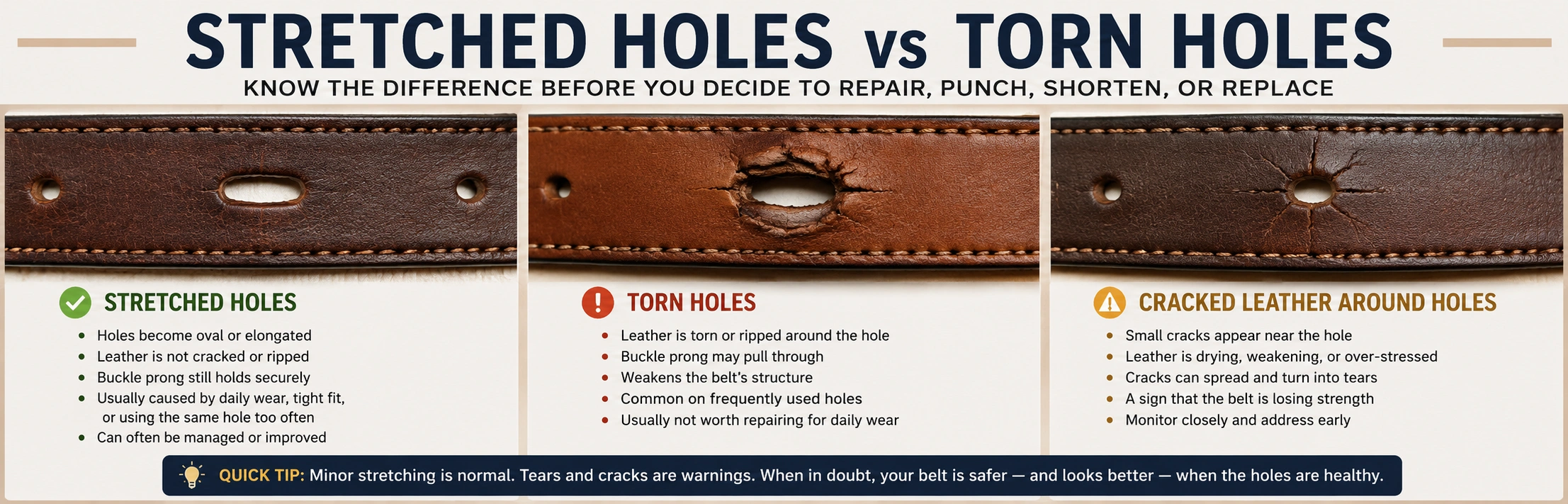
This distinction decides almost everything that follows, so it's worth being precise about.
Stretched Belt Holes
A stretched hole has lost its round shape — gone oval or elongated — but the leather itself is intact. The edges haven't split. The buckle pin still seats securely. The belt works fine, even if the fit feels a touch less precise than it used to.
This is wear, plain and simple. It happens to every belt eventually and doesn't mean the belt is finished. Worth keeping an eye on, but not a failure.
Torn Belt Holes
A torn hole is a different animal. The leather at the edge has actually separated — there's a visible split running outward, or the hole has opened enough that the pin no longer holds firmly. The structure at that point is compromised.
And here's why that matters: a torn hole doesn't recover. Every wearing loads the already-torn edge, and the tear keeps growing. A stretched hole is a warning. A torn hole is a countdown.
Cracked Leather Around The Holes
This sits between the other two. The leather hasn't torn yet, but cracking near the hole means the fibers around that stress point are already weakening. A crack next to a hole that's also stretched is a belt very close to tearing — worth addressing rather than wearing indefinitely. For what different leather cracks actually mean and which ones are fixable, see can you repair a cracked leather belt.
Can You Fix A Stretched Belt Hole?
Not really — not in the sense of making it round again. A stretched belt hole can sometimes be managed, but it usually can't be perfectly restored.
What you can do is work around it. Switch to a different hole and give the worn one a rest. Or punch a fresh hole at the right position so you stop relying on the stretched one altogether. Neither repairs the hole, but both can buy the belt real extra life.
What doesn't work is trying to compress or reshape the hole with heat or tools. Once the fibers have deformed, no practical home method puts them back.
The better question isn't whether you can fix the hole — it's what the rest of the belt looks like. If the leather is still firm and the other holes are clean, the stretched hole is a local issue and the belt has plenty left. If several holes are going, the leather feels soft overall, or the hole has started to tear, you're looking at a different situation entirely.
Can You Fix A Torn Leather Belt Hole?
A torn belt hole usually isn't worth repairing — unless the belt is decorative and no longer in daily rotation.
The core problem: any repair has to survive the exact stress that caused the tear. The pin goes through that spot again tomorrow, and the next day, with the same daily load it always carried. Glue, leather filler, and stitching can all stabilize a torn hole temporarily, but none of them rebuild the original fiber structure, and none hold up reliably under repeated mechanical stress at that specific point.
This is the common outcome with glued or stitched repairs at a hole: they look convincing once they've cured, then come apart again within a couple of weeks of daily fastening — usually starting from the edge of the repair rather than the original tear. The fix looks solid when dry. It doesn't stay solid in use.
If the torn hole is one you rarely touch, you can often just route around it and use a different hole. If it's your main fastening hole, the belt's primary stress point has failed, and replacing it is the more honest path than patching it.
Should You Punch A New Hole Instead?
Often, yes — and people reach for this option less than they should.
If the belt is in good shape overall and the real issue is fit — the hole you need falls between two existing ones, or you're a single notch off — then a new hole is exactly the right move. It fixes the actual problem without a new belt or any awkward repair.
The conditions that make it work: space the new hole evenly with the existing ones, matching the belt's original hole spacing instead of guessing by eye. Keep it far enough from the belt edge to have solid leather around it, and use a proper leather punch rather than a knife or a screwdriver. Done right, a new hole in healthy leather disappears into the belt — it looks like it was always there.
Where it doesn't work: leather that's already tearing at the other holes, or that's gone thin and soft. Adding a hole to failing leather just hands the belt another weak point at the same breaking threshold. Punch extra holes in a leather belt covers the full method and when it makes sense.
When Adding Holes Is A Good Idea
It comes down to the condition of the belt, not just the fit.
Good time to add a hole:
- The belt runs slightly large and the hole you need sits between two existing ones
- The current holes are stretched but not torn, and the leather around them is still firm
- The belt is the right width, style, and material — it just needs a small fit tweak
- You want to spread wear across a couple of holes instead of always using one
Not a good time to add a hole:
- The leather near the existing holes is cracking or starting to tear
- The belt is so long that a new hole would leave an awkwardly long tail
- Several existing holes are already noticeably stretched
- The whole strap feels thinner, softer, or more pliable than it did new
For a step-by-step home approach, add holes to your leather belt at home walks through the options.
When You Should Shorten The Belt Instead
Punching a hole fixes a fit problem inside the belt's range. It doesn't fix a belt that's simply too long.
If the tail hangs well past the first loop even on the tightest existing hole, adding holes at the tight end gives you a better fastening point but leaves that long tail flapping. The proportions stay wrong no matter how many holes you add.
In that case, shortening from the buckle end is the cleaner fix. You pull the buckle, trim the excess from the buckle side — not the tail — and reinstall the hardware. On any belt with a removable buckle, which most quality belts have, it's a straightforward job. Shorten a leather belt has the full walkthrough.
A simple rule of thumb: one notch too loose, punch a hole. Two or more notches too loose with an obviously long tail, shorten it. Significantly oversized in every dimension, replace it with the right size — that beats any modification.
When Belt Hole Damage Means It's Time To Replace The Belt
The Main Hole Is Torn
The hole you fasten daily has structurally failed. It's the belt's most critical load point, and once it tears, the belt isn't dependable for everyday use anymore.
Several Holes Are Stretched
When it's a pattern rather than a single hole, the problem isn't that one spot — it's that the leather lacks the density or thickness to hold up under normal use. Switching holes won't change the material.
Cracks Are Spreading Around The Holes
Cracks near holes mean the fibers at those stress points are weakening. Cracks that are actively spreading mean the decline is ongoing, not settled.
The Leather Feels Thin, Soft, Or Brittle
Leather that's lost its firmness has less material to resist the forces at the holes. Any new hole you punch will stretch faster than the originals did.
The Buckle Pin Is Pulling Through
This is the end stage — the hole edge no longer stops the pin from migrating outward. A belt in this state can fail without warning and isn't safe to keep relying on day to day.
For the broader signs that a belt has reached genuine end-of-life, see when to replace a leather belt.
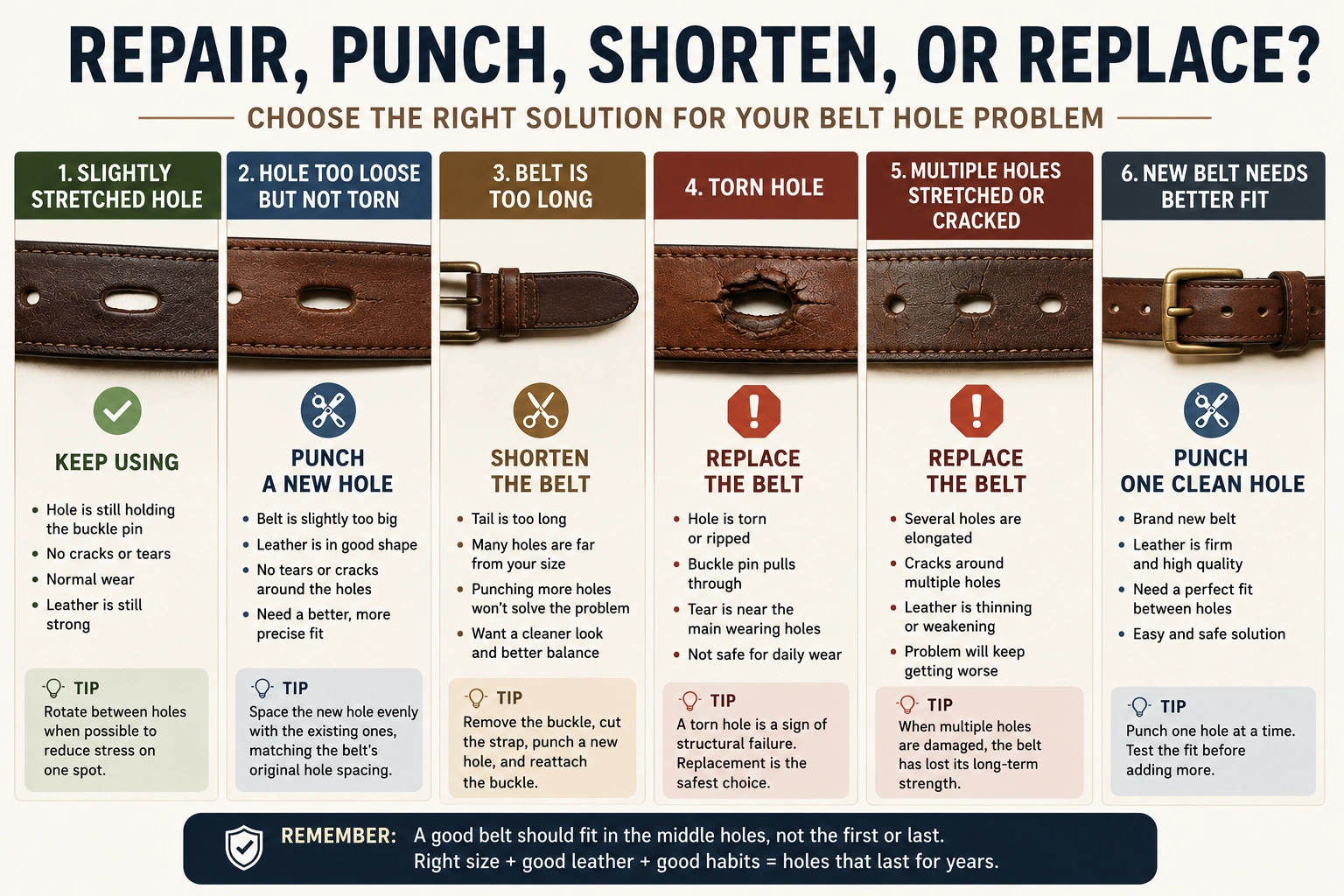
How To Prevent Belt Holes From Stretching Again
Choose The Right Belt Size
Ideally the belt fastens near the middle hole of its range. Living on the first or last hole concentrates more stress at that edge position than the belt was designed to take. The belt size chart [CHECK URL] covers how to size correctly the first time.
Don't Overtighten Your Belt
A belt should hold your pants comfortably, not compress your waist. Every notch tighter than comfortable is extra daily tension on that hole.
Rotate Between Holes When Possible
If the fit gives you a little room, alternate between two adjacent holes instead of hammering the same one. It spreads the load.
Choose Stronger Leather
Full-grain leather at 4mm or thicker has more fiber depth at the holes than thin or low-grade leather — more material to resist deformation right where the pin presses.
Keep The Belt Dry And Clean
Sweat and lingering moisture soften leather exactly at the holes, the spots most exposed to contact. An occasional wipe-down and natural drying — rather than wearing it through soaking conditions — pays off over the years.
Use A Proper Belt Punch
If you're adding holes, a real leather punch makes a cleaner, structurally sounder hole than anything you'd gouge out with a blade. Clean holes last longer.
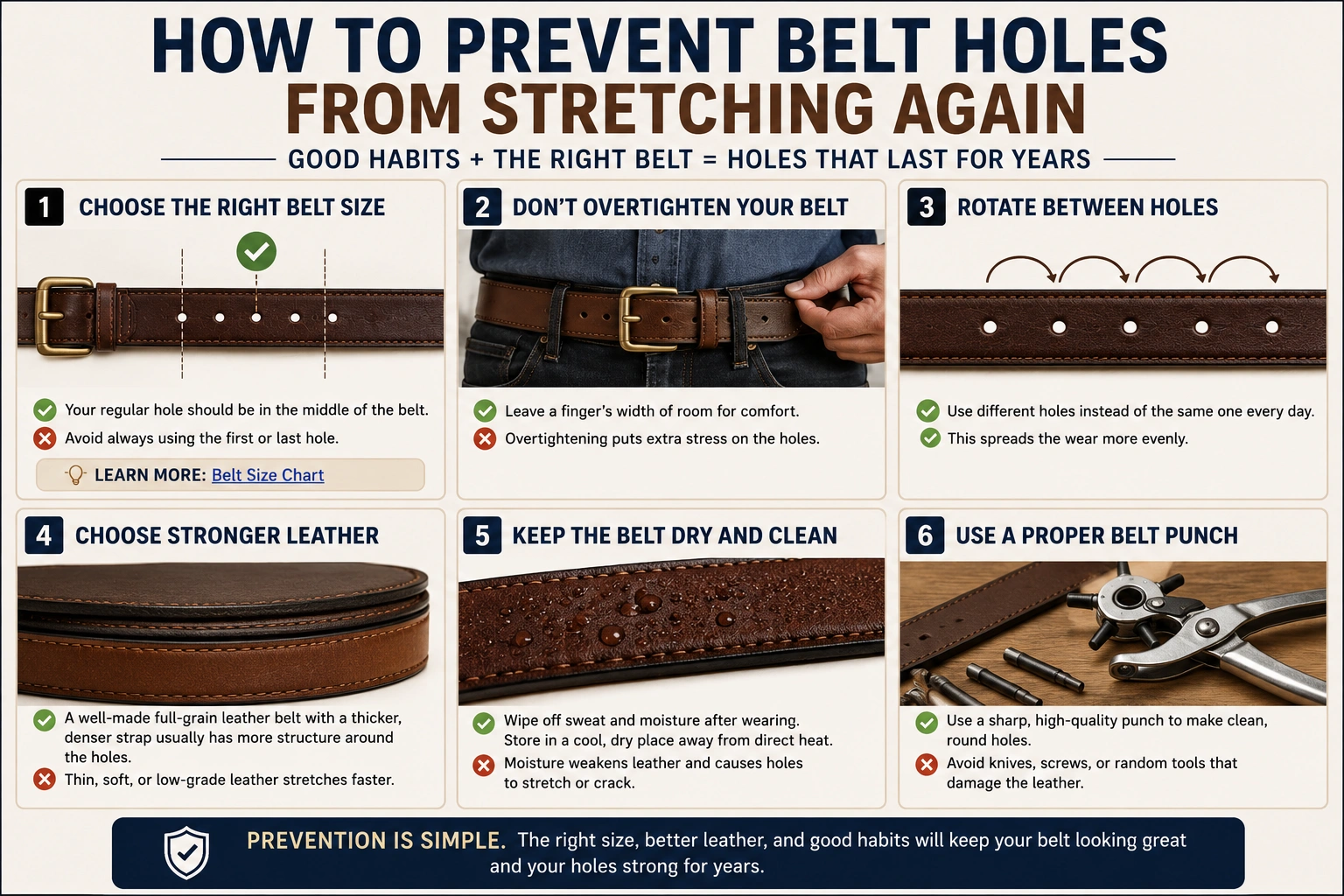
Repair, Punch, Shorten, Or Replace? A Simple Decision Guide
| Belt Hole Problem | Best Action | Why |
|---|---|---|
| Slightly stretched, still holds | Keep using or condition lightly | Normal wear if leather is still strong |
| Loose fit but not torn | Try another hole or add a new one | Fit is just slightly off |
| Belt is too long overall | Shorten from the buckle end | New holes won't fix a long tail |
| Main hole is torn | Replace the belt | Primary stress point has failed |
| Cracks around several holes | Replace the belt | Leather structure is weakening |
| Multiple holes stretched | Check size and leather quality | Not a single-hole problem |
| Belt healthy, fit slightly off | Add a clean new hole | Good option when leather is strong |
Final Verdict: Are Damaged Belt Holes Fixable?
Lightly stretched holes are fine to keep using, and a clean new hole can sharpen the fit when the leather's still healthy.
Torn holes are a different story. They're rarely worth repairing, because they sit at the most critical load point on the belt — and any patch has to survive the same stress that tore them in the first place.
So the honest answer depends on what you're looking at. A single oval hole on an otherwise solid belt? Manage it, or punch a fresh one. A torn main hole, cracks spreading across several holes, or a pin starting to pull through? That's the belt telling you it's done — and the better move is a new one, sized correctly and built from leather with enough structure to hold its holes for the long haul. If you're replacing rather than repairing, starting with a properly sized leather belt in a denser full-grain leather is the surest way to avoid landing back here a year from now.
Frequently Asked Questions
Can you fix a stretched belt hole?
You can work around it — use a different hole, or add a new one at a better spot — but the stretched hole itself won't return to its original shape. The fibers have deformed and don't reset through any practical home method. Whether it matters depends on how far it's stretched and whether the belt still fastens securely there.
Can you repair a torn leather belt hole?
Usually not reliably for daily wear. Glue, filler, and stitching can stabilize a tear temporarily, but the repair has to survive the same daily stress that caused it, and most fail within weeks of regular use. If the torn hole isn't the one you use daily, routing around it is often the more practical move.
Why do my belt holes stretch so fast?
Most often it's wearing the belt too tight, sitting on the edge-of-range hole because the belt's slightly too big, leather that's too thin or soft to resist deformation, or just cumulative daily use on one hole over years. Holes stretching noticeably within a year or two usually points to the leather thickness or grade.
Should I punch a new hole or buy a smaller belt?
If the belt's only slightly off and the leather's in good shape, a new hole is a fine fix. If it's significantly too large — long tail, multiple stretched holes, two or more notches off — sizing down gives the better result.
Is it bad to use the same belt hole every day?
Not immediately, but it does concentrate wear at one spot. If the belt fits right and you're on the middle hole, it's mostly fine over a normal timeline. If you're stuck at the edge of the range, that hole takes more stress than it should and tends to go faster.
When should I replace a belt with damaged holes?
When the main daily hole has torn, when several holes are noticeably stretched, when the leather around the holes is cracking or thinning, or when the pin is starting to pull through rather than seating securely. At that point, modification won't change the underlying material — replacement is the better call.