A good leather belt can last for years.
Some last a decade or more — full-grain leather, properly cared for, has that kind of staying power built in.
But every belt reaches a point where repairs stop making sense. The hard part isn't noticing that something's wrong. It's knowing the difference between normal aging — which is fine, expected, even attractive on quality leather — and the kind of damage that actually means the belt is done.
Most belts don't fail all at once. They fail gradually, and the signs are visible well before the belt stops working entirely. Here's what those signs actually look like, and how to tell whether you're looking at something repairable or something that's reached the end of the line.
How Long Should A Quality Leather Belt Last?
The honest answer depends almost entirely on what the belt is made from — not its age in years, but its construction.
Bonded leather — leather scraps and fiber held together with polyurethane binder — typically shows real failure within one to two years of regular use. The binder has its own lifespan, separate from the leather it's holding together, and once it starts to go, it tends to go across a wide area rather than one isolated spot.
Genuine leather, which covers a broad range of quality, generally performs for a few years before showing meaningful wear. Where exactly it falls in that range depends on the specific grade and thickness — genuine leather isn't one material, it's a category.
Corrected grain leather tends to hold up longer than genuine leather generally, often performing well for several years with reasonable care.
Full-grain leather, given basic periodic conditioning, frequently lasts a decade or more. The dense, intact fiber structure resists the stretching and cracking that affects lower grades much sooner.
The full breakdown of what drives these differences is in how long leather belts last. But the practical point here is this: age alone tells you almost nothing. A three-year-old bonded leather belt and a three-year-old full-grain belt are in completely different stages of their respective lifespans. What matters is condition, not the number of years on the calendar.
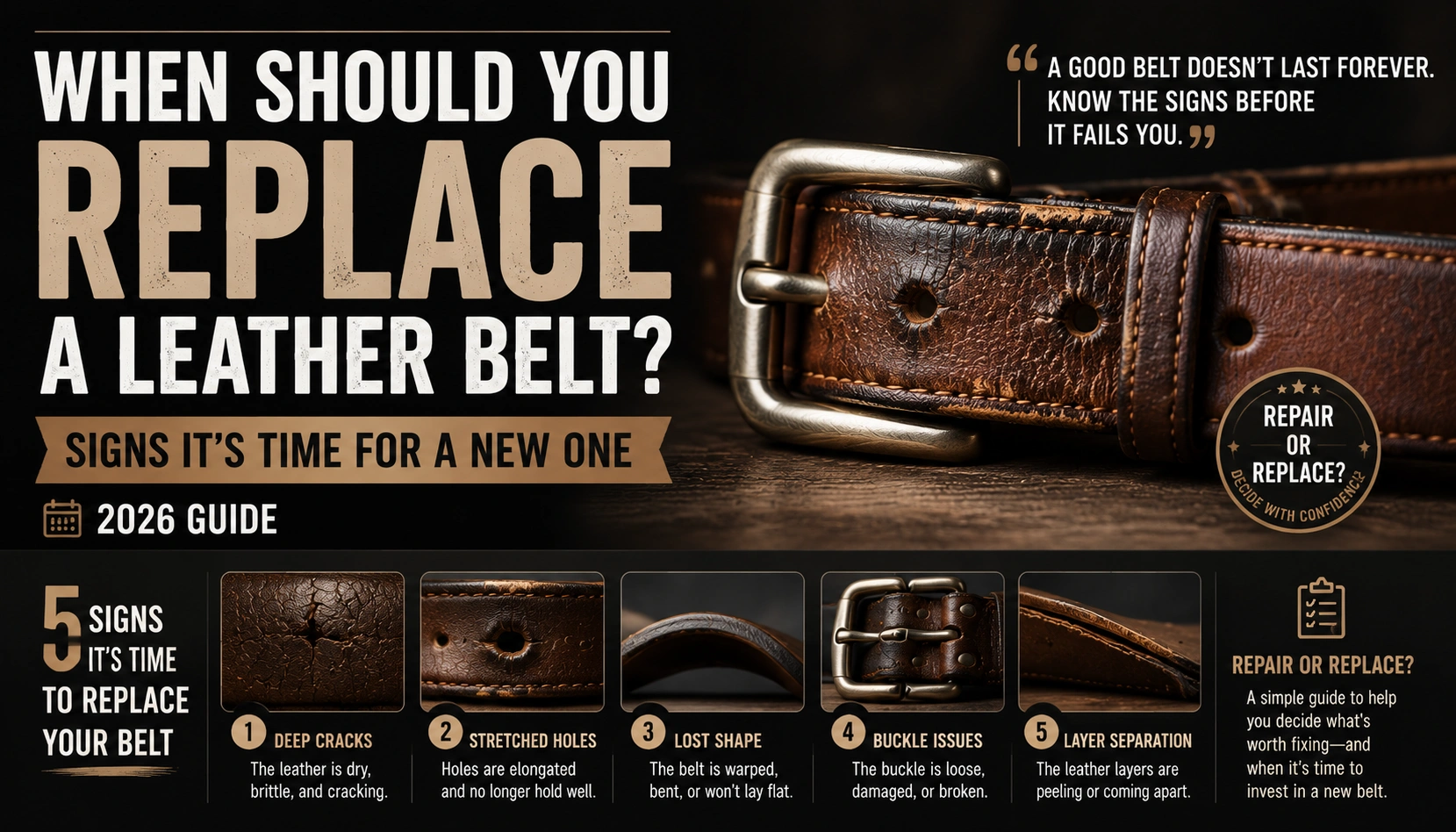
5 Signs It's Time To Replace Your Leather Belt
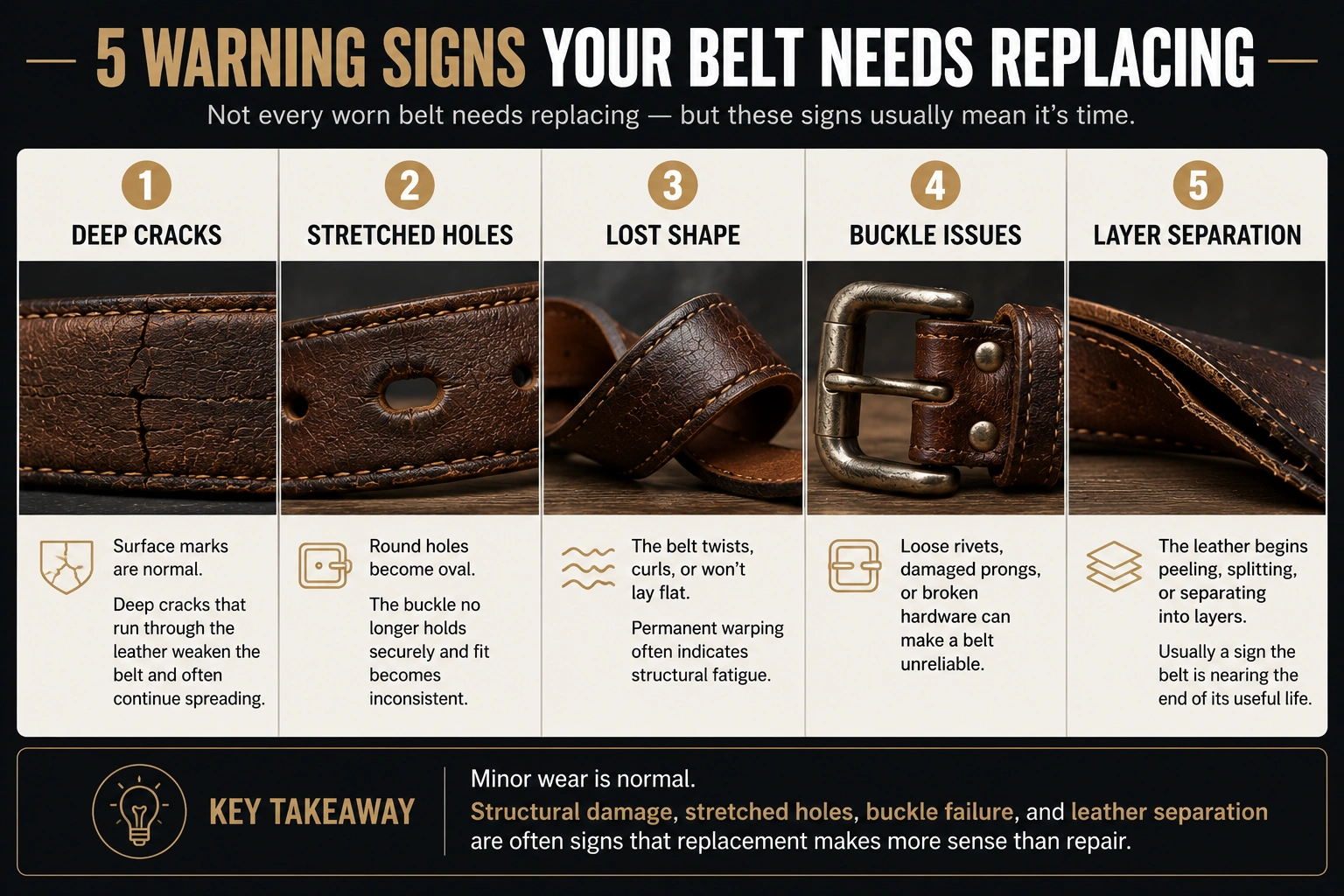
These are the indicators that actually matter — not cosmetic changes, but signs that the belt's structural integrity has been compromised.
Deep Cracks Across The Leather
Not the fine surface lines that sometimes appear at the buckle fold from normal flexing — those are often a dryness issue that conditioning can address. Deep cracks are different. They open up visibly when the belt flexes, sometimes showing a lighter color underneath or an actual gap in the material.
This level of cracking means the fiber structure itself has separated, not just the surface. Conditioning the leather around it can keep the rest of the belt healthy, but it won't rebuild fibers that have already broken apart at that point.
Belt Holes Are Permanently Stretched
Every hole on a belt eventually shows some wear from the buckle pin pushing through it repeatedly — that's normal, and usually cosmetic at first. The problem starts when the most-used hole has stretched into a clear oval, or worse, when the buckle pin no longer holds securely in it.
At that stage, the belt isn't reliably doing its one job — staying fastened. This is the mechanism covered in detail in why belt holes stretch and tear, and it's worth checking: is it just the most-used hole that's affected, or has the leather around it actually torn? One is wear. The other is failure.
The Belt Has Lost Its Shape
A belt that's developed a permanent curve, a twist, or won't lie flat anymore has likely been stored or worn in a way that's set that shape into the leather fibers permanently. Some of this is reversible with conditioning and careful reshaping. Significant warping — where the belt visibly curls or won't sit straight when worn — usually isn't.
This is different from the natural softening and slight shape-taking that happens as quality leather molds to how you wear it. That kind of change is patina. A belt that's genuinely warped looks wrong even when it's not being worn.
The Buckle No Longer Functions Properly
A loose buckle pin, a Chicago screw that won't stay tight, hardware that's visibly corroded or cracked — these are mechanical failures, not cosmetic ones. The buckle bears real load every single day, and once the attachment point or the pin itself is compromised, the belt's basic function is at risk.
⚠️ Worth checking specifically: does the buckle pin sit firmly in the hole, or does it feel loose even when freshly fastened? A pin that doesn't engage securely is a sign the buckle mechanism itself has failed, independent of the leather's condition.
The Leather Layers Are Separating
This shows up almost exclusively on belts built from layered construction — multiple thinner pieces of leather glued together rather than cut as a single strap. Over years of flexing and moisture exposure, the adhesive bond between those layers eventually fails. You'll see it at the edges first: a visible gap, a slightly spongy feel when you press the belt, layers that have started to peel apart.
This kind of damage doesn't reverse. Once the bond has failed, it continues to separate with continued use.
Can A Damaged Leather Belt Be Repaired?
It depends entirely on which of the five signs above you're looking at — and how far it's progressed.
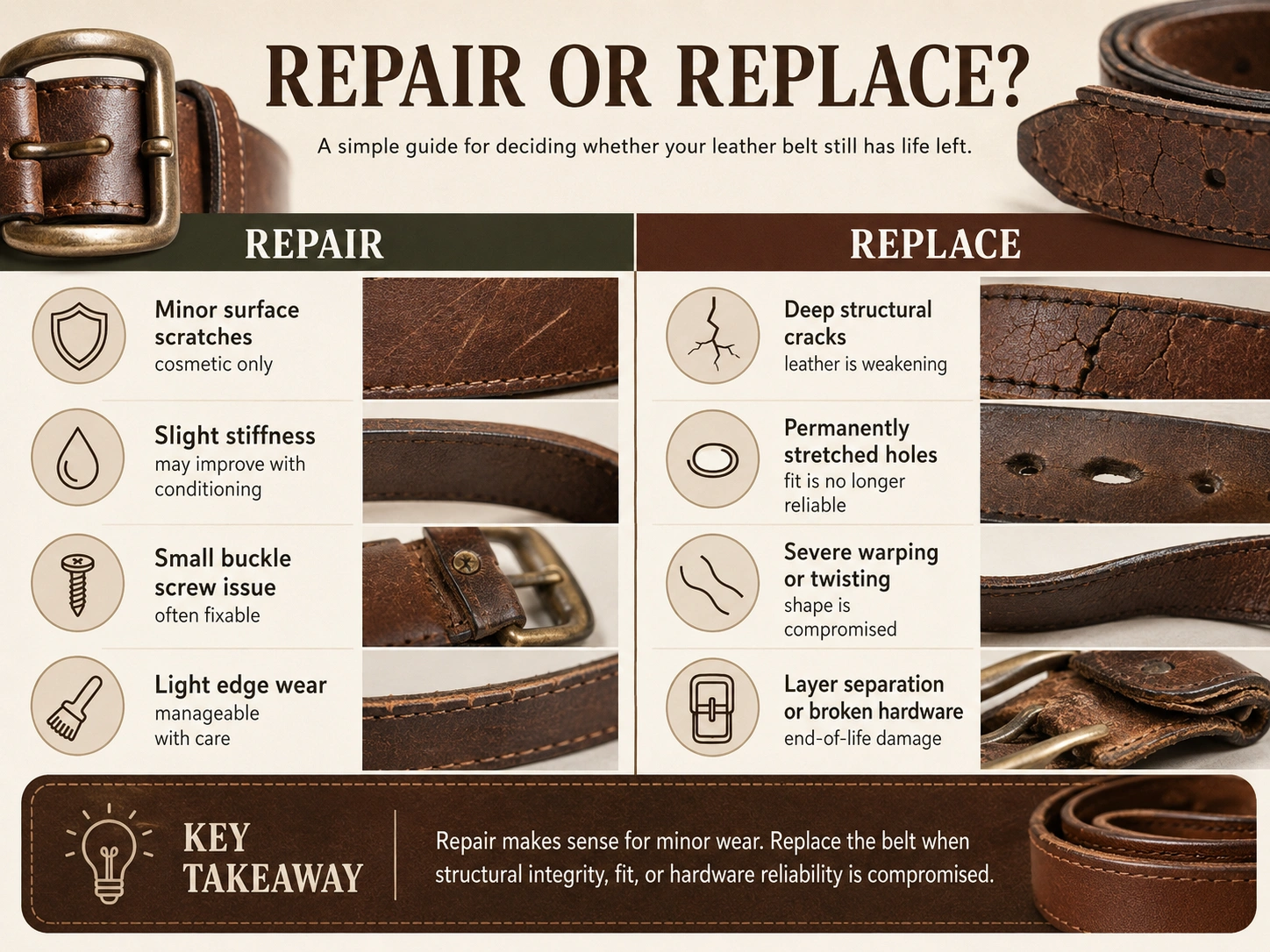
Things that often can be improved: Early surface cracking from dryness responds well to conditioning, which restores some of the oils the leather has lost and can meaningfully reduce stiffness and the appearance of fine lines. A slightly stretched hole, caught before it tears, can sometimes be carefully re-rounded with a leather punch. A buckle pin that's loosened slightly can often be tightened or reseated.
Things that generally can't be reversed: Deep structural cracks where the fiber has actually separated. Holes that have torn rather than just stretched. Layer delamination, once it's started. A buckle mechanism that's structurally cracked rather than just loose.
The honest distinction is between maintenance and repair. Conditioning, minor adjustments, and careful re-rounding of a hole are maintenance — they keep a belt that's still fundamentally sound performing well. True repair of structural damage — rebuilding separated fibers, reattaching delaminated layers — isn't really possible with leather the way it might be with some other materials. Once that threshold is crossed, you're managing decline, not fixing the problem.
Repair Or Replace? A Simple Decision Guide
Minor crack, caught early, leather otherwise supple → Condition and monitor. This is maintenance territory. A conditioner application now can prevent the crack from progressing and may improve the appearance somewhat.
One stretched hole, rest of the belt in good shape → Punch a new hole or monitor. If the stretching hasn't progressed to tearing, this is often just a sign the belt needs a hole adjustment, not replacement. Punching a new hole nearby is frequently the right call here.
Deep crack, visible gap when flexed → Replace. This is structural damage that conditioning won't reverse. The belt may still be wearable depending on where the crack is located, but it's on a clock.
Multiple holes torn or stretched beyond function → Replace. When the damage isn't isolated to one hole but is showing up across the belt, that's a sign the underlying leather quality or thickness wasn't sufficient for how the belt was used — and the same problem will likely recur with any new hole you add.
Layers separating at the edges → Replace. This doesn't reverse and tends to worsen with continued use. There's no maintenance step that addresses delamination.
Buckle mechanically failing (cracked, won't hold tension) → Replace, or have the buckle professionally swapped if the leather itself is otherwise in excellent condition. A cobbler can sometimes replace just the buckle hardware on a quality belt, which is worth considering if the leather is genuinely still in good shape.
When Keeping An Old Belt Becomes A Problem
It's not just about appearance. A belt that's reached genuine end-of-life creates problems beyond looking worn.
Comfort suffers first, often before anyone notices why. A belt that's lost its flexibility from years of dryness sits stiffer against the body, and one that's developed an uneven shape doesn't distribute pressure evenly around the waist the way it should.
Reliability is the more practical concern. A belt with a stretched or torn hole doesn't hold its fastening position securely — which means it can loosen unexpectedly during the day. A buckle with a compromised pin is a failure waiting for the wrong moment to happen.
Appearance, while real, is actually the least important of the three. A belt that's developed genuine patina — darkened, softened, slightly textured from years of honest use — often looks better than it did new. The appearance problem only becomes relevant once the leather has crossed from patina into actual deterioration: dull, cracked, or visibly damaged rather than aged.
The practical test: if the belt is still comfortable, still holds securely, and the changes you're seeing are about color and texture rather than function — it's fine. If any of those three things has actually broken down, it's time.
How To Make Your Next Belt Last Longer
Whatever replaces the old belt, a few habits make a meaningful difference in how long the next one lasts.
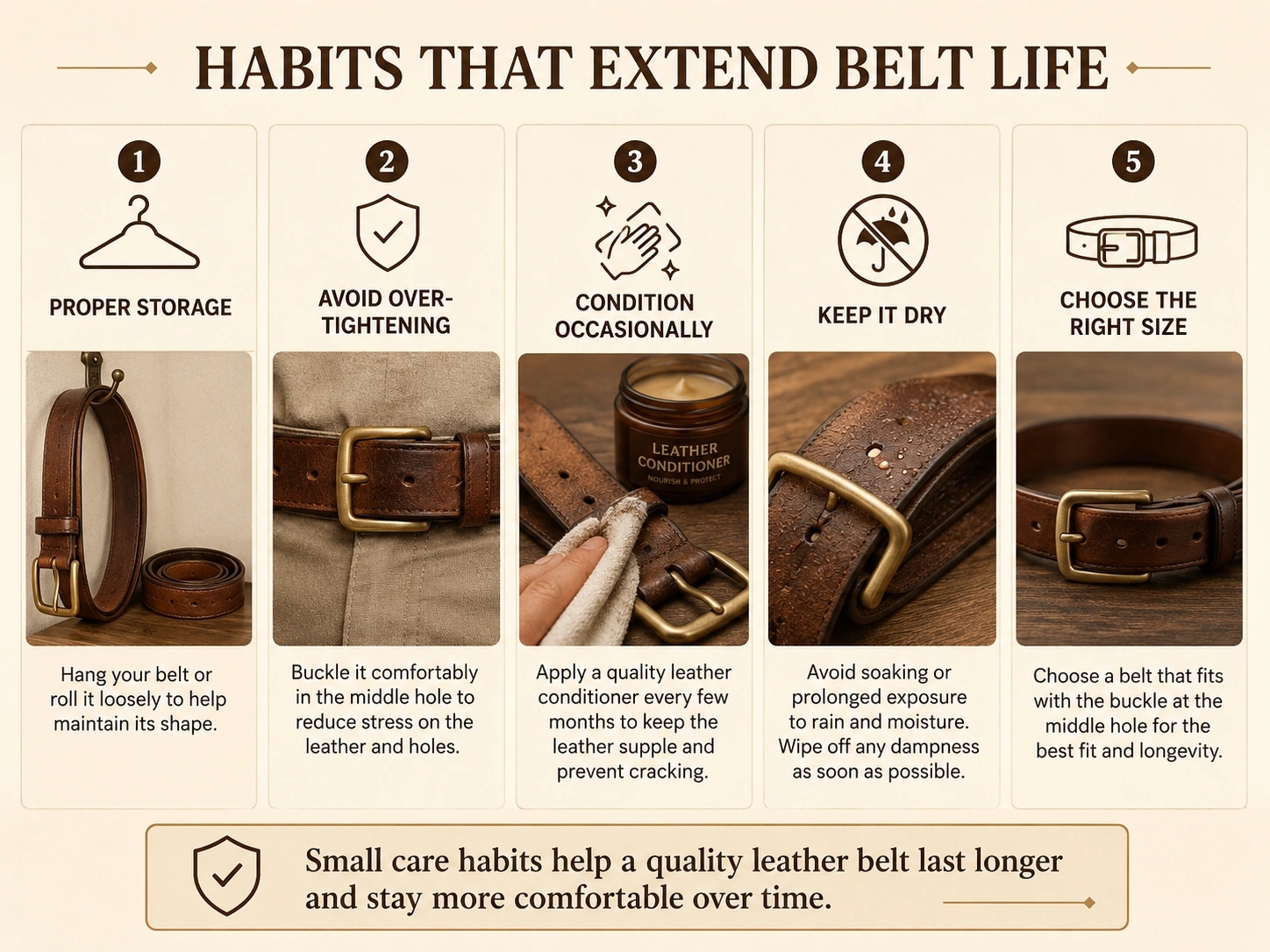
Keep it conditioned, but not over-conditioned. Leather needs periodic oil replenishment to stay flexible and resist the dryness that leads to cracking. The leather belt care guide covers how to tell when conditioning is actually needed versus when the leather is already in good shape.
Handle water exposure correctly. A belt that gets caught in the rain isn't ruined by the water itself — it's the drying process afterward that determines the outcome. Quick heat-drying causes far more damage than the original wetting. The guide to leather belts getting wet covers the right way to handle this.
Choose appropriate thickness for how you'll actually use it. A belt that's too thin for daily wear shows hole wear and fold cracking earlier than one built with enough material for the job. The belt thickness guide breaks down what thickness suits which use case.
Avoid chronic overtightening and rotate if possible. Every extra tension cycle on the most-used hole adds up over years. Splitting wear between two belts roughly halves the annual stress on each one's high-wear points.
Store it hanging, not tightly coiled. A belt coiled tightly around its buckle for long periods can develop a permanent crease at the fold — exactly the kind of shape distortion that shows up later as a replacement-worthy sign.
What To Look For When Replacing A Leather Belt
When the old belt has genuinely reached the end, the specifications that determine whether the next one lasts:
Full-grain leather — the dense fiber structure at the outer hide resists the cracking, hole stretching, and general deterioration that lower grades show much sooner. This is the single biggest factor in long-term durability.
Around 4mm thickness — enough material at the stress points (holes, buckle fold) to handle daily use without the kind of premature wear that thinner leather shows.
Solid brass or steel hardware — buckles that age rather than fail. Plated alloy hardware is where mechanical buckle failure most often originates.
Single-piece construction — no adhesive bonds between layers that can eventually separate.
Correct sizing — fastening at the middle hole, which puts mechanical stress where the belt was designed to handle it rather than at the edge of its range.
At KKICO, we focus on these fundamentals because they directly affect how long a belt remains comfortable and dependable — not just how it looks on day one.
Frequently Asked Questions
How long should a leather belt last?
It depends heavily on the leather grade. Bonded leather often shows real failure within one to two years. Genuine leather typically lasts a few years before meaningful wear appears. Full-grain leather, with basic periodic conditioning, frequently lasts a decade or more. Age in years matters far less than leather grade, thickness, and how well the belt has been cared for.
Can cracked leather belts be repaired?
It depends on the type of crack. Fine surface cracking from dryness often improves significantly with conditioning — the leather softens and the appearance can recover meaningfully, though existing lines won't fully disappear. Deep structural cracks, where the fiber has actually separated, cannot be reversed. Conditioning can prevent the surrounding leather from deteriorating further, but it won't rebuild what's already broken.
Should I replace a belt with stretched holes?
Not necessarily, and it depends on severity. A single stretched hole on an otherwise sound belt can often be addressed by punching a new hole nearby. If the stretching has progressed to actual tearing, or if multiple holes are showing significant wear, that's a stronger sign the belt has reached the end of its useful life — particularly if the underlying leather grade or thickness wasn't sufficient for how the belt was used.
How do I know if a belt is worn out?
Look for function, not just appearance: does the buckle hold securely? Do the holes still hold the pin firmly? Is the leather still flexible rather than stiff or cracking? If the belt still performs its basic job reliably and the changes you're seeing are color and texture from normal aging, it's not worn out — it's developing patina. If the buckle, holes, or leather structure have actually failed, it is.
Is it worth repairing an old leather belt?
For minor issues — dryness, slight stiffness, a single stretched hole — yes, conditioning and small adjustments are worth doing and often meaningfully extend the belt's useful life. For structural damage — deep cracks, torn holes, separating layers, a mechanically failed buckle — repair generally isn't possible in any lasting sense, and replacement is the more practical choice.
What causes leather belts to fail?
Most belt failure traces back to a combination of factors: lower-grade leather with a looser fiber structure, leather that's dried out from lack of conditioning, concentrated stress at the most-used hole and the buckle fold from daily use, and in some cases construction issues like layered leather that eventually separates. The leather grade and thickness chosen at purchase largely determine how long the belt holds up before any of these become a problem.