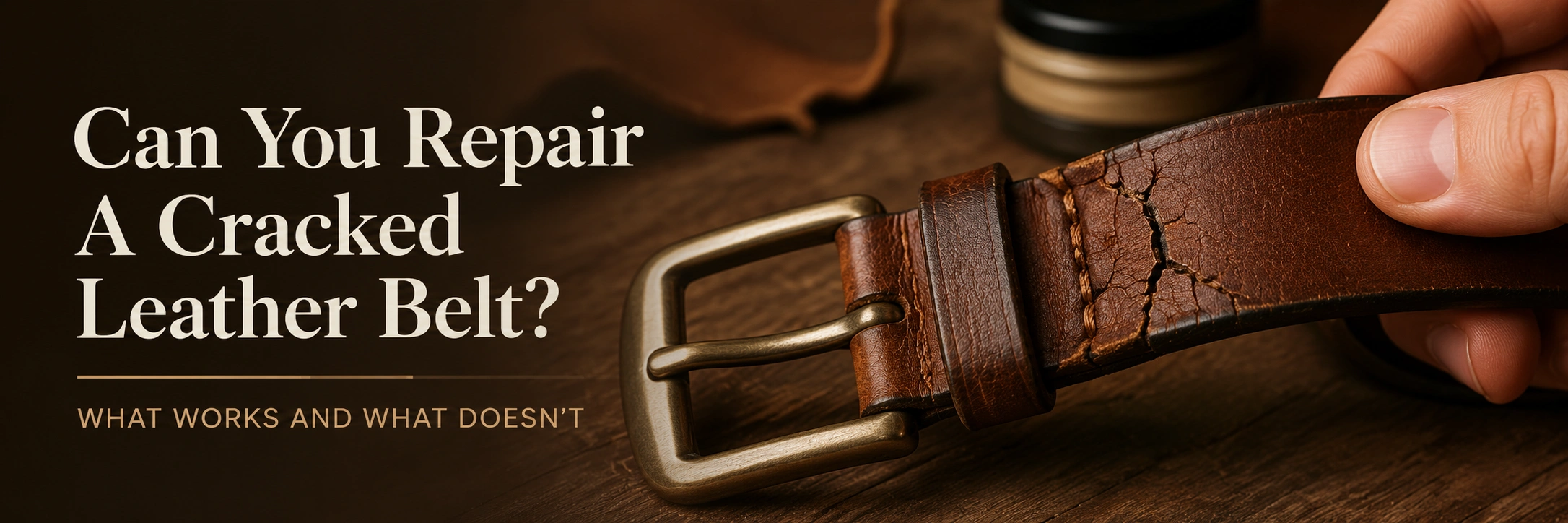
You notice it while putting the belt on — a thin line across the surface near the buckle fold, maybe a little rough to the touch. Or it's been there for a while and you've just been ignoring it, hoping it doesn't get worse.
Now you're wondering: can this actually be fixed? Or is this belt done?
A cracked leather belt can sometimes be improved — but not every cracked belt can be truly repaired. The honest answer depends entirely on what kind of crack you're looking at, and that distinction is where most of the confusion lives.
This guide walks through what actually works, what doesn't, and how to tell which category your belt falls into.
Can A Cracked Leather Belt Be Repaired?
The short version: sometimes, partially, and it depends on depth.
What conditioning and care can do: improve the appearance of light surface cracking, restore flexibility to leather that's gotten dry and stiff, and slow or stop the progression of early-stage cracks before they become something worse.
What it can't do: reverse fiber damage that's already happened. Leather fibers that have actually separated don't reconnect — no conditioner, oil, or treatment rebuilds broken structure. Once a crack has opened deep enough to show a gap or a lighter color underneath, you're managing the situation, not fixing it.
🔑 The quick test: flex the belt gently at the cracked area. If the crack is shallow and the leather still bends smoothly around it, conditioning is worth trying. If the crack opens visibly when flexed, or the leather feels stiff and brittle right at that point, you're past the stage where conditioning helps.
Why Leather Belts Crack In The First Place
Understanding the cause tells you something about whether this is likely to be a one-time issue or a sign of something ongoing.
Dry leather fibers. Leather contains natural oils that keep the fiber structure flexible. Over time — faster in dry climates, with sun exposure, or simply from going long stretches without conditioning — those oils diminish. The leather that's left is technically the same material, just stiffer and considerably more prone to cracking under normal flexing.
Low-quality or bonded leather. Bonded leather — leather scraps bound with polyurethane and pressed onto a backing — doesn't have the continuous fiber structure that solid leather does. It's prone to surface failure that often looks like cracking but is really a coating breaking down. Heavily corrected genuine leather, where a thick finish is doing most of the visual work, has a similar vulnerability once that finish starts to age.
Repeated bending at the same point. The fold where the belt bends through the buckle flexes every single time the belt goes on or comes off — hundreds of times a year. That's concentrated, repetitive stress on one specific crease line, and it's almost always where cracking shows up first.
Heat, sweat, rain, and poor storage. Direct sun, a hot car interior, indoor heating in winter, and tight coiling around the buckle for long periods all accelerate the drying process that leads to cracking. None of these cause damage instantly — they compound quietly over months.
The mechanics behind all of this are covered in more depth in why leather belts crack, if you want the full picture.
Surface Cracks vs Deep Cracks: Know The Difference
This distinction is the single most useful thing in this entire guide, because it's what actually determines the outcome.
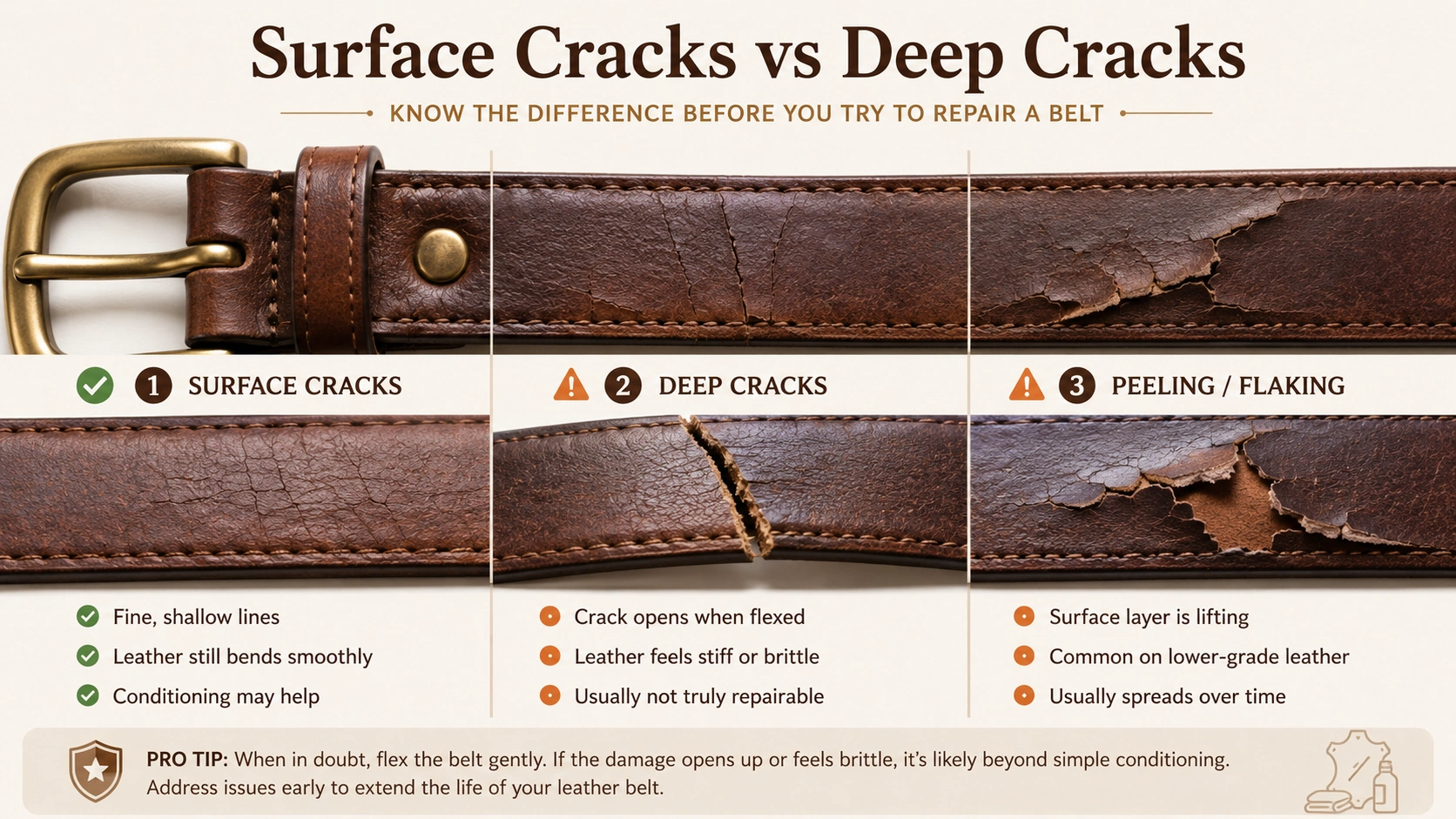
Surface cracks are fine, shallow lines — usually at the buckle fold, sometimes near a frequently used hole. The belt is still flexible overall. When you bend it, the crack doesn't open into a visible gap. This is typically a dryness issue, and it's the stage where conditioning genuinely helps.
Deep cracks look and feel different. The crack opens visibly when the belt flexes — sometimes showing a lighter color underneath, sometimes an actual gap in the material. The leather around it often feels stiff or brittle rather than supple. This is structural damage. The fiber has separated, not just the surface finish.
Peeling or flaking is a related but separate problem. This is the surface coating — present on bonded leather and many corrected-grain leathers — lifting away from the material underneath, usually starting at an edge or a stress point. It's not technically a crack in the leather itself; it's a finish failure. But it behaves the same way practically: once it starts, it spreads, and there's no fixing it.
Knowing which of these three you're dealing with is the difference between "this is fixable" and "this belt is on its way out."
How To Fix Minor Cracks In A Leather Belt
If you've checked and you're dealing with surface-level cracking, here's the process that actually works.
Step 1: Clean the belt gently. Wipe the leather down with a dry or slightly damp soft cloth to remove dust, sweat residue, and surface grime before conditioning. Conditioning over dirt just traps it against the leather.
Step 2: Apply a small amount of leather conditioner. Less is more here. Apply a small amount to a soft cloth and work it into the leather, paying particular attention to the cracked area and the surrounding leather. Don't saturate the surface — a thin, even layer does more good than a heavy application.
Step 3: Let it absorb naturally. Set the belt aside at room temperature and give it at least 20–30 minutes to absorb. Avoid hair dryers, radiators, or direct sunlight to speed this up — heat-forcing the process is part of what causes cracking in the first place, and it works against you here too.
Step 4: Buff the surface. Once the conditioner has absorbed, use a clean dry cloth to buff the leather lightly. This removes any excess product and brings up a slight, even sheen.
Step 5: Repeat only if needed. If the leather still feels dry after the first application, a second light pass a day or two later is reasonable. Don't over-condition in the same session — leather that's saturated with too much oil softens past the point of holding its shape well, which creates a different problem.
I'd recommend checking the result after a few days rather than judging immediately — the improvement in flexibility often becomes more apparent once the conditioner has fully settled into the fiber structure.
What You Should Not Do To A Cracked Leather Belt
A few specific mistakes come up often enough to call out directly.
Do not soak it in oil. More conditioner doesn't mean more repair. Oversaturating leather with oil softens the fiber structure past a healthy point, and the belt can lose its shape and structural firmness as a result. A thin, even application is always better than a heavy one.
Do not use shoe polish as a real repair. Polish can mask discoloration around a crack, but it does nothing for the underlying fiber damage. It's cosmetic, and it can actually make the crack harder to monitor because it's now hidden under a colored layer.
Do not glue deep cracks and expect it to last. Adhesive can hold a crack together temporarily, but the belt is still under the same daily flexing stress that caused the crack in the first place. The glued section becomes a new weak point, and it tends to fail again — often worse — under normal wear.
Do not keep wearing a belt that's tearing at the holes. A hole that's torn rather than just stretched means the leather right at your most critical stress point has already failed structurally. Continuing to wear the belt risks a sudden failure — the buckle pin pulling through entirely — at an inconvenient moment, which is a different and more immediate problem than a crack elsewhere on the strap.
When A Cracked Leather Belt Is No Longer Worth Repairing
The cracks are near the holes. The hole area is the belt's primary stress point — it's where the buckle pin bears load with every single fastening. Cracking here isn't just cosmetic; it's happening exactly where the belt can least afford structural weakness.
The belt feels hard and brittle overall. If the stiffness isn't localized to one spot but extends across most of the strap, that's not a single dry patch — it's the whole belt having lost its oil content and flexibility. Conditioning a small area won't address a problem that's belt-wide.
The leather is peeling or separating. As covered above, this is usually a finish or construction issue rather than something conditioning can touch. Peeling spreads. Layer separation doesn't reverse.
The buckle area is tearing. This is the highest-stress location on the entire belt, flexing every single day. Tearing here means the belt's most mechanically demanding point has already failed — and that's not a spot you want to be relying on after it's shown structural weakness.
It looks bad even after conditioning. If you've gone through the repair steps and the belt still looks rough, feels stiff in places, or the crack is still visibly open — that's useful information. The leather has told you it's past the point where care alone fixes things.
For more detail on the broader signs that a belt has reached genuine end-of-life — not just cracking, but stretched holes, buckle failure, and lost shape — see when to replace a leather belt.
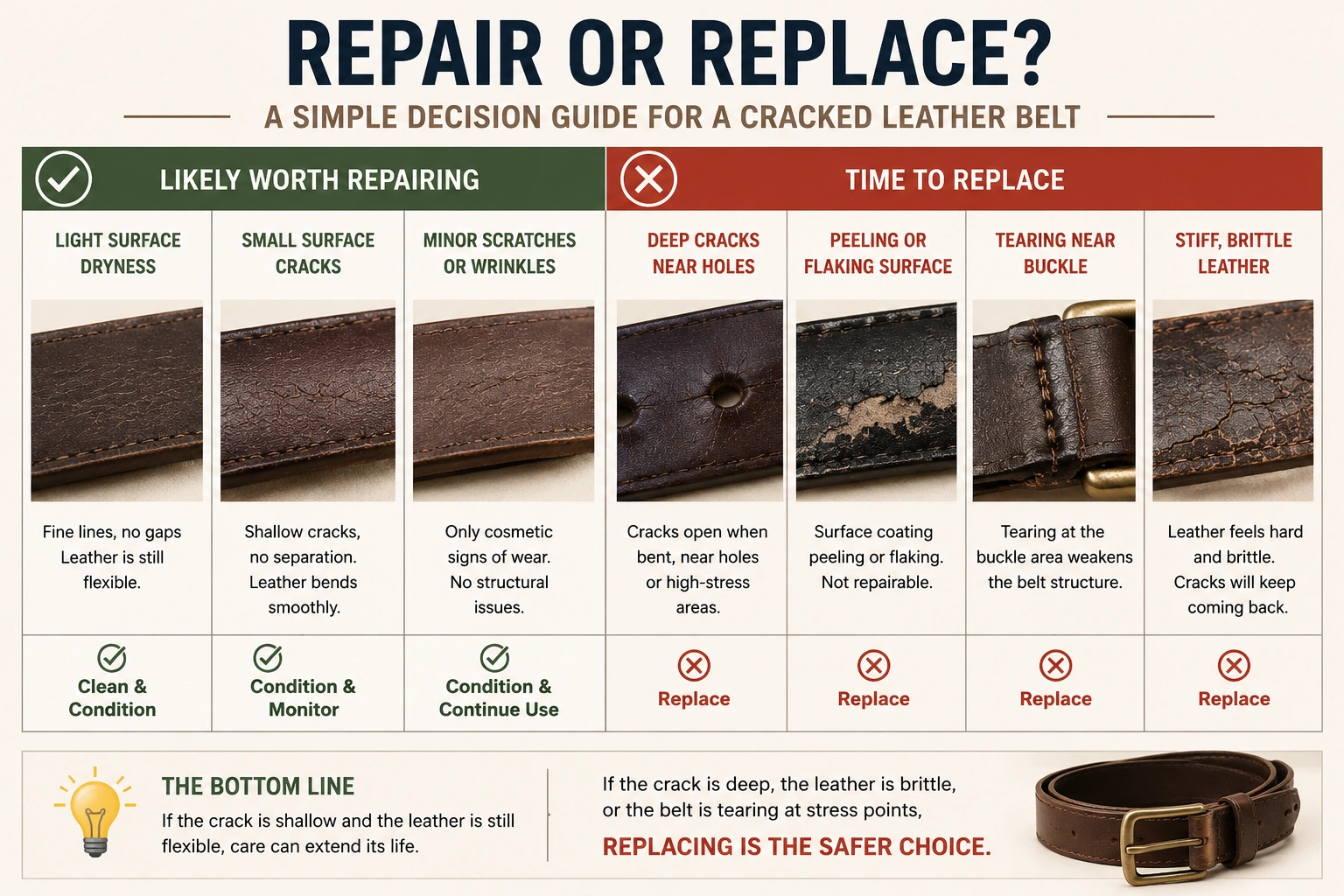
Repair Or Replace? A Simple Decision Guide
| Belt Condition | Repair It? | Best Action |
|---|---|---|
| Light surface dryness | Yes | Clean and condition |
| Small surface cracks | Maybe | Condition and monitor |
| Deep cracks near holes | No | Replace |
| Peeling surface | No | Replace |
| Tearing near buckle | No | Replace |
| Stiff and brittle leather throughout | Usually no | Replace |
| Minor scratches on full-grain leather | Yes | Condition, or leave as character |
That last row is worth a quick note: surface marks and light scratches on full-grain leather often aren't damage at all — they're the early stages of patina, and they tend to soften into the leather's surface character with continued use rather than needing any intervention.
How To Prevent Your Next Leather Belt From Cracking
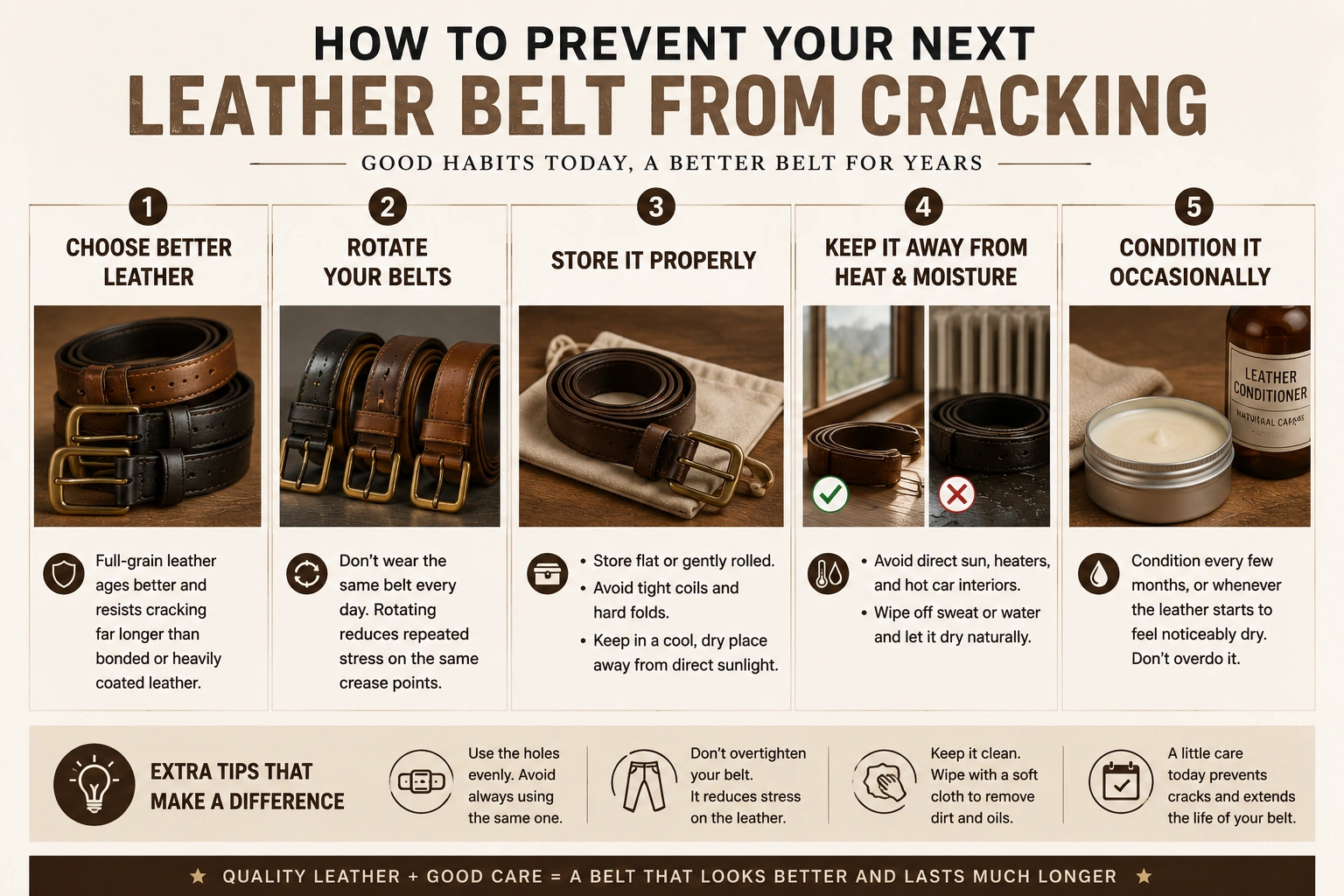
Choose better leather from the start. Full-grain leather generally ages better than corrected, bonded, or heavily coated leather, because the dense, intact fiber structure resists the drying and stress damage that lead to cracking. This is the highest-leverage decision in the entire process, and it's made once, at purchase.
Rotate your belts. Wearing the same belt every day means the same buckle fold and the same hole absorb every flex cycle, every day, indefinitely. Alternating between two belts — even loosely — roughly halves the cumulative stress at those specific points over a given year.
Store it flat or gently rolled. Long-term tight coiling around the buckle, or folding the same crease repeatedly, can set a permanent shape into the leather at a point it wasn't designed to hold that sharply.
Keep it away from heat and excess moisture. Direct sun, car interiors in summer, and indoor heating vents all accelerate oil loss. None of these cause damage in a single exposure — it's the cumulative effect that matters.
Condition it occasionally. A daily-wear belt benefits from conditioning every few months as a baseline — more often in dry climates, less if the belt sees light use. The leather belt care guide covers how to tell when conditioning is genuinely needed versus when the leather is already in good shape, which matters because over-conditioning has its own downsides.
For a fuller picture of what realistic belt lifespans look like depending on leather grade and care, how long leather belts last breaks it down directly.
Is A Full-Grain Leather Belt Less Likely To Crack?
Generally, yes — though it's worth being precise about why, rather than treating it as a blanket guarantee.
Full-grain leather retains the natural outer fiber layer of the hide, left completely intact. That layer has the densest, most tightly interlocked fiber structure of any part of the hide, and density is exactly what resists the kind of repeated-flex cracking that shows up at buckle folds and stress points over years of use.
This doesn't mean full-grain leather is immune. Left dry long enough — years without conditioning, particularly in a harsh climate — even full-grain leather will eventually crack. But the timeline is considerably longer, and the cause is almost always maintenance-related rather than a structural deficiency in the material itself.
Compared to bonded leather or heavily coated genuine leather, full-grain leather also ages differently when it does eventually show wear. Rather than peeling or failing abruptly, it tends to develop a natural, gradual patina — darkening, softening, picking up character — which is a meaningfully different outcome than the surface breakdown lower grades show. The full comparison is in full-grain leather belt vs genuine leather belt.
Final Verdict: Can You Repair A Cracked Leather Belt?
Sometimes — and the honest version of that answer matters more than a reassuring one.
Light surface cracking, caught early, often improves meaningfully with conditioning. Deep structural cracks, tearing near the holes or buckle, and peeling surfaces generally don't reverse, no matter how careful the treatment.
The real question isn't whether you can hide a crack. It's whether the belt is still safe, comfortable, and dependable enough to keep wearing — and whether it still looks like something worth wearing, rather than something you're making excuses for.
Frequently Asked Questions
Can cracked leather be fully repaired?
Not in the sense of returning it to its original, undamaged state. Light surface cracking caused by dryness can improve meaningfully with conditioning — the leather softens, flexibility returns, and the appearance often gets noticeably better. Deep cracks, where the fiber structure has actually separated, can't be reversed. Conditioning at that stage can prevent further deterioration, but it won't undo what's already happened.
Can leather conditioner fix cracks?
It can fix the conditions that lead to cracking — primarily dryness — and it can improve the appearance and flexibility of early-stage surface cracks. It cannot repair leather where the fiber structure has already broken apart at a deep crack. Think of conditioner as effective for prevention and early intervention, not as a repair tool for structural damage.
Is it safe to wear a cracked leather belt?
If the cracking is limited to shallow surface lines away from the holes and buckle attachment point, it's generally safe to keep wearing while you address it with conditioning. If the cracking is near a hole, at the buckle fold, or at the buckle attachment itself — the belt's primary load-bearing points — continued use risks sudden failure at an inconvenient moment, and replacement is the safer choice.
Why is my leather belt cracking so quickly?
Common causes include lower-grade leather with a looser fiber structure, extended dryness from lack of conditioning, frequent exposure to heat or sun, sweat and moisture without proper drying, and simply the cumulative effect of daily flexing at the same fold point over time. If a belt is cracking within the first year or two of normal use, the leather quality or thickness is usually the underlying factor.
Should I repair or replace a cracked belt?
Light dryness and minor surface cracking are worth conditioning and monitoring. Deep cracks, peeling, tearing near the holes or buckle, and leather that's stiff and brittle throughout are signs that replacement makes more sense than continued repair attempts. The decision guide table above covers the most common scenarios directly.
How do I stop a leather belt from cracking again?
Choose full-grain leather for your next belt, since its denser fiber structure resists cracking longer than lower grades. Beyond that: rotate between two belts to reduce stress at any single fold point, store the belt hanging or loosely coiled rather than tightly wound around the buckle, keep it away from prolonged heat and direct sun, and condition it every few months as a baseline rather than letting it go dry for years at a stretch.