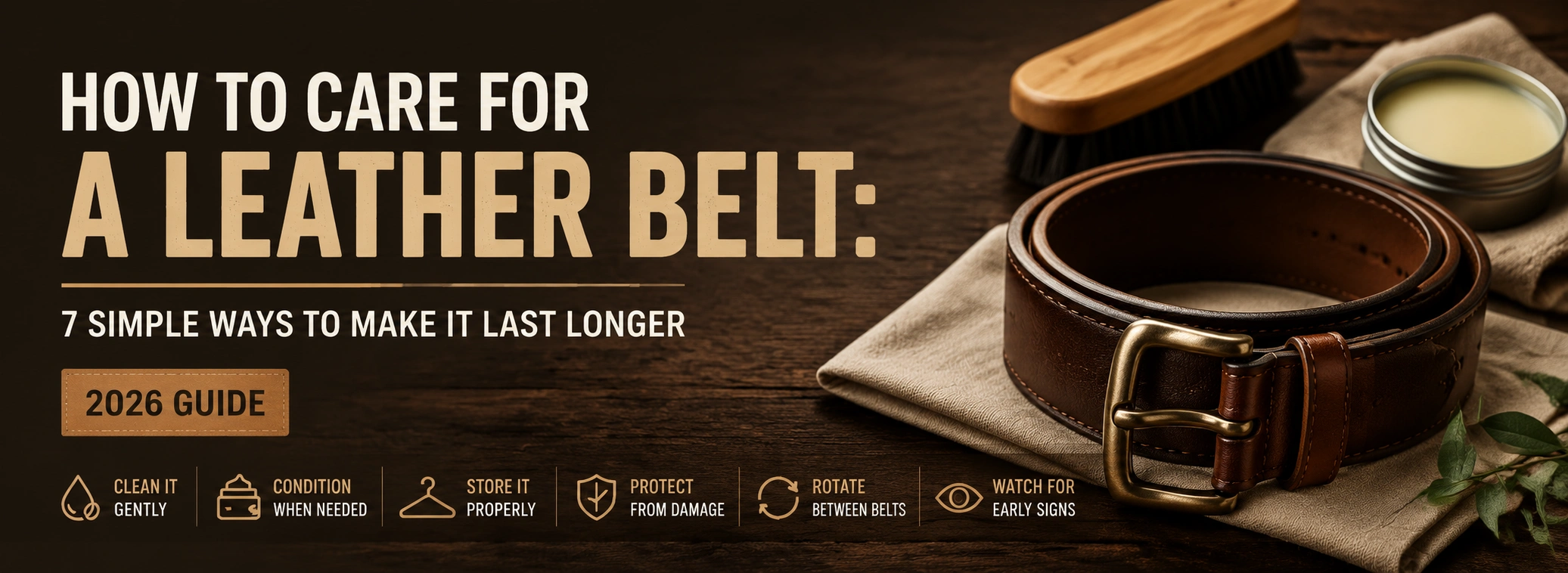
Some leather belts seem to improve with age. The color deepens, the surface softens, the edges round off in a way that looks genuinely better than new.
Others start cracking after only a few years.
Why?
Most people assume it's purely about leather quality — that the first belt was simply made from better material, and the second one was cheap. Sometimes that's true.
Not necessarily, though. We've seen plenty of decent leather belts develop problems early, and plenty of mid-range belts hold up far longer than expected. The material sets the ceiling, sure. But how a belt is treated — quietly, in the background, day after day — often has more influence on the outcome than people realize.
This isn't a cleaning checklist. It's more about understanding what actually wears a belt down, so the things you do (or don't do) actually move the needle.
Do Leather Belts Actually Need Maintenance?
Here's an honest observation: a lot of people have owned leather belts for years and never conditioned one. Not once. And plenty of those belts are still fine.
So does maintenance actually matter, or is this overstated?
Both, kind of.
Some belts have more margin than others. A belt made from dense, well-constructed leather can go a long time without attention and still be okay — not because maintenance doesn't matter, but because the starting material had enough structural reserve to absorb years of neglect without showing it.
If you're unsure how leather grade affects long-term durability, see our full grain vs genuine leather comparison.
A belt made from thinner material, or one where a heavy surface coating is doing a lot of the visual work, has less margin. Genuine leather in particular spans a wide range — some of it holds up fine with minimal care, and some of it is leaning on that finish coat more than people realize, which means once that finish starts to go, neglect shows up faster and more visibly.
So the honest answer is: maintenance always helps, but how much it matters — how visible the difference is — depends a lot on what you started with. For a belt with plenty of structural margin, care is the difference between "looks good" and "looks great." For a belt with less margin, it's sometimes the difference between "fine" and "not fine."
The Biggest Mistake Leather Belt Owners Make
People assume leather wears out because it's old.
The reality is that age itself isn't really the mechanism. A belt that sat in a drawer for fifteen years isn't "fifteen years old" in any way that matters structurally — what matters is what happened to it during those fifteen years.
And the single biggest factor, by a wide margin, is dryness.
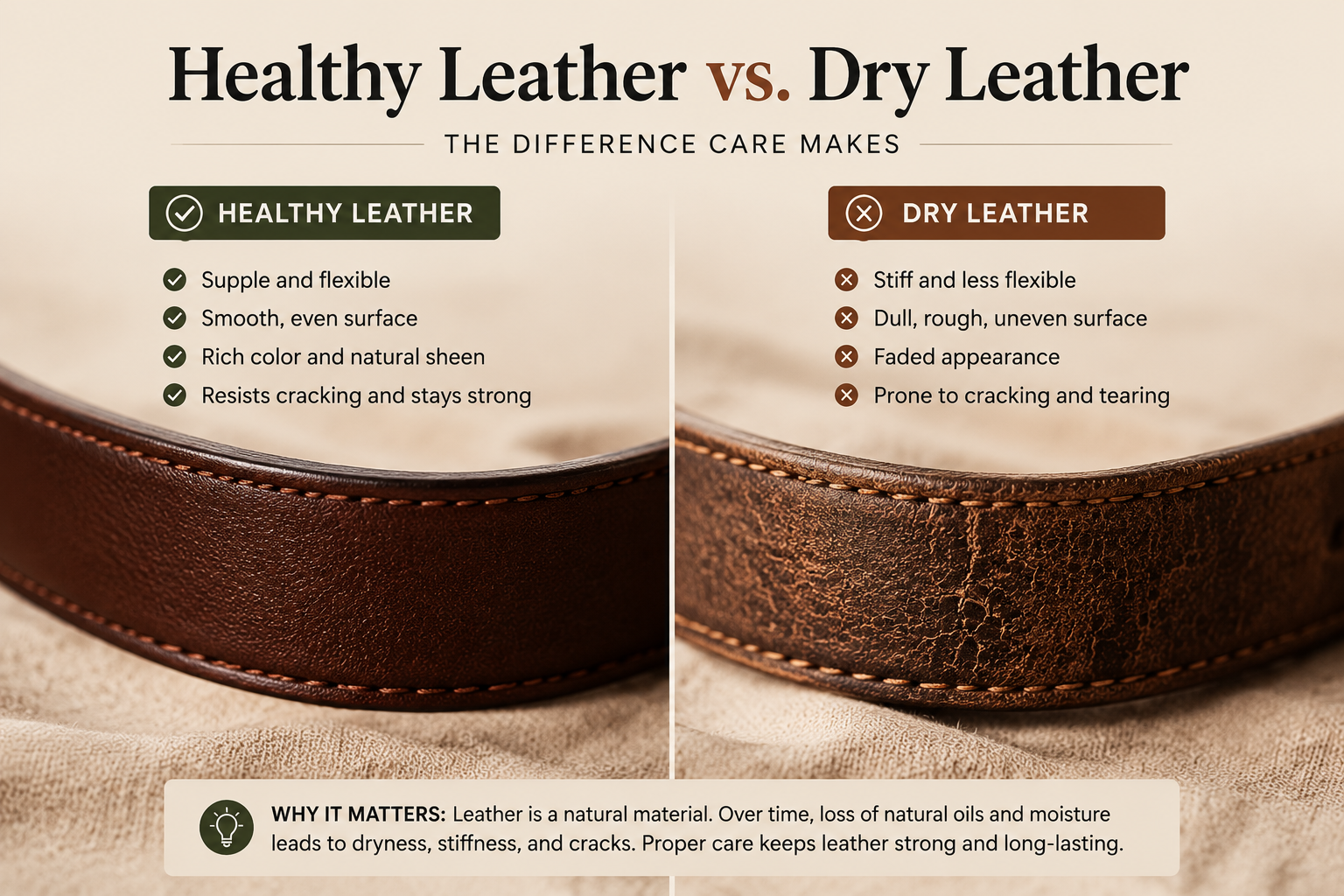
Leather is fundamentally an organic material — by definition, it's animal hide that's been tanned into a durable, flexible material, and part of what keeps that flexibility intact is the natural oil content within the fiber structure itself. (Source: general definition of leather, Wikipedia – "Leather.") Over time, and especially under certain conditions, that oil content diminishes. The leather that's left behind is technically the same material — just stiffer, less able to flex without resistance, and considerably more prone to cracking under stress.
Here's the part that makes this tricky: dryness doesn't announce itself with a crack. It announces itself quietly — the leather gets a little stiffer, a little duller, a little less responsive when you flex it. None of that looks alarming in isolation. By the time an actual crack appears, the leather has usually been dry for a while already.
This is the mechanism behind most of what follows. Almost everything in this guide, in one way or another, comes back to managing that one variable.
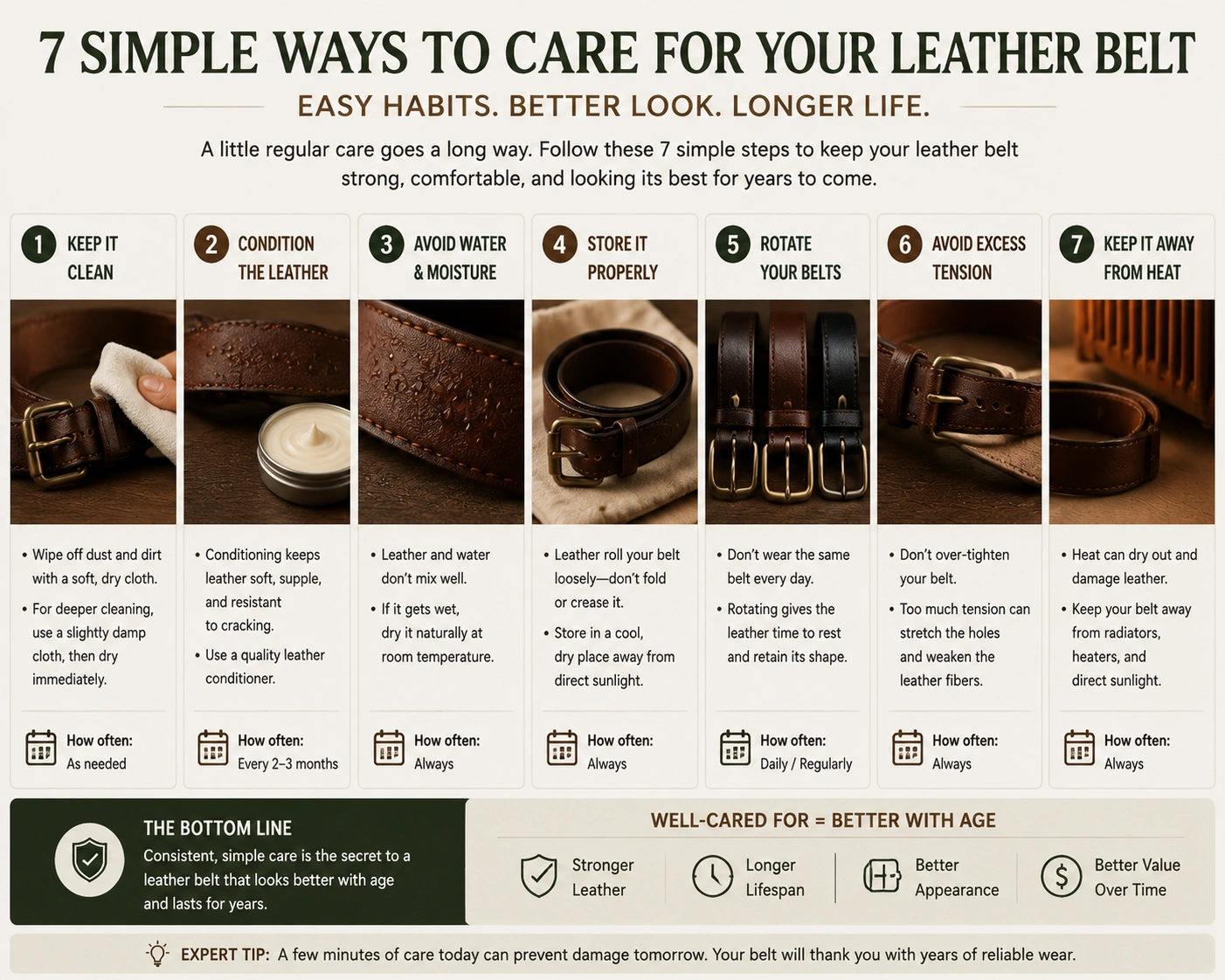
1. Keep Leather From Drying Out
The good news is that this is mostly about avoiding a handful of specific situations, not constant vigilance.
Direct heat is the obvious one — radiators, heating vents, anything that puts the belt in a consistently warm environment. Less obvious: car dashboards and glove compartments, which in summer can reach temperatures that genuinely cook leather, sometimes within a single afternoon.
Indoor heating during winter is a quieter version of the same problem. Heated indoor air can have dramatically lower humidity than the air outside, and a belt hanging in that environment for months is slowly losing moisture the whole time — without anyone noticing, because nothing looks different day to day.
Prolonged direct sunlight does similar damage through a slightly different mechanism — UV exposure breaks down the oils in leather faster than ambient dryness alone would.
None of this means leather is fragile. Full-grain leather in particular has enough density that it takes a meaningful amount of sustained exposure before any of this becomes visible. But "takes longer to show" isn't the same as "doesn't happen" — it's just a longer runway before the same outcome.
2. Condition Leather When It Starts Feeling Dry
This is the part where most guides give you a number. Every three months. Twice a year. Whatever.
Here's the more honest answer: it depends.
It depends on your climate — dry regions and dry seasons accelerate the process described above. It depends on how often the belt is worn — more flexing means more opportunity for the leather to either absorb conditioning or lose moisture, depending on which direction things are going. And it depends on the leather itself — denser, full-grain material holds onto its oils longer than thinner or more processed leather.
A calendar isn't really the right tool here. The leather itself is.
The leather will tell you before it cracks — it just doesn't shout about it. A good way to check is to flex the belt gently and run your thumb across the surface. Compare a high-contact area, like near the buckle, to a section that rarely gets touched. If the high-contact area feels noticeably stiffer or looks duller than the rest — rather than softer and slightly deeper in color, which is what healthy aging looks like — that's a signal worth acting on.
That distinction matters. Softening and darkening with use is patina — leather doing what it's supposed to do. Stiffening and dulling is the opposite signal, and it's the one that actually calls for conditioner.
3. Clean Dirt Before It Becomes Wear
This one gets overlooked because dirt seems purely cosmetic. It isn't, entirely.
Dust, sweat residue, and general daily grime sit on the surface of the leather, and every time the belt flexes — at the buckle, around the body — that grime is essentially being ground into the surface along with the leather itself. Over months and years, that's a small but real source of surface abrasion that has nothing to do with the leather's quality and everything to do with what's been sitting on top of it.
The fix is genuinely simple: wipe the belt down periodically with a dry or slightly damp soft cloth. That's most of it.
Where people sometimes go wrong is reaching for something stronger when a belt starts looking dingy — household cleaners, alcohol-based wipes, anything marketed as a general "cleaner." These can strip oils from the leather faster than the dirt itself was ever going to cause damage, which means the cleaning step ends up doing more harm than the thing it was meant to fix. If a belt needs more than a wipe-down, a product formulated specifically for leather is worth seeking out — general-purpose cleaners aren't the same thing, even when they're marketed as gentle.
4. Avoid Overloading the Belt
This one rarely makes it onto care guides, and it's genuinely relevant for belts in a way it isn't for most other leather goods.
A belt rated for daily wear is rated for daily wear — holding up pants, flexing at the buckle, the baseline load it was designed around. What that rating doesn't necessarily account for is everything else people hang on it: a heavy multitool, an oversized keychain, a phone holster, a holster of any kind.
None of this is inherently bad. People carry things on their belts for good reasons. But it's worth being aware that every additional pound of hanging weight translates into additional constant tension — pulling on the belt loop area, adding load to the buckle fold, and in some cases concentrating stress at a single point rather than distributing it the way a properly fitted, unloaded belt would.
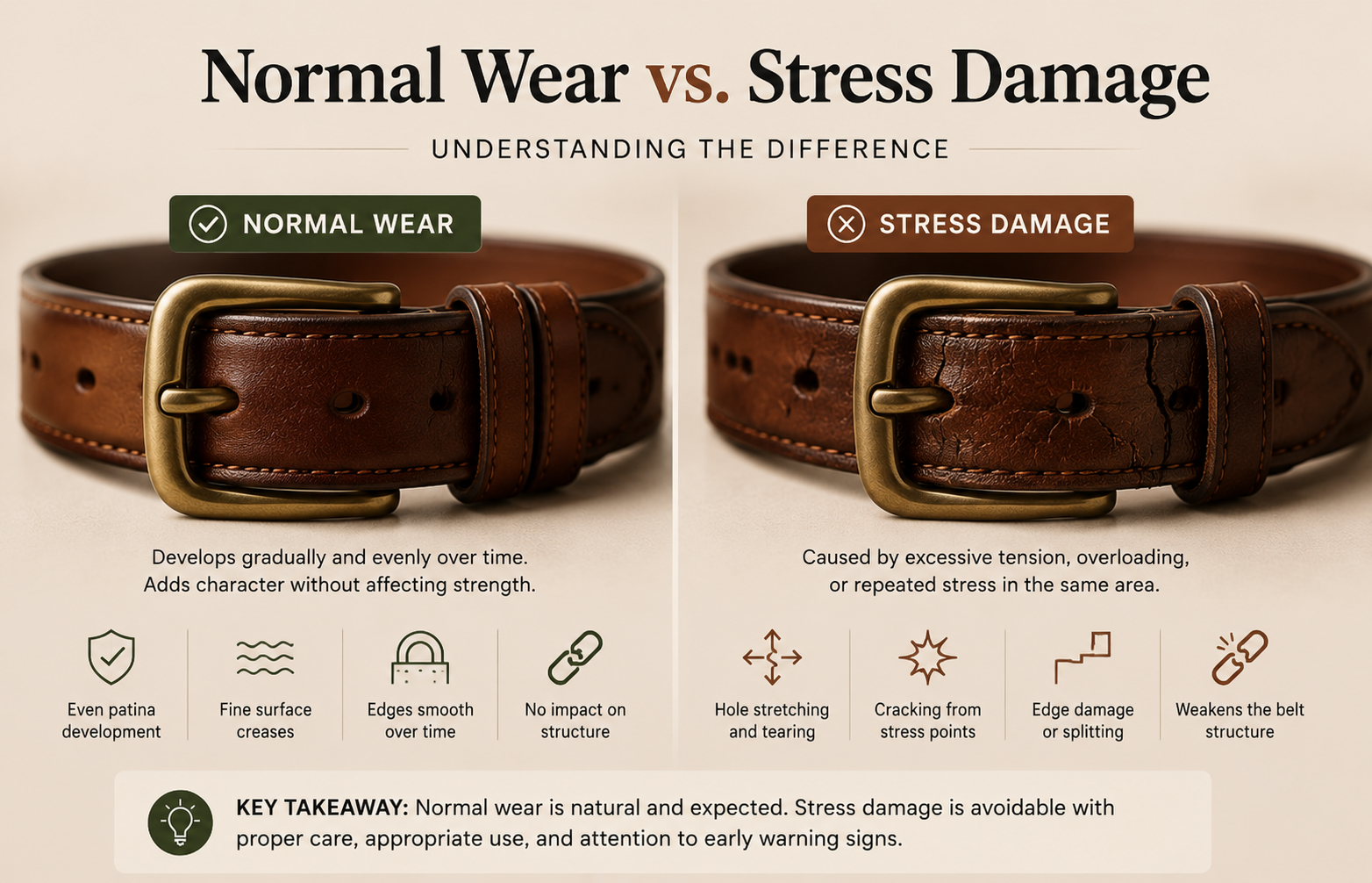
This isn't really about the leather "wearing out" faster in a general sense. It's more specific than that — it's about certain points on the belt experiencing more stress than they would otherwise, which, over time, is exactly the kind of localized stress that shows up later as the early warning signs covered further down.
If you're regularly carrying real weight on a belt, it's worth occasionally checking those high-load areas specifically — the loop where the weight hangs, the buckle fold — rather than just glancing at the belt as a whole.
5. Store Your Belt Properly
How a belt spends its time not being worn matters more than people expect, mostly because of one specific habit: coiling it tightly around the buckle.
It's the natural thing to do — roll the belt up, buckle on the outside, tuck it in a drawer. But doing this consistently, especially over long periods, creates a tight permanent fold at a point the leather wasn't necessarily designed to bend that sharply or hold that shape indefinitely.
Folding flat has a similar risk if it's the same fold every time — a sharp crease that the leather eventually "remembers," whether you want it to or not.
Hanging is generally the gentler option. The belt's own weight distributes evenly along its length, there's no forced crease, and the buckle fold experiences roughly the same gentle bend it would during normal wear rather than a tight, sustained one.
None of this is dramatic in the short term. A belt coiled in a drawer for a month looks completely fine. The difference shows up over years — the belt that's been hung tends to retain a more even shape and surface, while the one that's spent years tightly coiled often develops a more pronounced permanent crease at that one specific point.
6. Rotate Between Belts
A lot of people end up doing this without ever framing it as "maintenance" — they just have a couple of belts and wear whichever one matches the day.
It turns out that's quietly doing something useful.
Every time a belt is worn, the same buckle fold bends the same way, and the same most-used hole takes the same load from the buckle pin. Wear it every single day, and that's hundreds of repetitions per year concentrated on the exact same two spots.
Split that between two belts — even loosely, not on any strict schedule — and each belt's high-stress points are absorbing roughly half the cumulative flexing they would otherwise. That's not a small effect over a few years.
This isn't a suggestion to go buy more belts than you need. It's more that if you already own more than one, there's a real benefit to actually using both, rather than reaching for the same one every morning out of habit while the other sits untouched.
7. Pay Attention To Early Warning Signs
This is the section that ties everything else together — because most of the problems people eventually search for didn't appear overnight. They were visible, in a smaller form, for a while before anyone noticed.
Hole stretching is one of the quieter ones. The hole you use every day takes the brunt of the buckle pin's pressure, every single fastening. Early on, this might just mean that hole looks very slightly less round than the others — barely noticeable unless you're comparing directly. Left alone, that gradual change is what eventually leads to a hole that's visibly oval and doesn't hold the buckle as securely as it used to.
Surface cracking almost always starts small — fine lines, usually at the buckle fold, often easy to miss unless the belt is flexed and examined directly. At this stage, it's frequently still a dryness issue rather than a structural one, which means it's also the stage where conditioning can still make a real difference.
Edge damage — fraying, slight separation along an edge — tends to develop gradually too, often starting in one small spot before spreading.
The mechanics behind all of this — exactly why these specific failure points develop the way they do, and what separates a surface issue from a structural one — is something we've gone into in detail in why leather belts crack. The short version here is simply this: catching any of these early, while they're still small, is the difference between "this can still be helped" and "this is now just how the belt is."
Can Leather Conditioner Fix A Damaged Belt?
People search this constantly, and it deserves a direct answer rather than a vague one.
For minor damage — early surface cracking caused by dryness, leather that's gotten stiff and dull but hasn't actually torn or separated — yes, conditioner can genuinely help. It replaces oils, restores some flexibility, and can visibly improve both the look and feel of leather that's been neglected but not yet structurally compromised.
For structural damage — deep cracks where the fiber has actually separated, holes that have torn into ovals, edges that have delaminated — no. Conditioner doesn't rebuild fiber structure that's already broken apart. It can keep the rest of the belt from deteriorating further, but it won't reverse what's already happened at that specific point.
A useful way to think about it: conditioner is maintenance, not repair. It's extremely good at keeping leather from reaching the point of structural damage, and reasonably good at improving leather that's drifted toward that point without quite getting there. Once a belt is past that point at a given spot, conditioner stops being the relevant tool — the question shifts from "how do I fix this" to "is the rest of the belt still doing its job."
How Much Longer Can Proper Care Add?
This is where it would be easy to throw out a number — "proper care adds five years" or something similarly specific. That's not really honest, so we won't.
What's true is something a bit less satisfying but more useful: care cannot turn poor leather into premium leather, but it can slow wear significantly on whatever leather you actually have.
Think of it less as addition and more as a ceiling and a floor. The leather itself — its grade, thickness, and construction — sets a ceiling on how long a belt can realistically last. That's covered in more depth in what makes a good leather belt, and it's genuinely the bigger factor of the two. No amount of conditioning turns thin, lower-grade leather into something it isn't.
Care affects how close to that ceiling you actually get. A well-made belt that's properly cared for tends to spend most of its life near the top of its potential lifespan. The same belt, neglected — dried out, never cleaned, coiled tightly for years — tends to drift toward the lower end of what it was capable of, reaching the kinds of structural issues described earlier sooner than it otherwise would have.
For a fuller picture of what realistic belt lifespans actually look like across different leather grades — and how much of that range care genuinely influences — how long do leather belts last goes into that directly.
Final Thoughts
The goal of leather care isn't to keep a belt looking new forever.
That's worth sitting with for a second, because it's a slightly different goal than most care guides imply. "New" isn't actually the target — a belt that looks exactly like it did on day one, years later, usually means it's barely been used, which is its own kind of waste for an object made to be worn.
The actual goal is to help good leather age well — to let the darkening, the softening, the slight shift in character that comes from years of use happen the way it's supposed to, without dryness, dirt, or unnecessary stress derailing that process into cracking, stiffness, or damage instead.
Preserved and cared-for aren't the same thing. A preserved belt resists change. A cared-for belt changes — just in the right direction.
Frequently Asked Questions
How often should I condition a leather belt?
There's no fixed schedule that works for everyone — it depends on climate, how often the belt is worn, and the leather itself. Rather than conditioning on a calendar, check the leather directly: if a high-contact area feels stiffer or looks duller than the rest of the belt, that's the signal to condition. Softening and darkening with use is normal aging and doesn't call for conditioner; stiffening and dulling does.
Can I use leather conditioner on a belt?
Yes, and for most leather belts, periodic conditioning is one of the more effective things you can do to prevent dryness-related cracking. Apply a small amount, work it in evenly, and avoid over-saturating the leather. For belts with a heavy surface coating rather than exposed natural leather, check that the product is suitable for that type of finish first.
How do I clean a leather belt?
For routine cleaning, a dry or slightly damp soft cloth wiped across the surface handles most everyday dust and residue. Avoid household cleaners or alcohol-based wipes, which can strip natural oils from the leather faster than the dirt itself would have caused damage. If a belt needs more than a basic wipe-down, look for a product formulated specifically for leather rather than a general-purpose cleaner.
Should leather belts be stored rolled or hung?
Hanging is generally gentler on a belt than tightly coiling it around the buckle, particularly over long periods. Tight coiling can create a permanent fold at the buckle area that the leather "remembers" over time. If hanging isn't practical, storing the belt in a loose loop rather than a tight coil reduces the same risk.
Can leather care prevent cracking?
Care significantly reduces the likelihood of dryness-related cracking, which is the most common cause — and it can also help at the early surface-cracking stage, before the damage becomes structural. It can't prevent cracking caused by the leather itself being thin or poorly constructed from the start; in those cases, care slows the process but doesn't change the underlying material.
How long does a leather belt last with proper care?
This depends heavily on the leather grade and construction to begin with — care influences how close a belt gets to its realistic potential, rather than setting that potential itself. A well-made full-grain belt with reasonable care can last considerably longer than the same belt neglected, often by a meaningful margin. For a detailed look at lifespan expectations across different leather grades, see how long do leather belts last.