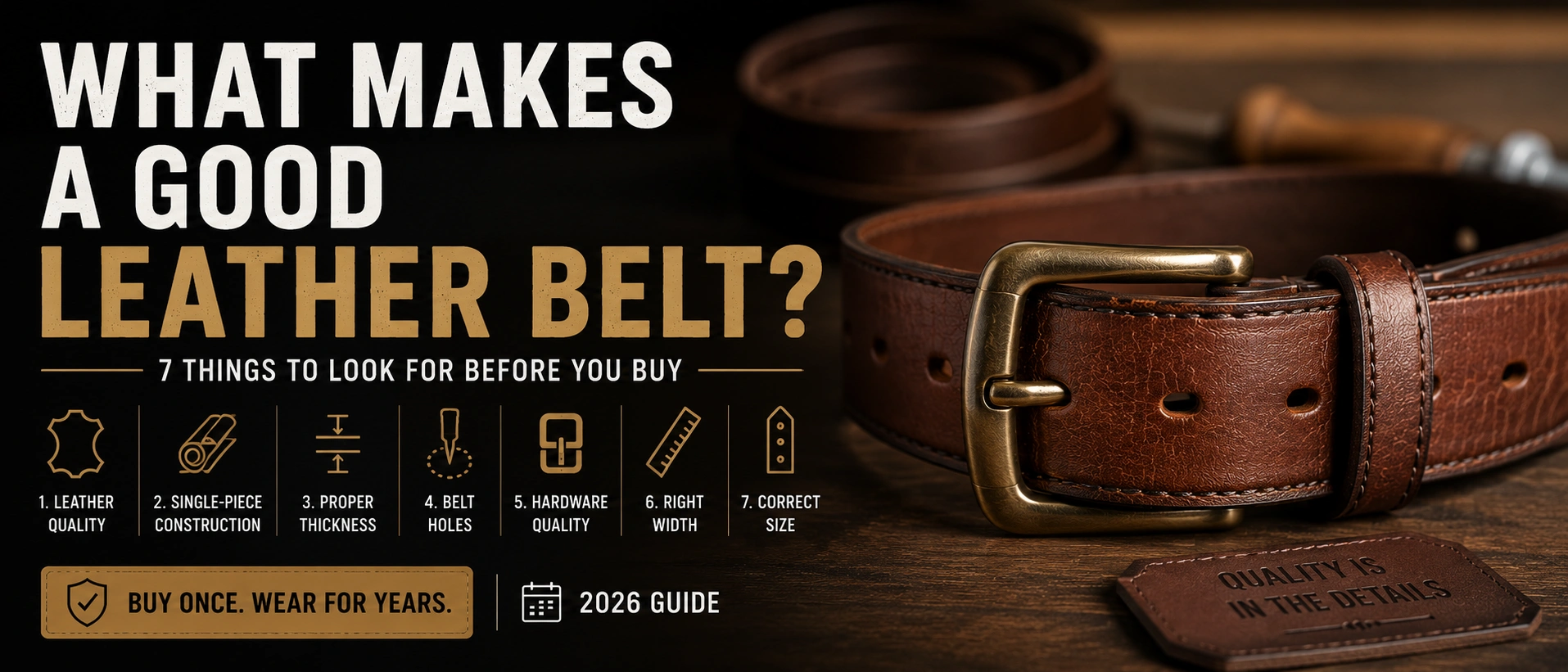
A good leather belt is built from full-grain leather at least 3.5mm thick, cut as a single piece, fitted with solid metal hardware, and finished with cleanly cut, evenly reinforced holes. A belt meeting that standard is designed to stay in daily service for ten years or more — not one or two.
Most belts don't announce which side of that line they fall on. They look fine in the box. The leather feels reasonable, the buckle has some weight to it, the stitching is even. Then, somewhere between six months and two years in, something starts to go wrong: the surface begins to crack at the fold, the edges start peeling in thin strips, the hole you use most stretches into an oval, or the buckle pin starts to feel loose.
None of that is visible on day one. It's determined by decisions made before the belt ever reached you — the grade of leather, how it was cut, how thick it is, how the holes were made, what the hardware is actually made of. This guide walks through the seven things that separate a belt built to last from one that's quietly counting down to its replacement, plus the buying habits that lead people toward the wrong one without realizing it.
Why So Many Leather Belts Fail Early
The most common belt failures fall into a handful of categories, and they're worth naming directly because each one points to a different underlying cause.
Hole stretching and tearing happens when the leather around the most-used hole isn't dense enough to withstand the daily mechanical load of the buckle pin. Over hundreds of fastenings, the hole widens, loses its round shape, and eventually stops holding the belt securely.
Edge separation shows up on belts constructed from multiple layers of thinner leather glued together. The adhesive bond is a weak point that doesn't exist on a single-piece belt, and under repeated flexing and exposure to moisture, it eventually gives way.
Surface cracking typically appears at the fold point where the belt bends through the buckle — the highest-flex area on the entire belt — and is often a sign that the leather's fiber structure can't withstand repeated bending, or that it's dried out from lack of conditioning.
Peeling is almost always a coating problem. A surface finish applied over lower-grade leather to make it look uniform has a limited lifespan, and once it starts to delaminate, the process accelerates.
Buckle and hardware failure ranges from plating wearing through to expose dull base metal, to the buckle pin itself bending or snapping under sustained load.
Many belt owners assume all leather belts are roughly similar until they own one that's still going strong after ten years sitting next to one that needed replacing within twelve months. Side by side, the difference in how they were actually built becomes obvious — but by then, it's too late to do anything but compare. The goal here is recognizing those differences before you buy, not after.
1. Start With the Leather Quality
This is the foundation everything else is built on, and it's worth understanding the hierarchy.
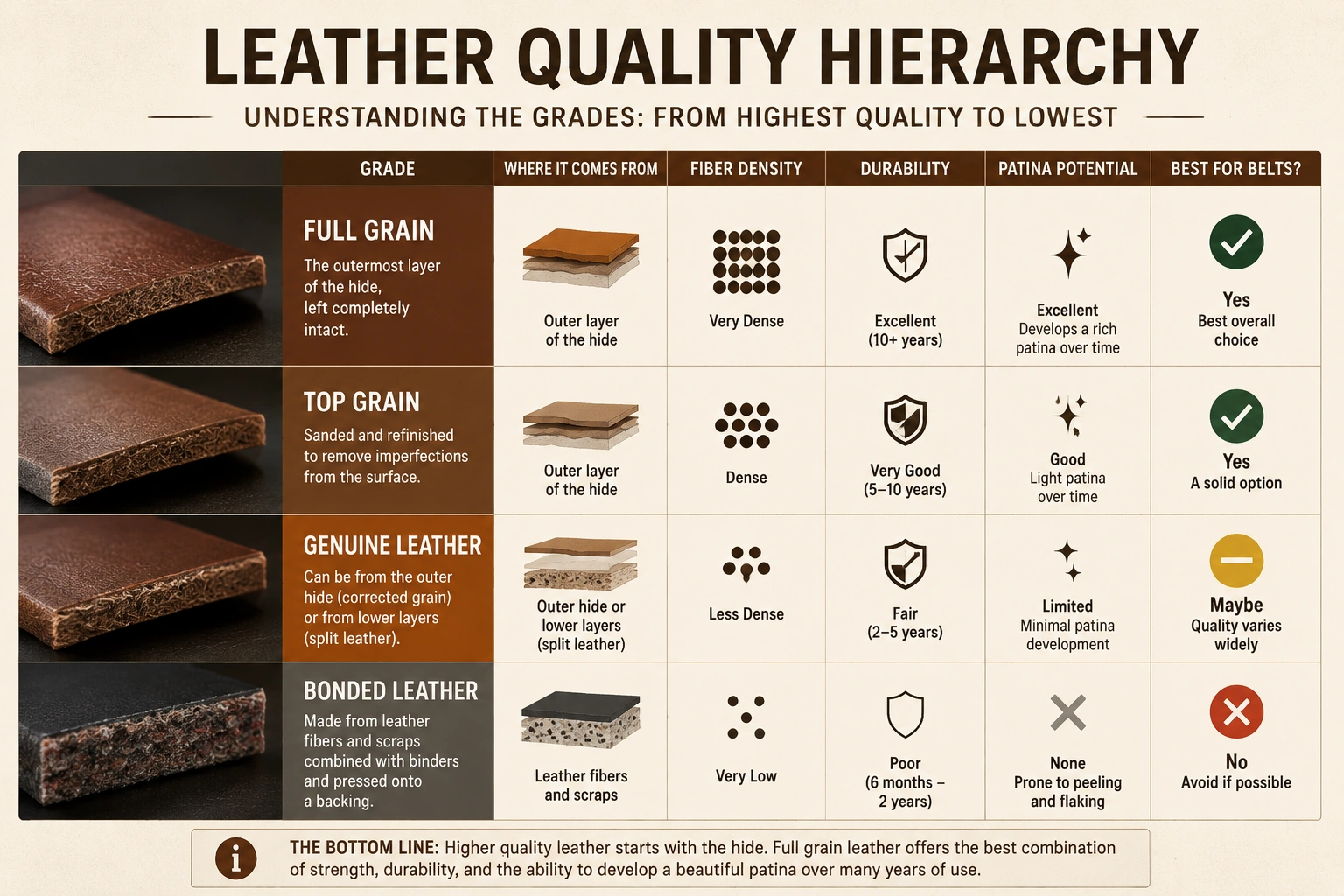
Full-grain leather is the outermost layer of the hide, left completely intact — no sanding, no surface correction. It has the densest fiber structure of any leather grade, which translates directly into resistance to stretching, tearing, and deformation at stress points. It also develops a genuine patina over time, deepening in color and developing character as it's used.
Top-grain leather also comes from the outer hide, but the surface has been sanded to remove natural marks and then refinished. It looks more uniform out of the box but loses some of the fiber density and the ability to develop a true patina.
Genuine leather is a broad term that says less than it sounds like it does. It can refer to corrected-grain leather from the outer hide, or to split leather from lower hide layers with a much looser fiber structure. The label confirms the material is real leather; it doesn't tell you which grade.
Bonded leather isn't really leather in any meaningful structural sense — it's leather scraps and fiber bound with polyurethane and pressed onto a fabric backing. It's the least durable option and the most prone to peeling.
None of this means every genuine-leather belt is bad or every full-grain belt is automatically excellent — construction and thickness matter too, which is why they're separate items on this list. But leather grade sets the ceiling. A belt can't outperform the material it's made from, regardless of how well everything else is done. (For a deeper look at how full-grain and genuine leather actually compare in daily use, see our full breakdown.)
2. Look for Single-Piece Construction
This is one of the most overlooked quality indicators, mostly because it's invisible in product photos.
A high-quality leather belt is cut from a single piece of leather running its entire length — one continuous strap from the tail to the buckle end, with a uniform cross-section throughout. There's no seam, no adhesive bond, no transition between materials.
A layered belt achieves its thickness differently: two or more thinner pieces of leather glued together to create the appearance of a substantial single piece. This can look identical to single-piece construction when new. The problem emerges over time. The adhesive bond between layers is a structural weak point that single-piece construction simply doesn't have. Repeated flexing, exposure to sweat and moisture, and the general mechanical stress of daily wear gradually work on that bond. Eventually the layers begin to separate — the belt starts to feel spongy, the edges show visible gaps, and the structure that looked solid on day one starts coming apart.
The good news is that this is checkable before you buy, or at least before you commit to wearing a belt for years. Look at the cut edge — the side profile of the belt, particularly near the tail. A single-piece belt shows one dense, uniform material straight through. A layered belt shows a visible seam or a transition line where two pieces meet. If you're buying online and can't inspect the edge directly, look for explicit confirmation of single-piece or solid leather construction in the product description — it's a detail that quality makers tend to state plainly because it matters.
3. Check the Belt Thickness
Thickness is the specification most likely to get overlooked because it doesn't show up in a photo and most listings don't lead with it.
For an everyday belt — the one you'll wear with jeans, chinos, or work pants most days — 3.5mm to 4mm is the range that provides the best balance. At this thickness, the leather has enough material to resist deformation at the holes under the repeated cycle of the buckle pin entering and withdrawing. It holds its shape through the fold at the buckle. It feels substantial without being stiff.
Go thinner — into the 2.5mm to 3mm range — and the belt may feel perfectly fine when new, but under daily use the holes tend to widen faster, the leather around the buckle fold shows wear sooner, and the overall structure softens and loses shape more quickly than thicker leather would.
Go thicker — beyond 4.5mm or so — and you start running into a different set of problems. A belt that's too thick for its width can feel rigid and uncomfortable, resist folding through the buckle smoothly, and in some cases be difficult to fit through narrower belt loops at all.
If you're shopping online, look for an explicit thickness specification in millimeters. If you're evaluating a belt in person, hold it and flex it gently — a belt in the right thickness range has a slight, controlled resistance to bending. It shouldn't fold as easily as a piece of card stock, and it shouldn't feel like it's fighting you.
4. Pay Attention to the Belt Holes
This is the detail almost nobody checks, and it's one of the clearest indicators of how a belt will hold up over time.
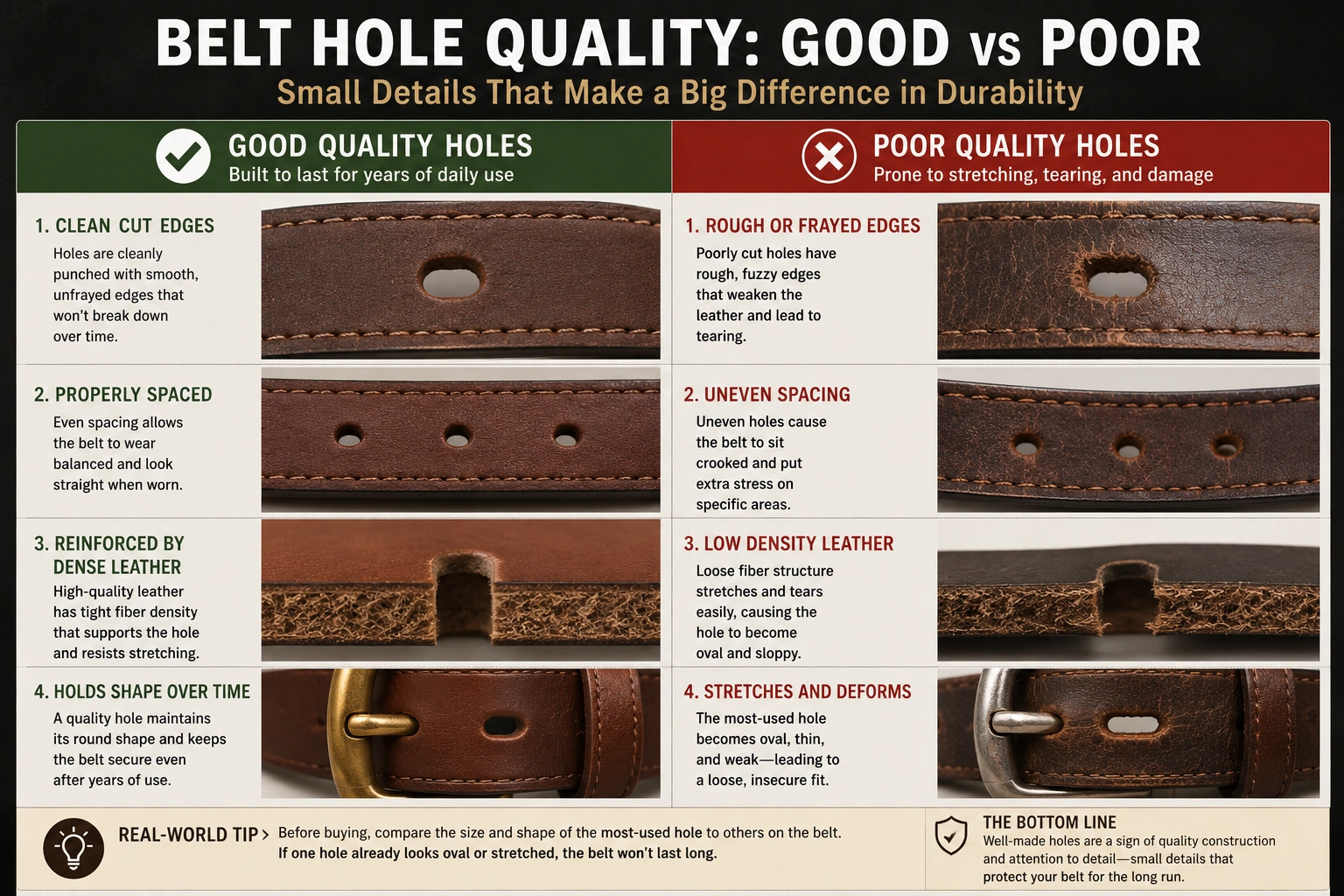
On a well-made belt, the holes are evenly spaced — typically one inch apart — and cleanly punched through dense leather, leaving a tight, round opening with no fraying or tearing at the edges. The leather immediately surrounding each hole is part of the same dense fiber structure as the rest of the belt, which means it can absorb the repeated stress of the buckle pin without deforming significantly over time.
On a lower-quality belt, holes are often punched through thinner or less dense material, and the difference shows up exactly where you'd expect: at the hole you use every single day. One common sign of a low-quality belt is that the most-used hole becomes noticeably larger — often oval rather than round — within a matter of months. You can actually check this right now on a belt you already own: compare the size and shape of your most-used hole to one near the end of the belt that you rarely or never use. If there's a visible difference in size or shape, that's the leather telling you something about its density.
A belt with the right leather grade and thickness resists this kind of hole deformation for years. The hole you use daily should look essentially the same as the ones you don't.
5. Examine the Buckle and Hardware
The buckle isn't decorative — it's a mechanical component that bears load every single day, and the material it's made from determines how it ages.
Solid brass is the standard for good reason. It doesn't corrode, it doesn't crack under sustained stress, and rather than degrading over time, it develops its own surface patina — a warm, deepening tone that complements aged leather instead of clashing with it.
Stainless steel is also genuinely durable — corrosion-resistant and strong — though it tends to maintain a more uniform, technical appearance rather than developing the same kind of warm patina that brass does. It's a solid choice, particularly for belts with a more minimal or modern aesthetic.
Plated zinc alloy is where most problems originate. A thin layer of chrome, nickel, or gold plating sits over a base metal that's considerably softer and more brittle than either brass or steel. The plating looks identical to solid metal when new. Within months of regular wear, it begins wearing through at contact points — the edges, the bar, anywhere friction occurs — revealing the dull grey or brassy base metal underneath. Worse, the underlying alloy itself can crack or bend under the sustained mechanical load the buckle pin experiences, particularly at the point where it engages the belt hole.
Beyond the buckle material itself, how it's attached to the leather matters. A properly installed Chicago screw or equivalent fastener through dense leather sits flush and secure for the life of the belt. A rivet through thin leather can work loose as the material around it compresses over years of use.
When you're evaluating a belt, the buckle deserves the same scrutiny as the leather. A solid brass belt buckle on a quality full-grain strap is a combination where both components are built to age in the same direction — together, rather than one outlasting the other.
6. Make Sure the Width Matches the Purpose
Width doesn't determine durability on its own, but it does determine whether a belt actually functions correctly for what you're wearing it with — and a belt that doesn't fit its purpose won't get the use (or the appreciation) it deserves regardless of how well it's made.
1.25-inch belts are the standard for dress pants and formal wear — narrow enough to suit slimmer belt loops and pair correctly with smaller, sleeker buckle hardware.
1.5-inch belts are the everyday standard — built to fill the loops on jeans, chinos, and most casual and work pants, with enough visual presence to look intentional.
1.75 inches and above moves into work-belt and load-bearing territory, where the additional width helps distribute the weight of tools or equipment.
Buying a belt in the wrong width for its intended use creates problems regardless of how good the leather is — a narrow belt in heavy denim loops will shift and rotate all day, and a wide belt forced through dress-pant loops will bulge and look out of place. For a full breakdown of how to match width to your wardrobe, see our belt width guide.
7. Get the Size Right
This is the factor that has nothing to do with the belt's construction and everything to do with whether it actually works for you — and it's the one that even a perfectly made belt can't compensate for.
A belt sized correctly fastens near the middle hole of its range, with the buckle centered and the tail ending cleanly through the first belt loop. A belt sized incorrectly — even one built from the best full-grain leather with a solid brass buckle and perfect single-piece construction — will either fasten at the very edge of its hole range (leaving no adjustment room) or produce an awkwardly long tail that never sits right.
The good news is that belt sizing is straightforward once you know the method: measure from the buckle pin connection point to the hole you use most on a belt that currently fits well, or take your pants waist measurement through the loops and add about two inches. For the full method and a complete reference chart, see what size belt do I need and the belt size chart.
Common Buying Mistakes
Only Looking at Price
Belt prices vary widely, and the variation isn't arbitrary — it tends to map directly onto the six factors above. A belt priced significantly lower than another is usually achieving that price by giving something up: thinner leather, a lower grade, layered construction instead of single-piece, holes punched without reinforcement, or plated hardware instead of solid metal. Often it's not just one of these — it's two or three at once, because each cost-saving measure compounds with the others.
This doesn't mean the most expensive belt on a page is automatically the best, or that a reasonably priced belt can't be well made. But price differences between leather belts are rarely about branding alone — they generally reflect real differences in the material and construction decisions covered in this guide. A belt priced to reflect full-grain leather, proper thickness, single-piece construction, and solid hardware is priced that way because all four of those things cost more to produce than their alternatives. Understanding what you're actually paying for is more useful than treating price as a standalone signal in either direction.
Assuming "Genuine Leather" Means Premium Quality
As covered above, "genuine leather" is a floor, not a ceiling — it confirms the material is real leather without specifying which grade, layer, or construction method was used. A belt can be entirely accurate in calling itself genuine leather while still being made from split leather with a heavy surface coating that won't hold up to daily use. The label is a starting point for questions, not an answer.
Ignoring Thickness
Thickness rarely appears in product photos and isn't always listed in descriptions, which means it's easy to overlook entirely. But it's directly tied to how the belt performs at the holes and the buckle fold — the two places that experience the most daily stress. A belt that looks identical to a higher-quality one in every photo can be meaningfully thinner, and that difference shows up exactly where you'd expect, just later than you'd like.
Ignoring Construction
Single-piece versus layered construction is invisible from the front of a belt and often invisible in photography altogether. It's also one of the most significant determinants of how the belt ages — specifically whether it stays structurally coherent or begins separating at the edges after a year or two of regular use.
Choosing Style Before Quality
Customers often focus on appearance first — the color, the finish, the look of the buckle — and only discover quality problems after months of daily wear, when the belt that looked perfect on day one starts showing exactly how it was built. Style and quality aren't mutually exclusive, but they're evaluated differently: style is visible immediately, and quality often isn't visible until it's too late to return the belt.
How Long Should a Good Leather Belt Last?
The honest answer depends on how many of the seven factors above are addressed — and how consistently.
A belt that gets full-grain leather right but skips on thickness will hold up better than a thin genuine-leather belt, but it won't perform like a 4mm full-grain belt with solid brass hardware and reinforced holes. Each factor contributes, and they compound. A belt that addresses all seven — quality leather, single-piece construction, appropriate thickness, well-made holes, solid hardware, correct width, and correct size — is built to remain in daily service for many years, often a decade or more, while continuing to look better rather than worse as it ages.
A belt that compromises on two or three of these factors typically shows it within the first year or two: a hole that's already stretching, an edge that's starting to separate, a buckle that's lost its plating. The compromises don't always fail catastrophically — often the belt remains technically usable while looking and feeling progressively worse, which is its own kind of disappointment.
The factors that matter most for longevity specifically are leather grade, thickness, and construction — these three determine the structural ceiling. Hardware and hole quality determine how gracefully the belt approaches that ceiling. Width and size don't affect lifespan directly, but they determine whether you actually want to keep wearing the belt long enough to find out.
Final Checklist Before Buying
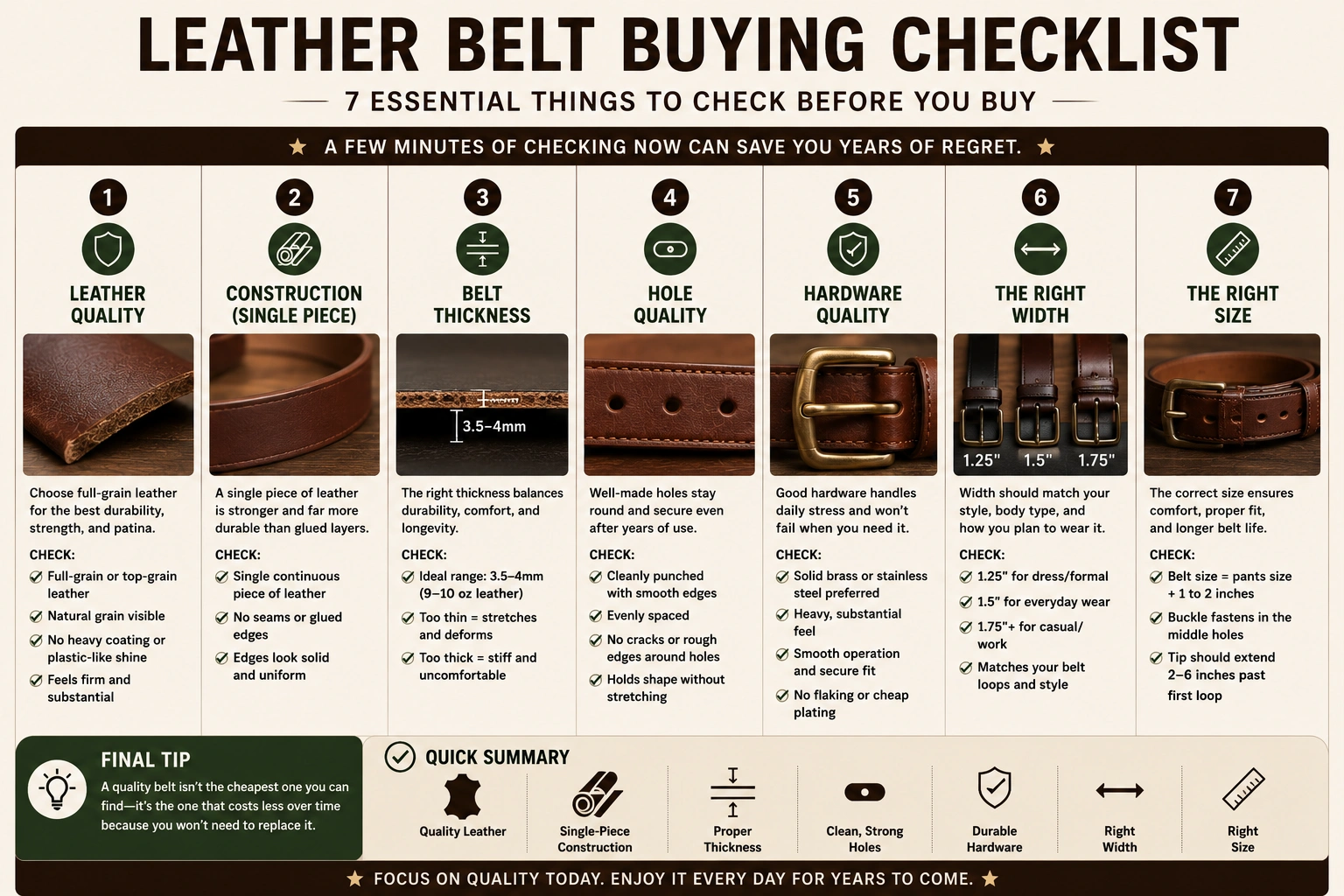
Before committing to a leather belt, run through these seven points:
✓ Leather quality — full-grain, with intact natural grain and dense fiber structure
✓ Construction — single piece from tip to buckle end, no glued layers
✓ Thickness — 3.5mm to 4mm for everyday use
✓ Holes — evenly spaced, cleanly punched, surrounded by dense leather
✓ Hardware — solid brass or stainless steel, securely attached
✓ Width — matched to your belt loops and intended use (1.25" dress, 1.5" everyday, 1.75"+ work)
✓ Size — fastens near the middle hole with the tail ending cleanly at the first loop
A belt that checks all seven boxes is built to be worn daily for years without becoming a recurring purchase.
Frequently Asked Questions
What makes a leather belt high quality?
A high-quality leather belt combines full-grain leather, single-piece construction, appropriate thickness (3.5–4mm for everyday wear), cleanly made and reinforced holes, and solid metal hardware — typically brass or stainless steel — securely attached to the leather. Each of these factors contributes to how the belt performs and ages over years of daily use, and the combination matters more than any single factor alone.
What is the best leather for belts?
Full-grain leather is generally considered the best choice for belts intended for daily wear, because its dense, intact fiber structure resists stretching and deformation at the holes and buckle fold better than lower grades. It also develops a genuine patina over time rather than simply wearing down. For occasional or formal-only use, well-made top-grain or corrected-grain leather can still perform adequately.
How can I tell if a leather belt is good?
Check the seven factors covered in this guide: leather grade, single-piece versus layered construction (visible at the cut edge), thickness (ideally 3.5–4mm), hole quality (clean, round, evenly spaced, and not already showing wear), hardware material (solid brass or stainless rather than plated alloy), width appropriate to your belt loops, and correct sizing. A belt that performs well across all seven is built to last.
Is full-grain leather worth it?
For a belt worn daily, yes. A belt experiences more repeated mechanical stress — bending at the buckle, tension around the holes — than almost any other leather accessory, and the dense fiber structure of full-grain leather is specifically what resists that stress over years. The higher upfront cost is typically offset by significantly longer service life and a surface that improves with age rather than deteriorating.
How thick should a leather belt be?
For everyday belts, 3.5mm to 4mm is the range that balances durability and comfort. Thinner leather tends to stretch and deform at the holes more quickly under daily use. Thicker leather can become stiff and uncomfortable, and may be difficult to fit through narrower belt loops.
Are solid brass buckles better?
Yes, for durability and long-term appearance. Solid brass doesn't corrode and doesn't crack under the sustained mechanical stress a buckle experiences daily, and it develops its own patina over time that complements aged leather. Plated zinc alloy hardware looks similar when new but wears through at contact points within months, exposing the base metal underneath and, in some cases, weakening at the pin under sustained load.
How long should a leather belt last?
A well-made leather belt — addressing leather grade, thickness, construction, hole quality, and hardware — can remain in daily service for many years, often a decade or more, with basic periodic conditioning. Belts that compromise on multiple factors typically show meaningful wear, such as stretched holes or separating edges, within the first one to two years of regular use.