A good pair of jeans can last for years.
The wrong belt can look out of place in months — and feel like it's failing even sooner.
Most men spend real time choosing denim. Fit, wash, weight, rise. Then they grab whatever belt is sitting in the drawer and call it done. The belt is an afterthought.
In practice, the belt often determines whether an outfit reads as put-together or slightly off. Not in an obvious way — more in the way that something just doesn't look quite right, and you can't immediately identify why.
For jeans specifically, the belt matters more than it does for dress pants. Dress belts get hidden under jackets. Jeans put the belt in full view, often all day. It's worth spending five minutes choosing the right one before spending money on the wrong one.
Why Jeans Require a Different Type of Belt
Denim isn't dress fabric. It's heavier, more textured, and built for different wear patterns than tailored trousers — and belt loops on jeans reflect that.
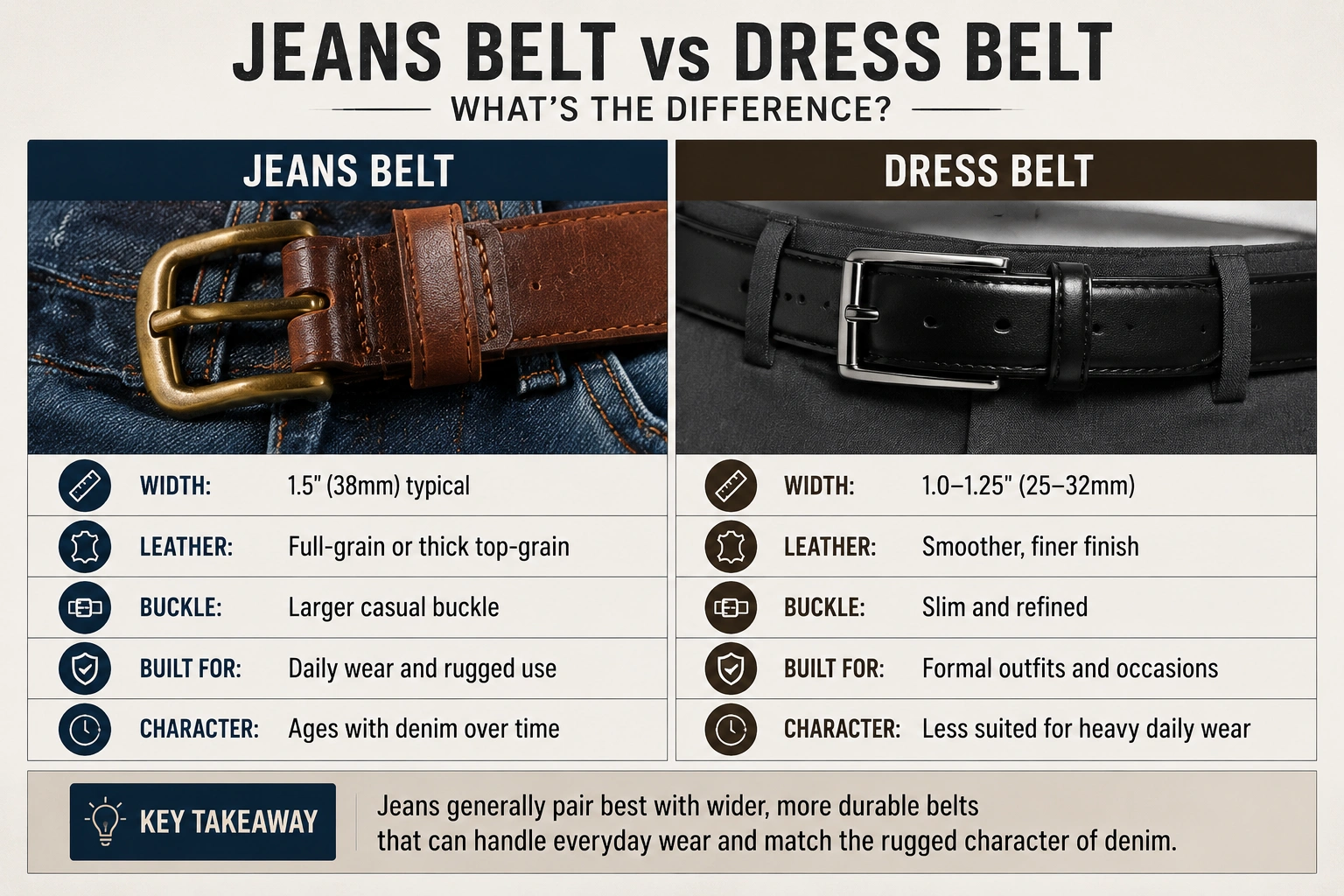
Standard jeans belt loops are designed to accommodate a belt roughly 1.5 inches (38mm) wide. Dress trouser loops are narrower — usually 1 to 1.25 inches. This single dimension difference is the main reason a dress belt looks oddly thin on a pair of jeans. It fits through the loops, but it doesn't fill them, and a belt that doesn't fill its loop sits slightly wrong — it shifts, it tilts, it doesn't anchor the way it should.
The visual weight of the belt also needs to match the visual weight of the fabric. Denim has texture and substance. A slim, polished dress belt looks like it wandered in from a different outfit. A belt with more presence — the right width, some surface character, a solid buckle — looks like it belongs.
There's also a frequency argument. Most men wear jeans more often than any other pant. A jeans belt gets more daily use than anything else in the wardrobe. That frequency matters for how the belt performs over time — more on that below.
What Belt Width Works Best With Jeans?
For most jeans, 1.5 inches (38mm) is the right width. Not because it's a style rule — because it's what standard jeans belt loops are designed for.
A 1.5-inch belt fills the loop cleanly without forcing. It sits flat and stable throughout the day, rather than shifting and rotating inside a loop that's slightly too wide for it. Visually, it carries enough weight to look proportional against denim without overwhelming narrower cuts.
Here's how the other common widths play out on jeans:
1.25 inches (32mm) — works, but sits slightly narrow in most jean loops. The belt moves around more during the day because it doesn't fill the loop fully. On slimmer-cut jeans with narrower loops, this can work well; on standard or relaxed cuts, the extra movement becomes noticeable.
1.75 inches (44mm) — on the wider end for most jeans. Fits through standard loops, but only just. On workwear-style denim with larger loops, 1.75 inches is exactly right. On regular jeans, it can sit a bit high and rigid around the waist.
The belt width guide covers this in more detail, but the practical answer for most people shopping for a jeans belt is simple: 1.5 inches, and you'll rarely go wrong.
Brown or Black Belt: Which Works Better With Denim?
Neither is universally correct. The honest answer depends on the denim color and what you're going for — not a fashion trend.
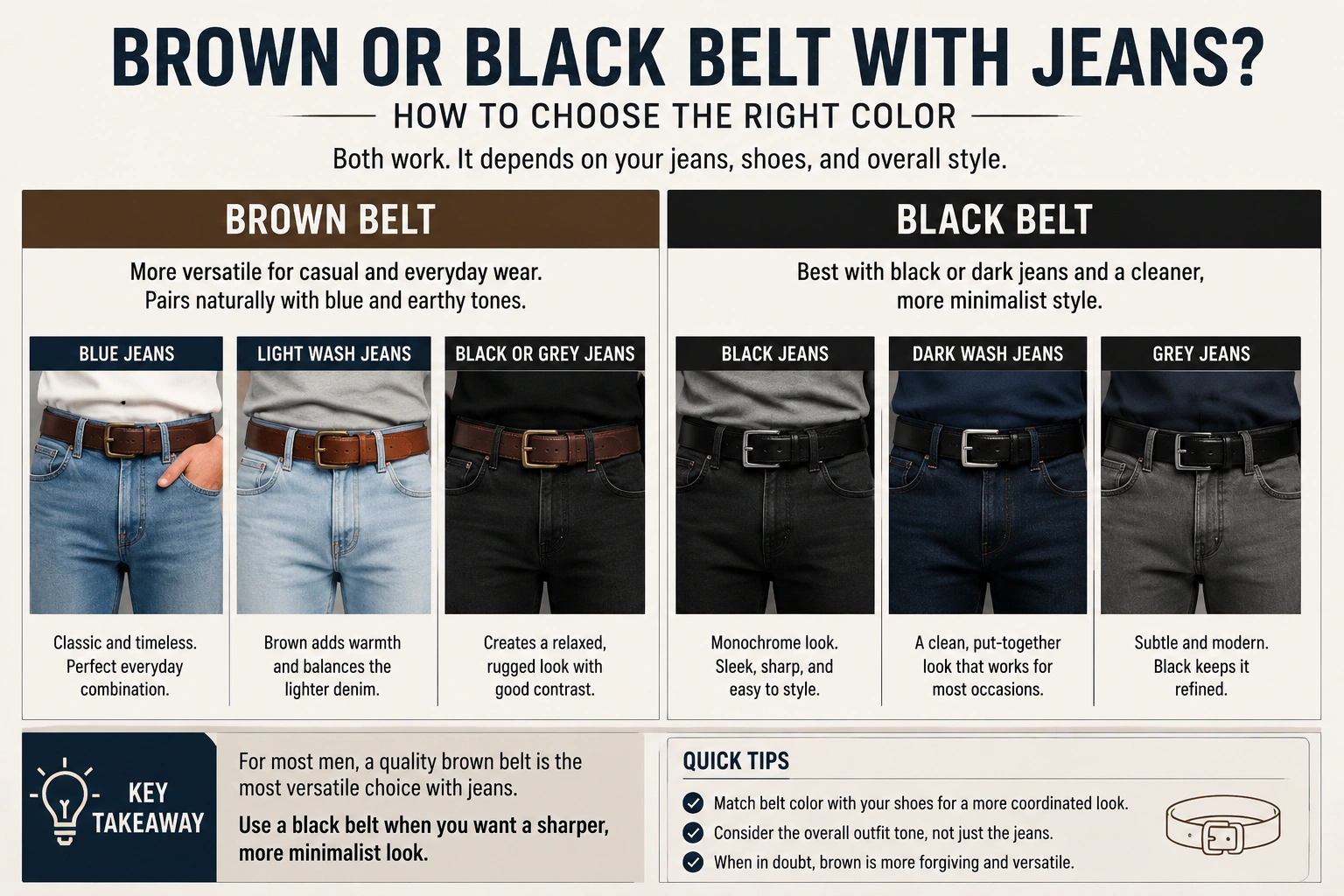
Brown with medium to dark blue denim is the combination that most people find naturally pleasing. Brown leather and blue denim sit in different tonal families — warm versus cool — in a way that creates contrast without competing. The relationship reads as casual and deliberate at the same time. Light brown (tan) with lighter denim is similarly balanced. A deep mahogany brown against darker indigo denim has more weight to it.
Black with black or very dark denim is the more formal-leaning combination. Black belt, black jeans, and black shoes create a clean, monochromatic line that works well when jeans are being dressed up slightly — dinner, smart casual, situations where you want the outfit to read pulled-together rather than relaxed.
Black with medium blue denim is where it gets more contested. It works, but the contrast can look more abrupt than brown would — less casual and relaxed, more like the belt and the jeans are from different outfits. Whether that matters depends on the context.
⚠️ One thing I'd avoid: a very shiny, patent-finish black belt with well-worn or raw denim. The finish levels clash in a way that reads as mismatched rather than intentional. Matte or semi-matte leather sits better with denim in almost every combination.
A brown crazy horse leather belt with medium blue jeans is a combination that holds up well over years and across a range of contexts — the surface character of the leather develops alongside the denim's fade in a way that makes both look more interesting with time.
Full Grain Leather vs Synthetic Belts for Everyday Jeans Wear
Most men who wear jeans daily go through belts more frequently than they'd like to. The cycle is predictable: buy something in the $20–40 range, wear it for a year, notice the hole stretching and the surface cracking, repeat.
The problem is that a belt designed to look good at purchase isn't necessarily designed to perform well under daily use. Synthetic belts and lower-grade genuine leather belts are built to meet a price point and look acceptable when new. They're not built for the specific stress patterns of daily jeans wear — which involves the same hole absorbing the buckle pin's pressure hundreds of times a year, the same fold bending through the buckle every morning, and the whole belt handling a level of cumulative mechanical stress that a dress belt worn twice a month never sees.
Full-grain leather handles this differently. The dense, intact fiber structure of the outer hide resists hole deformation and fold cracking under repeated daily stress in a way that lower-grade material doesn't. The surface develops a genuine patina as it's used — darker at the contact points, slightly more texture at the buckle area — rather than simply deteriorating. A full-grain belt at the eighteen-month mark often looks better than it did new. A synthetic belt at the same point usually looks done.
For jeans specifically, the patina argument matters in a practical way: denim itself develops character with age and wear. A belt that ages the same direction — deepening in color, developing surface history — suits denim in a way that a belt that just wears out doesn't.
The full comparison between full-grain and genuine leather is in the full-grain vs genuine leather guide. For realistic lifespan expectations across different belt types, how long leather belts last gives the concrete breakdown.
Why Many Men End Up Buying the Wrong Belt for Jeans
The errors are consistent enough that they're worth naming directly.
Too narrow. The most common mistake. A 1-inch or 1.25-inch belt that technically fits through the loops but doesn't fill them. It shifts position throughout the day, tilts slightly off-center, and never quite looks anchored — because it isn't. On jeans, where the belt is visible all day, this reads as something being slightly off even if you can't articulate why.
Too shiny. A high-gloss, patent-finish belt reads formal. It belongs with dress shoes and tailored trousers, not raw denim and casual footwear. The contrast between a mirror-shine belt and casual denim is exactly the kind of mismatch that makes an outfit look assembled rather than considered.
Wrong buckle scale. Small, delicate buckle hardware on a 1.5-inch casual leather belt doesn't belong. Neither does an oversized western-style buckle on slim jeans. The buckle should match the weight and scale of the belt and the denim — a medium, solid-frame pin buckle in brass or aged metal is the most versatile default.
Wrong size. Belt size is not the same as pants size — a 34-inch waist needs approximately a 36-inch belt. Getting this wrong means the belt fastens at the wrong hole, which looks off proportionally and puts extra stress on the hole at the edge of the range rather than the center. The belt size chart takes two minutes and prevents this reliably.
Buying thin leather for a daily-wear context. A 3mm belt on a pair of jeans you wear five days a week is going to show hole deformation faster than a 4mm belt would under the same conditions. The price difference is rarely more than a few dollars at comparable quality levels.
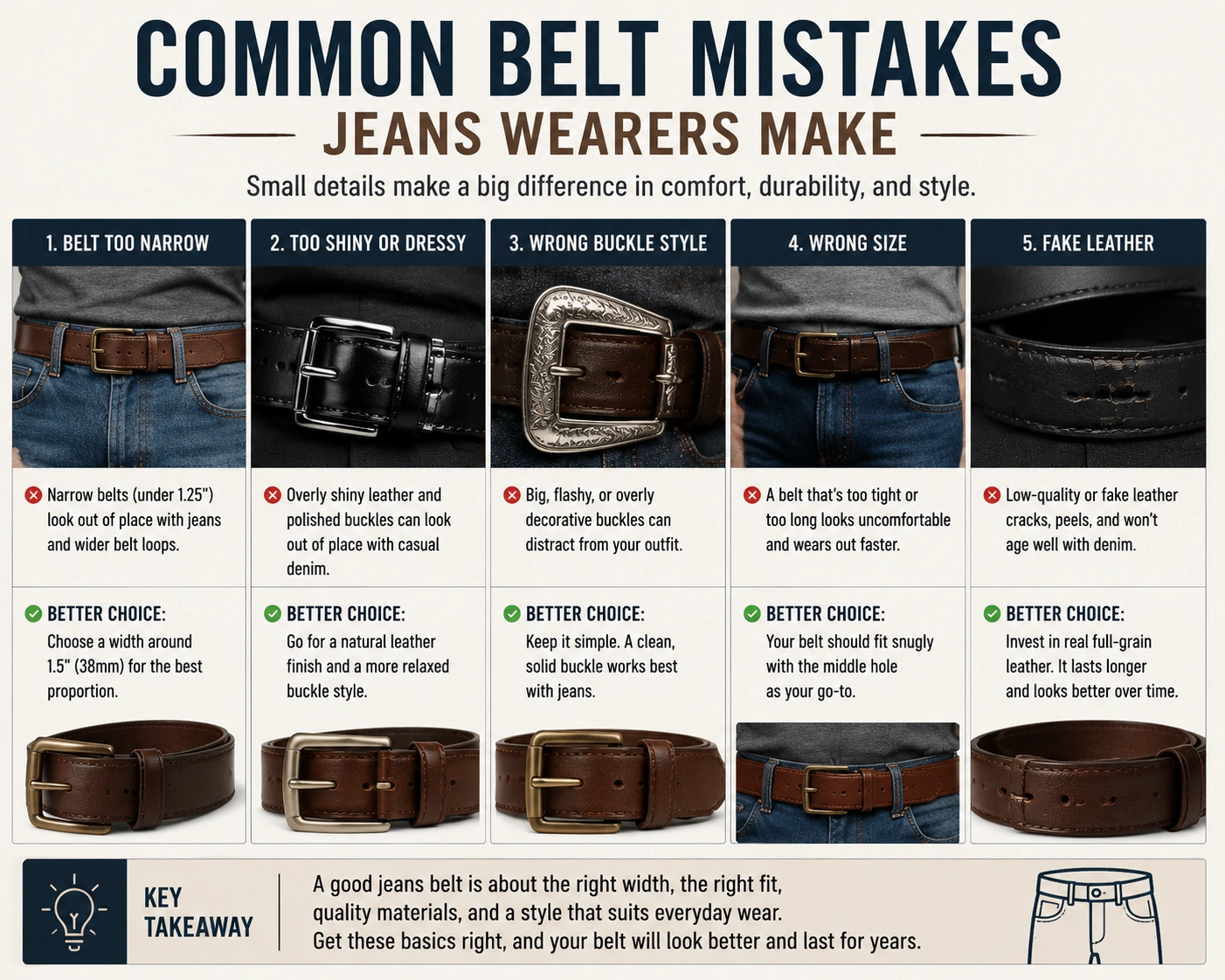
What To Look For In a Long-Term Jeans Belt
The specifications that actually predict whether a belt will still be performing in three years:
Full-grain leather — the fiber density at the outer hide handles the repeated daily stress of jeans wear better than any lower grade. The surface also develops the kind of patina that pairs naturally with denim as both age.
Around 4mm thickness — enough material at the holes to resist deformation under daily buckle stress. Below this, hole wear shows up faster. The leather belt thickness guide has the full breakdown.
Solid brass or steel buckle — not plated alloy. The buckle experiences real mechanical load every day. Plated buckles wear through the finish at friction points within months; solid brass doesn't. A brass buckle that develops its own surface patina alongside aged leather is a better-looking long-term combination than a buckle that starts flaking its finish within the first year.
1.5-inch width — fills standard jean loops correctly, sits stable throughout the day, proportional to the fabric weight.
Single-piece construction — no adhesive bonds between layered leather that can eventually separate at the edges.
Correct sizing — fastens at the middle hole of the belt's five-hole range, which is where the buckle pin bears load the way the belt was designed to carry it.
At KKICO, everyday wear and long-term durability are the priorities we build around — because a belt that performs well for years is a better outcome than one that looks perfect on day one.
Frequently Asked Questions
What is the best belt width for jeans?
1.5 inches (38mm) works best for most jeans. Standard jean belt loops are designed for this width — it fills the loop without forcing, sits flat and stable during wear, and carries enough visual weight to be proportional against denim. Narrower widths work in the loops but shift around during the day; wider widths can sit too rigid and high on regular-cut jeans.
Should I wear a brown or black belt with jeans?
Brown works better with most blue denim — the warm-cool contrast reads as casually balanced. Black works well with very dark or black denim, and works in smart-casual contexts where you want the combination to read slightly more formal. Black with medium blue denim works but creates more contrast than most people find ideal. Avoid high-gloss finish in either color with casual denim — matte or semi-matte leather suits denim much better.
Can I wear a dress belt with jeans?
Technically yes, but the result often looks mismatched. Dress belts are typically 1 to 1.25 inches wide and made from thinner, more polished leather with smaller, sleeker hardware. On jeans, the belt looks too narrow for the loops, the finish clashes with casual denim, and the scale of the buckle is off relative to the fabric. A dedicated casual leather belt at 1.5 inches does the job better.
What leather is best for a jeans belt?
Full-grain leather is the most practical choice for a belt worn daily with jeans. Its dense fiber structure resists the hole deformation and fold cracking that daily jeans wear produces over time, and it develops a patina that pairs naturally with how denim ages. Lower grades of genuine leather and synthetic materials are more prone to showing wear in ways that look like deterioration rather than character.
How long should a jeans belt last?
A well-made full-grain leather belt, properly sized and given occasional conditioning, should last many years of regular daily use — often considerably longer than most people expect from a belt. The key variables are leather grade, thickness at the holes, correct sizing, and basic periodic conditioning. Belts that fail within a year or two are almost always failing due to thin leather, wrong sizing, or lower-grade material — not from being worn too often.