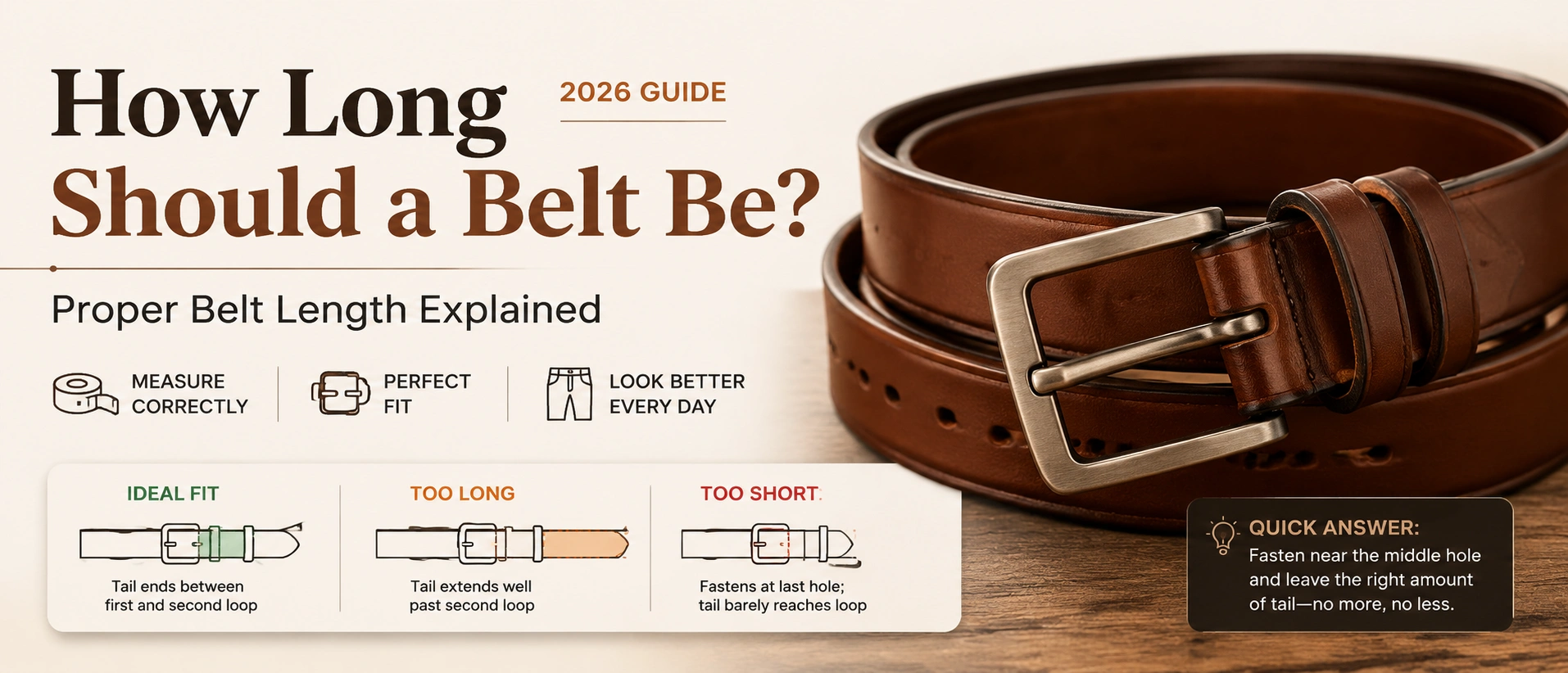
A properly fitting belt should fasten near the middle hole and leave enough tail to pass through the first belt loop comfortably — without the excess hanging past the second loop or flopping awkwardly against your pants.
That's the short answer, and for most people it's all they need. But belt length trips up a surprising number of buyers, including people who've been wearing belts for decades.
The confusion usually starts because belt length and belt size aren't the same measurement, the tail that sticks out after fastening is easy to misjudge when shopping online, and most product listings don't give you a clear picture of how the belt will actually look on your body.
This guide explains how long a belt should be, why the tail length matters, how to tell when a belt is too long or too short, and how to measure for the right fit before you buy.
The Ideal Belt Length at a Glance
Before getting into the details, here's a quick visual framework:
| Fit Category | What It Looks Like |
|---|---|
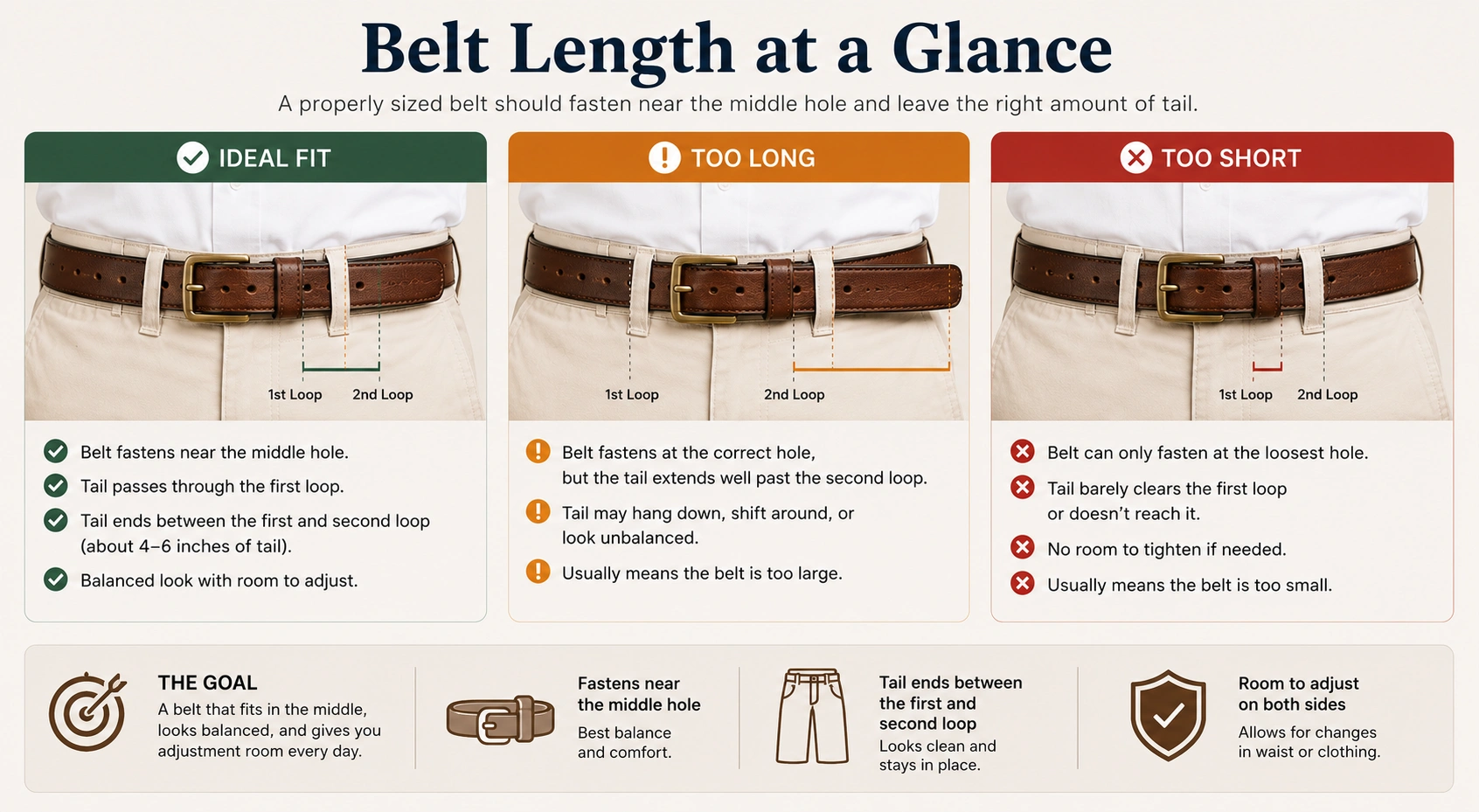
| Ideal fit | Belt fastens near the middle hole; tail passes through the first loop and ends between the first and second loop |
| Too long | Belt fastens at the correct hole but the tail extends well past the second loop, hanging visibly |
| Too short | Belt can only fasten at the loosest hole; tail barely clears the first loop or doesn't reach it |
The goal is a belt that works from the buckle all the way to the tail end — proportional, functional, and comfortable.
When the length is right, you don't notice it at all. When it's wrong in either direction, it's obvious.
How Much Belt Should Stick Out?
This is one of those questions that sounds trivial until you're standing in front of a mirror with four inches of leather flapping past your second belt loop.
The generally accepted standard for belt tail length is that the tail — the part of the belt that extends past the buckle after fastening — should pass through the first belt loop and end somewhere between that first loop and the second.
In practical terms, this usually means about four to six inches of leather extending past the buckle frame when the belt is fastened and lying flat.
This isn't an arbitrary aesthetic rule.
A tail that's too short doesn't anchor properly in the first keeper loop, which means the belt can shift or the tail can lift away from the pants during the day.
A tail that's too long creates a visible, awkward drape of excess leather against your leg — and if it's long enough, it can actually interfere with how the front of the belt sits.
A few factors affect where exactly the tail falls:
Number of belt loops.
Pants with more closely spaced loops leave less room between the first and second loop, which makes a slightly longer tail look more proportional.
Pants with wider loop spacing may make the same tail length look excessive.
Belt width.
Wider belts have proportionally more visual presence, which can make a slightly shorter tail look acceptable.
Narrow dress belts can make a long tail look stranger because the thin strip of leather has nowhere to go.
Personal style.
Workwear aesthetics tolerate a bit more tail length than a clean dress look.
There's no single universal rule, but four to six inches is a sensible target for most situations.
If your belt consistently produces a tail that's too long or too short, the issue isn't the belt — it's the size.
A belt properly sized for your waist should produce the right tail length automatically.
Why the Middle Hole Matters
If you take one sizing principle away from this guide, let it be this one:
A belt should fasten at the middle hole.
Most leather belts come with five holes spaced about one inch apart.
The middle hole — usually the third one — is where the belt is designed to fasten for its labeled size.
This exists for a practical reason:
life changes, and your belt needs room to accommodate that.
Your weight can fluctuate slightly throughout the year.
Different pants, seasonal clothing, and personal comfort preferences can all affect how a belt feels.
A belt that fastens at the middle hole gives adjustment room in both directions.
A belt that only fastens at the first or last hole has no flexibility left.
The middle hole fit is also the clearest indication that a belt is the correct size.
If you're consistently using the edge holes, the belt may technically close — but it is probably not the ideal length.
Common Customer Question: "Why Does My Belt Tail Hang So Far Past My Belt Loop?"
A common situation looks like this:
The belt fastens comfortably.
The buckle sits correctly.
But the tail extends far beyond the second belt loop.
Many buyers assume the belt is defective.
In reality, the belt is usually one size too large.
Here's what typically happens:
A buyer estimates their belt size, rounds up to be safe, and receives a belt that fastens comfortably — maybe even at a reasonable hole position — but leaves six or seven inches of leather tail hanging past the second loop.
The buckle looks fine.
The fastening is secure.
But the tail won't stay in the keeper loop, keeps shifting, and draws attention every time they move.
The instinct is to assume something is wrong with the belt.
Usually nothing is.
The belt is built correctly; it's just sized for someone with a larger waist.
The fix is sizing down, not modifying the belt.
On a quality leather belt with removable hardware, shortening the belt from the buckle end can remove extra length while keeping the original tail shape.
But the cleaner solution from the start is ordering the right size.
How to Measure Belt Length Correctly
There are two things you might want to measure:
- the belt itself
- your body
Here's how to do both accurately.
Measuring a Belt You Already Own
This method is the most reliable for determining what size to order next.
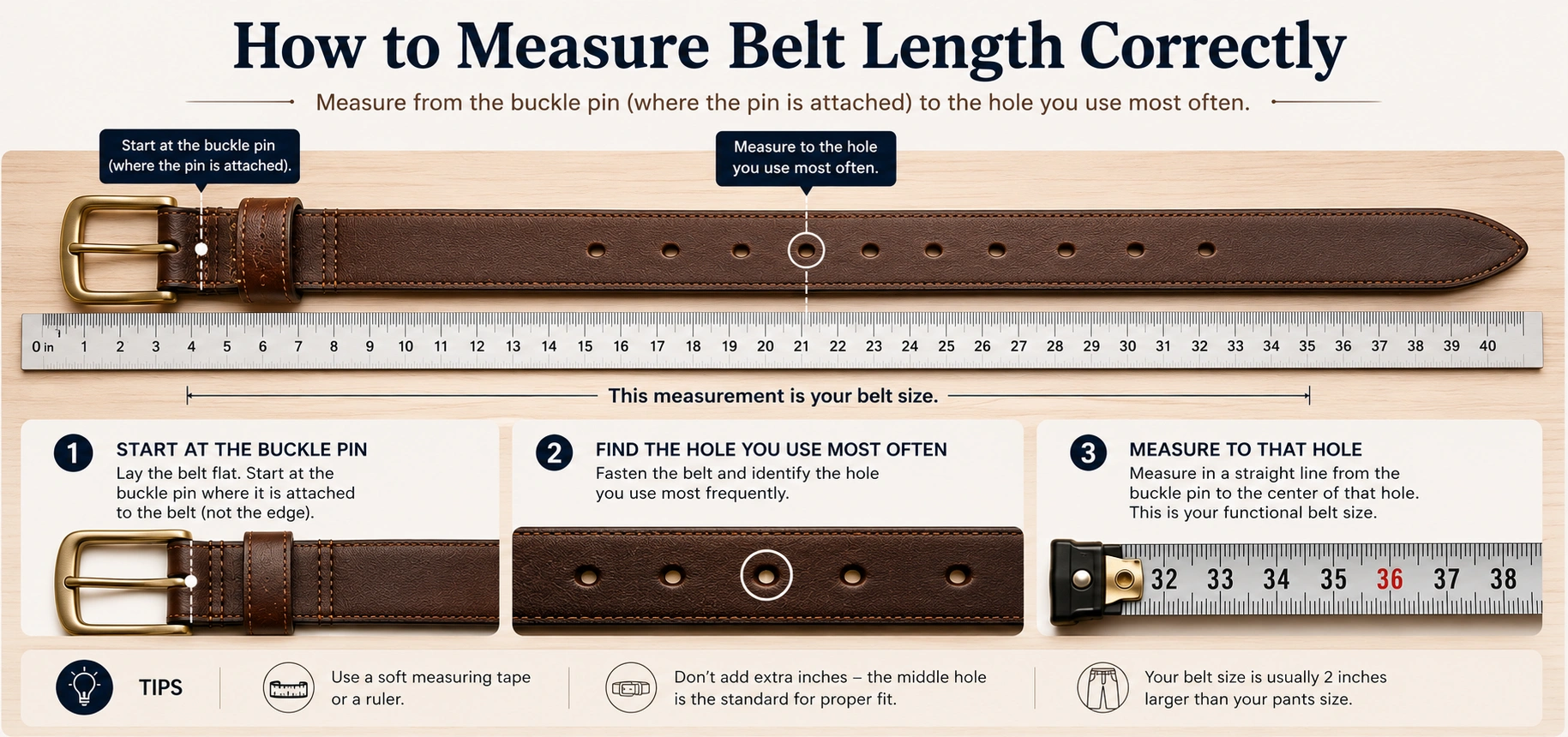
Step 1: Lay the belt flat on a hard surface.
Make sure the belt is fully extended and not bent or coiled.
Step 2: Find the buckle pin connection point.
This is where the buckle pin actually sits — not the outside edge of the buckle frame and not the tip of the belt.
Step 3: Measure to your most-used hole.
Run your measuring tape from the buckle pin connection point to the hole you fasten most often.
This distance is your functional belt size.
Why Belt Length and Belt Size Are Not the Same Thing
This distinction causes more confusion than almost anything else in belt shopping.
Belt size is the usable measurement.
It refers to the distance from the buckle pin connection point to the middle hole of the belt.
For example:
A size 36 belt usually means the middle fastening hole sits around 36 inches from the buckle pin.
This measurement tells you how the belt will actually fit on your body.
Belt length, however, refers to the total length of the leather strap.
This includes:
- the tail end
- extra leather past the holes
- the buckle attachment area
Because of this, total belt length is always longer than the usable belt size.
These measurements are often confused because different brands describe sizing differently.
A belt labeled by total strap length and a belt labeled by waist fit can represent completely different sizes.
The pants size vs belt size relationship adds another layer of confusion.
Your pant waist size and your belt size are not exactly the same.
A common starting point:
Your belt size is usually about two inches larger than your pants waist size.
For example:
34-inch pants → around a 36-inch belt
Ordering only based on your pants size often leads to a belt that feels too short.
What Many Belt Owners Get Wrong
Across leather communities and online discussions, one of the most common complaints is:
"My belt technically fits, but the tail looks awkward."
In many cases, the belt itself is not incorrectly made.
The problem is usually that the wearer is using a size that forces the belt into the wrong adjustment range.
A properly sized belt should balance both waist fit and tail length.
The buckle should sit naturally, the belt should fasten near the middle hole, and the tail should end in a visually balanced position.
Common Signs Your Belt Is Too Long
A belt that's too long usually shows its problems at the tail end rather than at the buckle.
Common signs include:
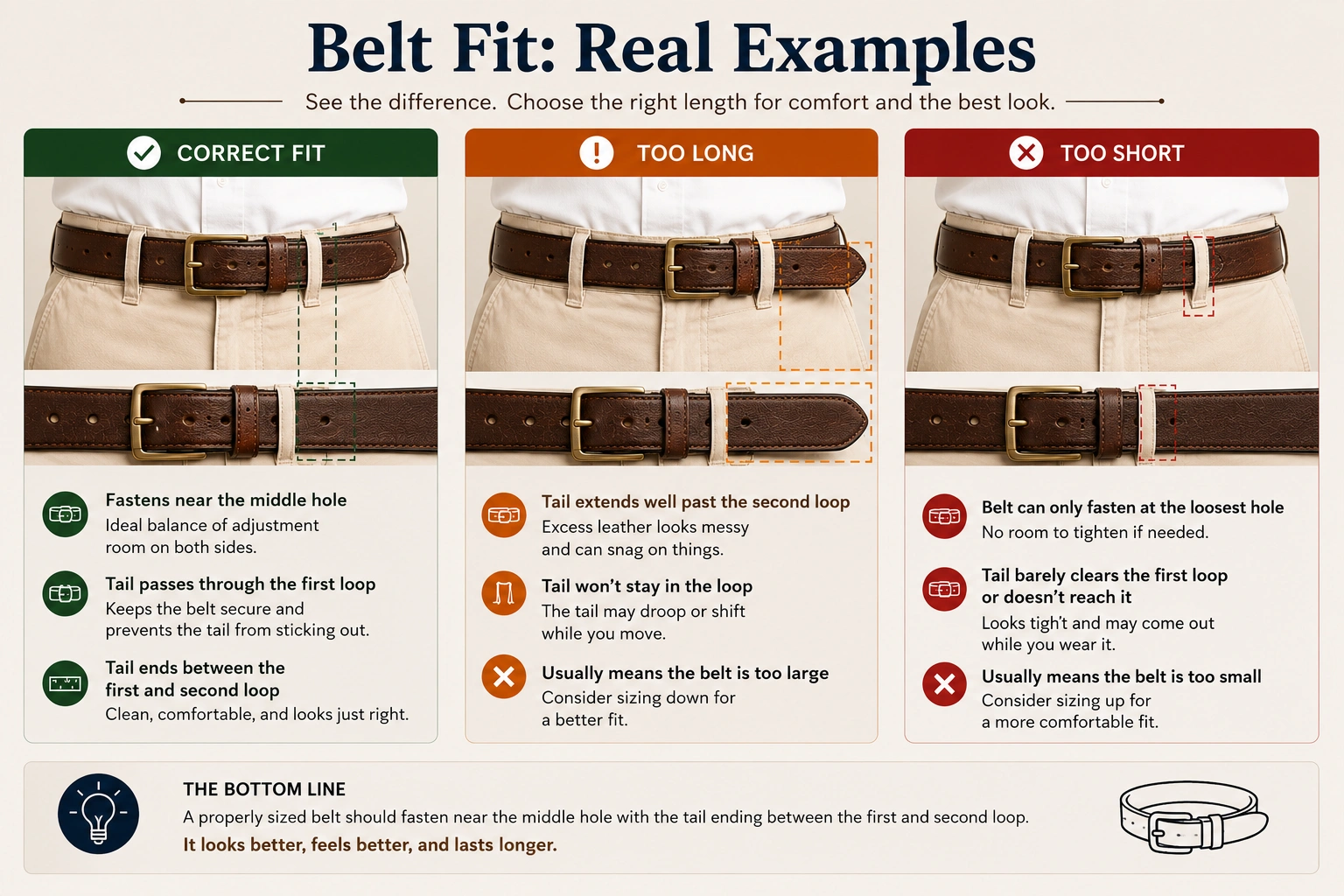
The tail extends well past the second belt loop.
This is the clearest visual indicator.
The extra leather continues beyond where it should naturally stop.
The tail won't stay in the keeper loop.
Too much excess leather can push outward or shift throughout the day.
You're fastening at the tightest available holes.
If you constantly need the smallest adjustment setting, the belt may be too large.
The buckle sits off-center.
A properly sized belt naturally keeps the buckle positioned in the center.
Too much extra length can shift the balance.
Common Signs Your Belt Is Too Short
A belt that's too short creates the opposite problem.
Signs include:
You can only fasten at the loosest hole.
This means the belt barely closes and leaves no adjustment room.
The tail barely reaches the first belt loop.
A proper belt tail should pass through the first loop comfortably.
Sitting feels uncomfortable.
A belt that's too small creates unnecessary pressure when sitting or moving.
You have no adjustment room left.
Even if the belt technically closes, it does not leave flexibility for daily changes.
Can You Fix a Belt That's Too Long?
Yes, depending on the belt construction.
If the belt is only slightly too long, adding a hole can sometimes improve the fit.
This works when you are only one adjustment position away.
However, adding holes does not remove excess tail length.
If the belt is significantly too long, shortening the belt from the buckle end is usually the cleaner solution.
This allows extra leather to be removed while preserving the finished tail.
Avoid cutting the tail end.
The tip is usually shaped and finished, and cutting it changes the appearance of the belt.
For a belt that's too short, there is usually no reliable way to add length.
Choosing the correct size is the better solution.
Do Different Belt Styles Require Different Lengths?
The same sizing principles apply across most belt styles, but the ideal appearance can vary slightly.
Casual Belts
Casual belts worn with jeans or workwear usually allow slightly more visual flexibility.
A slightly longer tail may look natural with rugged outfits.
Dress Belts
Dress belts usually look better with a cleaner appearance.
The tail should sit neatly without excessive overhang.
Work Belts
Work belts prioritize function and durability.
The same middle-hole principle applies, although appearance may matter less than comfort and performance.
No matter the style, the goal remains:
A secure fit, comfortable adjustment range, and balanced tail length.
What Leather Belt Owners Often Notice Over Time
If you wear a quality leather belt regularly, you will notice it changing.
But most changes are not about length.
A new belt often feels:
- firm
- structured
- slightly stiff
After months of wear, leather usually becomes:
- softer
- more flexible
- more comfortable
This is especially noticeable with full-grain leather, which develops character while maintaining its structure.
What usually does not change significantly is the actual length.
Many people wonder whether leather belts stretch over time, but normal wear usually does not change the size enough to fix a wrong fit.
A quality leather belt may soften, flex more naturally, and become more comfortable, but it generally maintains the same usable size throughout years of regular wear.
How to Choose the Right Belt Length Before Buying
The most reliable approach is to remove guesswork entirely.
What Size Belt Do I Need?
Many shoppers asking "what size belt do I need?" are actually trying to solve a belt length problem rather than a waist measurement problem.
A good fit is not only about whether the belt closes — it is about where it closes and how much tail remains after fastening.
The ideal belt fastens near the middle hole, leaves enough tail to pass through the first keeper loop, and avoids excessive overhang beyond the second belt loop.
If you are unsure about choosing the correct size, checking a detailed belt size chart before ordering can help compare your waist measurement with the recommended belt size.
Measure a Belt You Already Own
If you have a belt that currently fits well, measure from the buckle pin to the hole you use most often.
This gives the most accurate reference.
Use the Pants Size Plus Two Rule
A common starting point:
Add about two inches to your pants waist size.
Example:
34-inch pants → 36-inch belt
Always check the specific brand's size guide.
Aim for the Middle Hole
Choose a size that allows the belt to fasten near the center adjustment hole.
This gives you room for normal changes and provides the most balanced appearance.
Frequently Asked Questions
How long should a belt be?
A belt should fasten comfortably near the middle hole and leave enough tail to pass through the first belt loop without extending excessively beyond the second loop.
How much belt should stick out?
Most belts look best with about four to six inches of tail past the buckle, usually ending between the first and second belt loop.
What is the correct belt length?
The correct belt length depends on your waist size.
A properly sized belt should close near the middle hole and leave a balanced tail length.
Should a belt reach the second belt loop?
The tail can approach the second belt loop, but it usually should not extend far beyond it.
Can a belt be too long?
Yes.
A belt that is too long often creates excess tail length and forces you to use the tightest holes.
Can you shorten a leather belt?
Yes, many leather belts with removable buckles can be shortened from the buckle end.
This preserves the finished tail and creates a cleaner result.
What if my belt only fits on the first hole?
If your belt only fits at the loosest adjustment point, it is usually too small.
A properly sized belt should give adjustment room in both directions.
What size belt do I need if my belt tail is too long?
If your belt tail extends well beyond the second belt loop, you may need a smaller belt size rather than a shorter belt.
The best way to confirm is to measure from the buckle pin to your most-used hole and compare that measurement with a reliable belt size guide.
In many cases, an overly long tail is simply a sign that the belt is being worn outside its intended adjustment range.
Final Thoughts
Finding the right belt length is not just about choosing a number.
A great-fitting belt should:
- fasten near the middle hole
- leave a balanced tail length
- feel comfortable throughout the day
- provide adjustment room over time
The easiest way to avoid sizing mistakes is to measure carefully before buying.
A properly fitted leather belt should almost disappear when you wear it — comfortable, balanced, and ready for years of everyday use.