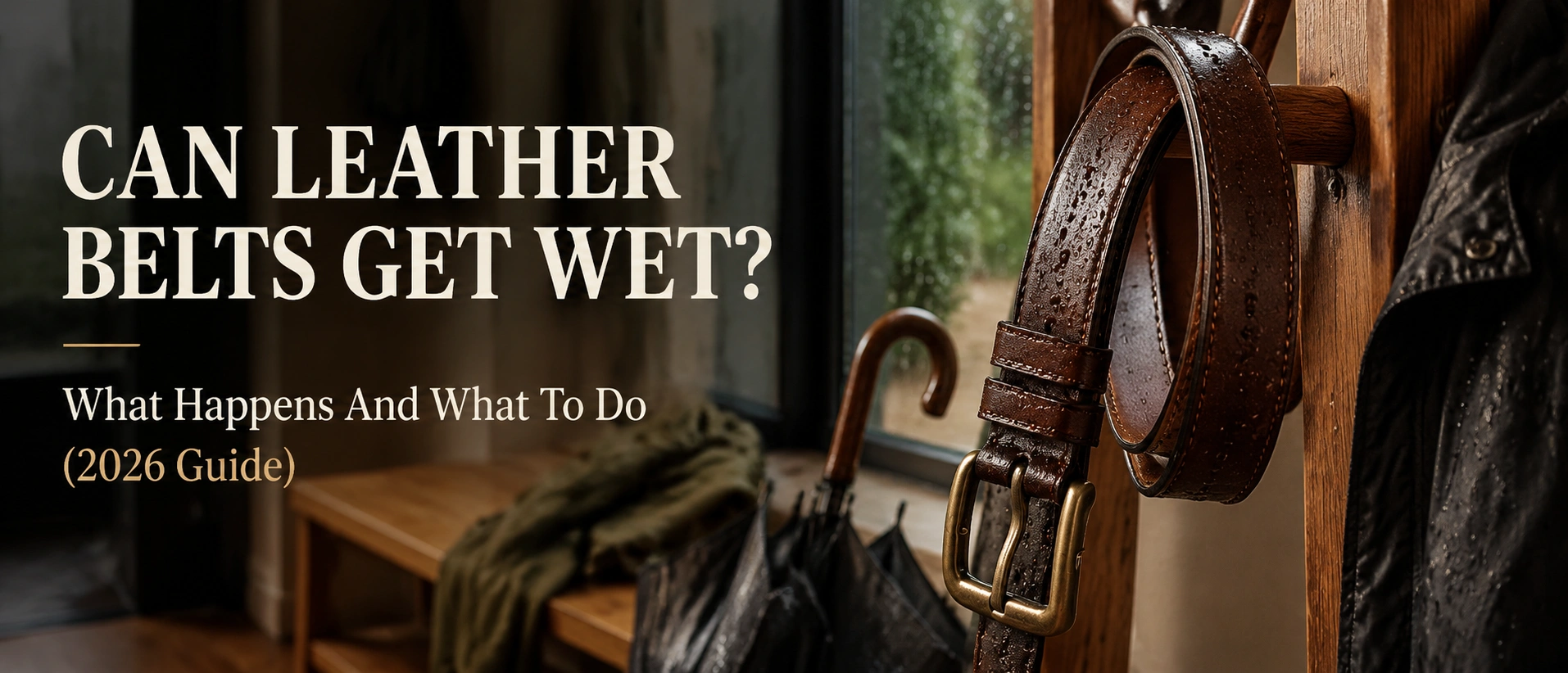
You're caught in the rain. Your jacket can't quite cover your waist, your belt takes the full hit, and by the time you get inside it's visibly dark and damp.
Now what?
Many people assume water instantly ruins leather — that a good soaking means the belt is finished. Others assume leather is tough enough that water doesn't really matter: it's survived for centuries, what's a little rain?
Neither of those is quite right. The truth is somewhere more specific, and more useful, than either.
A Quick Answer: Can Leather Belts Get Wet?
Yes. Leather belts can get wet, and in most cases, getting wet once — or even a few times — isn't what ruins them.
The real issue isn't the water itself.
It's what happens after the leather dries.
How you handle a wet belt in the hours that follow matters considerably more than the fact that it got wet in the first place. Get that part right, and most leather belts recover completely. Get it wrong, and that's often where the actual damage starts.
Why Water Affects Leather In The First Place
Leather is tanned animal hide — a process that converts raw skin into a durable, flexible material while preserving much of its structure. But even after tanning, leather remains an organic material with a real, physical fiber structure, not a synthetic one. (Source: general definition of leather, Wikipedia – "Leather.")
That matters because water interacts with organic fiber differently than it does with, say, nylon or canvas.
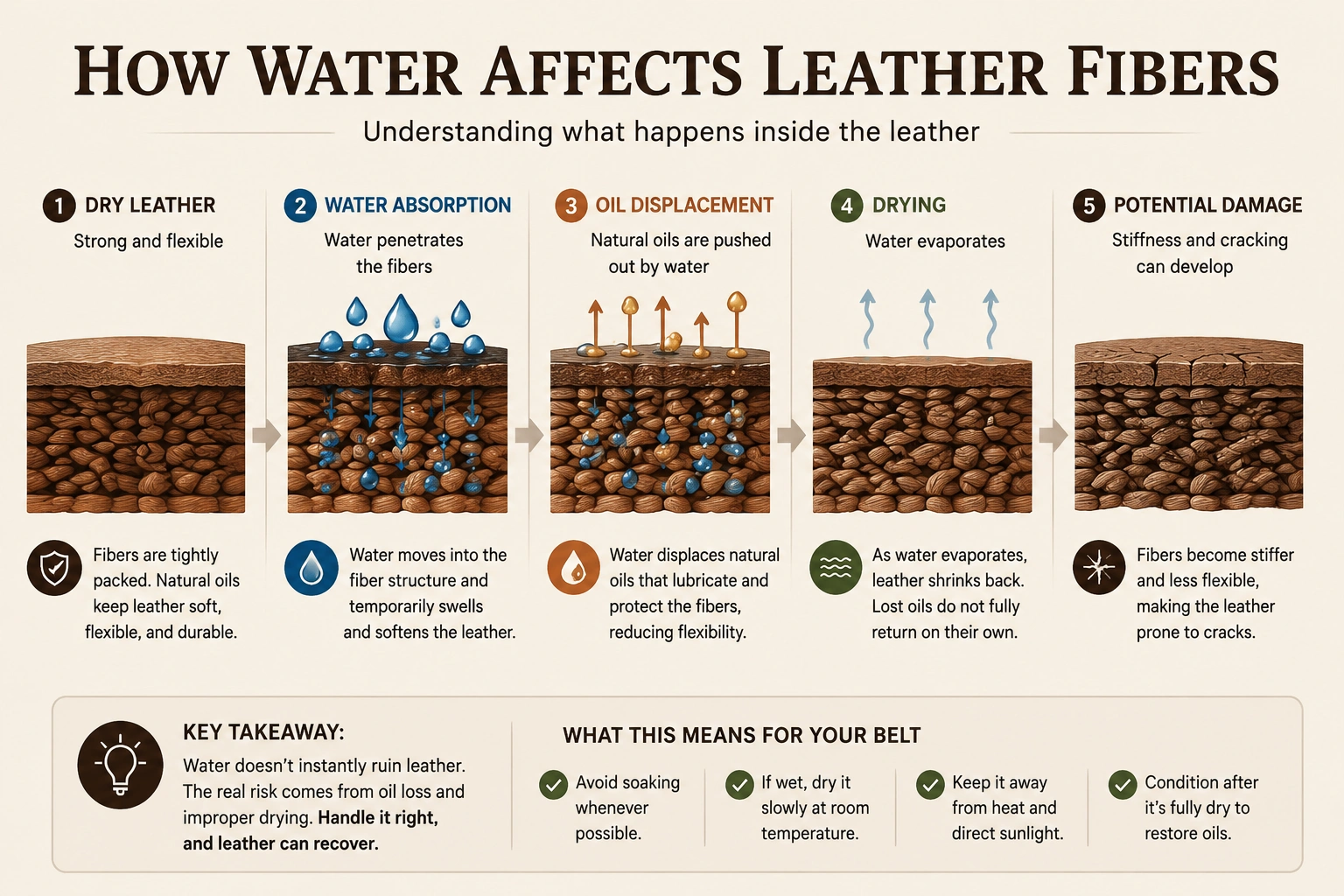
When leather gets wet, the water moves into the fiber structure and temporarily softens it. At the same time, it begins displacing the natural oils that keep the fibers flexible and lubricated. This isn't dramatic — the leather doesn't swell dramatically or fall apart. But as the belt dries, those displaced oils don't fully return on their own, and the fibers that were softened by the water can end up stiffer than they were before once the moisture is gone.
That's the core of it. Water softens leather temporarily; improper drying stiffens it permanently. The water is a catalyst, not the damage itself.
What Happens If A Leather Belt Gets Wet?
The changes don't necessarily happen immediately, which is part of what makes this confusing.
While wet, the belt usually feels softer and more pliable than normal — the water has temporarily loosened the fiber structure. The color darkens, often noticeably. The surface may feel slightly tacky if the belt has a wax or oil-based finish. All of this looks alarming, but it's still reversible at this point.
After drying, this is where things can go one of two ways. If the belt dried slowly, at room temperature, without being stretched or creased while still soft — it usually returns to something close to its normal condition, maybe slightly stiffer than before but otherwise intact.
If the belt dried quickly — near a heat source, or left to stiffen in a bent position while still soft — the fiber structure can lock in a shape or a stiffness that doesn't reverse. Leather remembers what position it dried in. A buckle fold that dried at a sharp angle, rather than the gentle one it normally sits at, can retain that sharper shape indefinitely.
Long-term, repeated wetting without appropriate care after each incident does compound. The cumulative oil loss builds up over multiple wet-dry cycles, and leather that was slightly stiffer after cycle one is slightly stiffer still after cycle five. At that point, you start getting into the territory covered in why leather belts crack — dryness as a mechanism for eventual structural failure.
Can Rain Damage A Leather Belt?
It depends on how much rain and how often — which is a less satisfying answer than "yes" or "no," but it's the accurate one.
Light rain — a short walk in a drizzle, some splashes, the kind of moisture that makes the surface look damp but doesn't soak through — is generally not a concern for a leather belt. Full-grain leather in particular handles this kind of incidental moisture well. Pat it dry when you get inside and carry on.
Heavy rain, or anything that fully saturates the belt, is a different category. The belt is still probably fine, but it's now a situation that calls for some attention. Left to dry on its own, without any intervention, the outcome is less predictable — how it dried, what position the buckle fold was in, whether it happened to end up near a heat source.
Repeated exposure without ever addressing oil loss between incidents is the version that actually causes long-term problems. One soaking followed by a slow natural dry and a light conditioning isn't a crisis. One soaking a week, over a few months, with nothing done between them — that cumulative oil depletion does add up.
Over time, that cumulative wear can have a noticeable impact on how long a leather belt lasts.
The type of leather matters here too. Full-grain leather, with its dense fiber structure, handles moisture better than thinner or more heavily processed leather. A wax-treated leather like crazy horse leather has even more inherent resistance to water penetration, because the wax layer creates a partial barrier before moisture even reaches the fiber structure. Heavily coated genuine leather can react differently again — the surface might shed water initially, but once the coating is compromised in any way, the underlying leather can absorb moisture unevenly.
Can You Wash A Leather Belt?
Generally, no. Not in any conventional sense of "washing."
Machine washing is off the table entirely — the combination of prolonged water saturation, mechanical agitation, detergent, and the heat of a dryer cycle is essentially a worst-case scenario for a leather belt. Each of those things causes real damage on its own; combined, they tend to ruin leather fairly comprehensively. Belts have been through washing machines and survived, but it's the exception, and usually they've aged several years in the process.
Hand washing in a sink, while gentler, still saturates the leather far more thoroughly than rain would, and most soaps or detergents are designed to remove oils and grease — which is exactly what leather needs to retain. Rubbing a wet belt down with soap is a very efficient way to strip it of the oils that were keeping the fibers flexible.
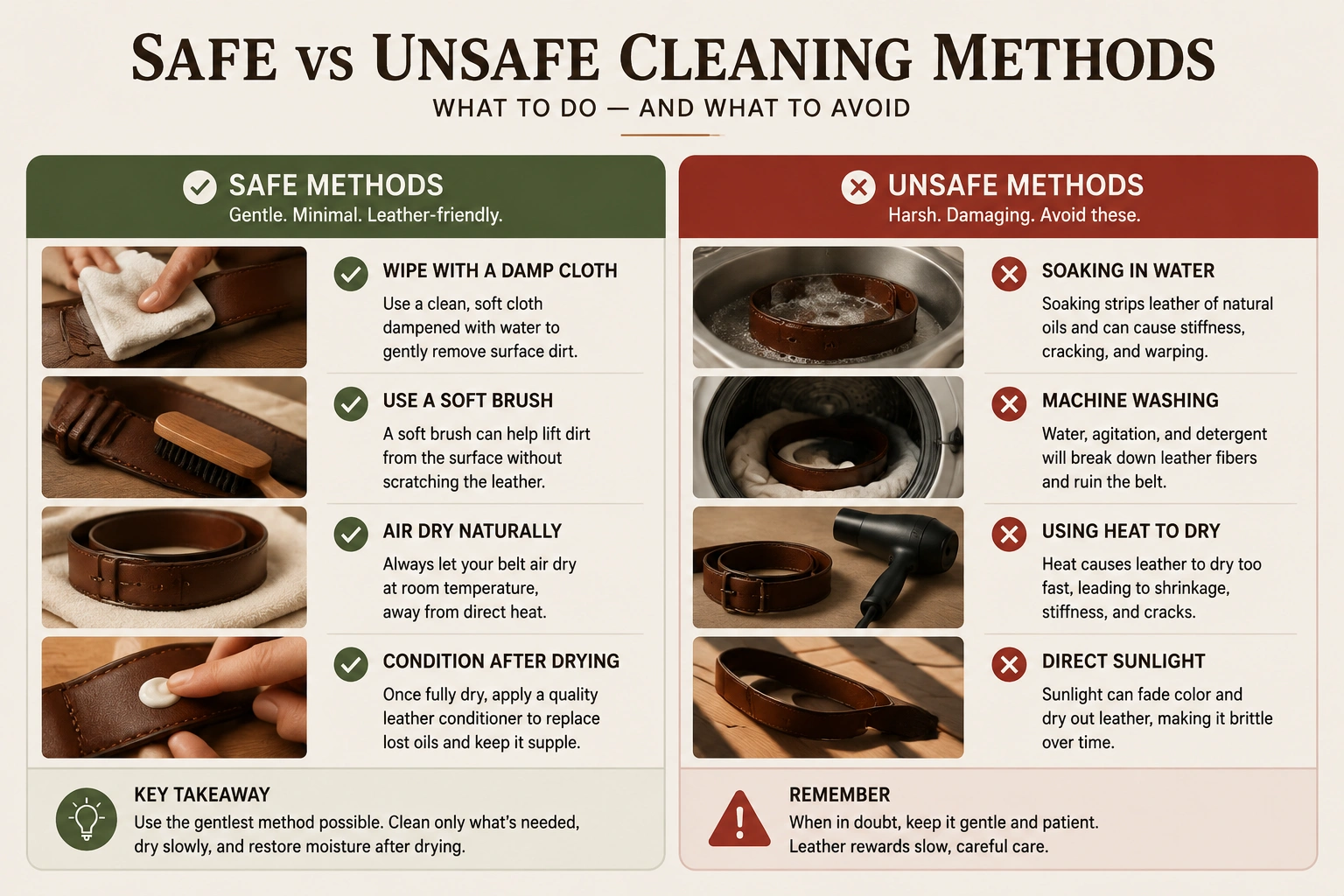
For actual cleaning — removing sweat residue, dirt, surface grime — a dry or lightly damp cloth handles most of it without approaching saturation. If a belt needs more than that, a product made specifically for leather cleaning is worth the effort. The reason leather-specific cleaners exist is precisely because general-purpose cleaning products tend to solve the dirt problem by creating a different, worse problem.
How To Dry A Wet Leather Belt Properly
This is the part that actually matters most, because it's where most of the recoverable wet-belt situations either stay recoverable or stop being so.
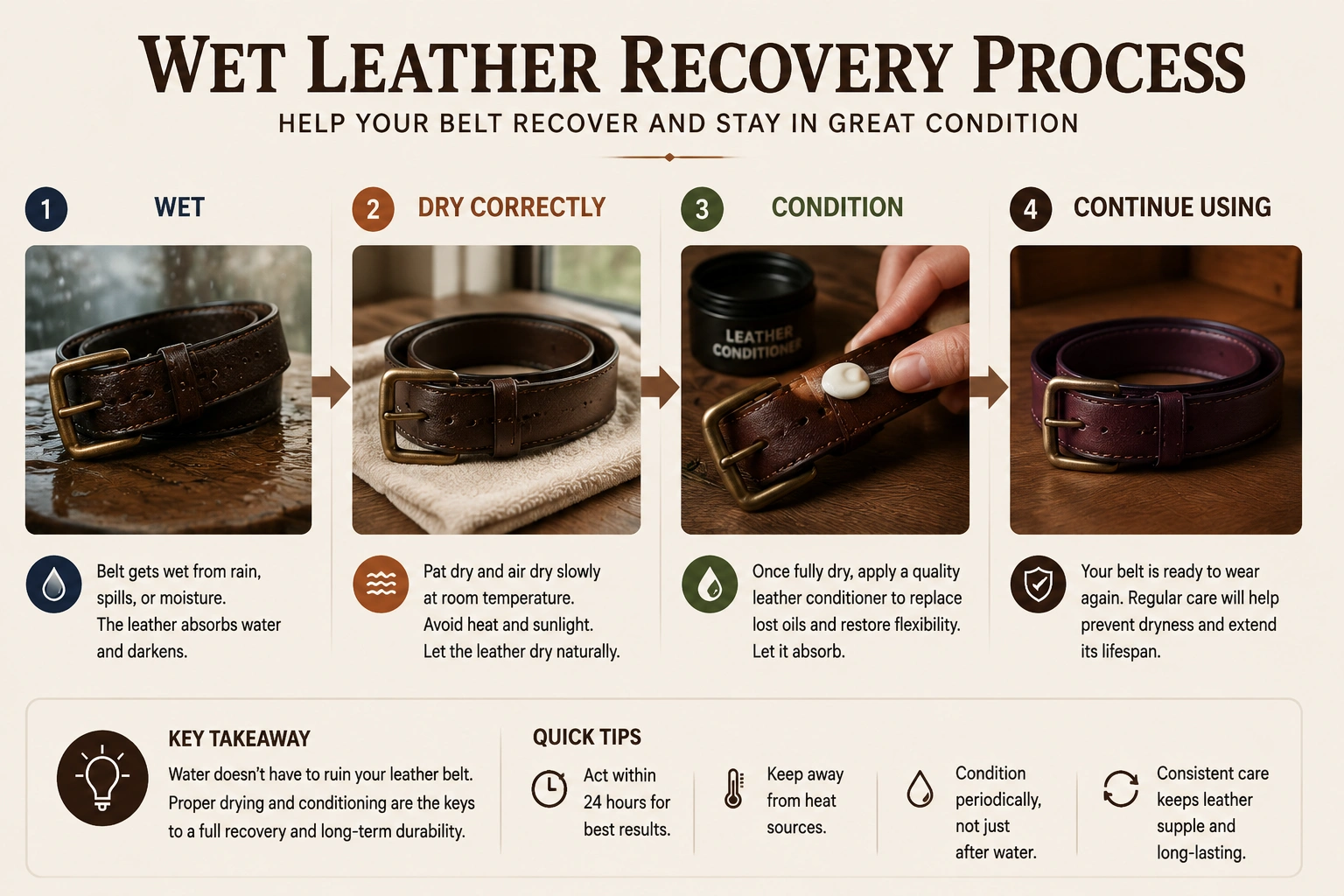
Pat dry first. Use a soft cloth or a clean towel to absorb surface moisture without rubbing. Rubbing a wet leather surface causes more friction than the softened fiber structure handles well. Patting removes most of the surface water without the abrasion.
Let it air dry at room temperature. This is the most important step and the one people most often skip in favor of something faster. Leather drying slowly, in ambient air, at a moderate temperature, gives the fiber structure time to settle back into something close to its original condition as the moisture leaves.
Keep it away from heat. Radiators, hair dryers, the back window of a parked car in summer — all of these dry leather too quickly and unevenly. Fast drying causes the outermost fibers to tighten and shrink before the interior has had time to adjust, which is precisely the mechanism that leads to cracking and stiffening. It can happen in minutes with a hair dryer and take months to show up as a crack.
Mind the shape while it's still soft. A wet belt is significantly more impressionable than a dry one. If it's draped in an unusual position, or if the buckle fold is compressed into a sharper angle than normal while it dries, the leather may hold that shape once it stiffens back up. Where possible, hang the belt naturally or lay it flat while it dries.
Condition after it's fully dry. Once completely dry — not slightly cool to the touch, but genuinely dry — a light application of leather conditioner helps replace some of the oils that the water moved or displaced. This step isn't always strictly necessary after a light wetting, but after any significant soaking, it's worth doing.
What Not To Do After A Belt Gets Wet
A few specific things that come up often and are worth addressing directly:
Hair dryers are probably the most common mistake. The speed and heat of direct air drying causes the exact kind of rapid, uneven drying that leads to cracking. It seems efficient. The leather usually looks fine immediately after. The damage often shows up weeks later.
Radiators and heating vents have the same problem as hair dryers, just slower. The belt dries out thoroughly rather than gently, and the oil loss that results often isn't immediately visible — until the belt starts feeling noticeably stiffer in the fold area.
Direct sunlight for extended periods is a version of the same mechanism, and it adds UV damage on top of the drying effect. Hanging a wet belt in a sunny window to dry faster is not the move.
Leaving the belt crumpled or tightly coiled while it dries is a quieter issue than heat, but still real. A belt that dries in a tightly coiled position around its buckle can retain a sharper curve at that fold than it naturally should have, which adds stress to exactly the spot that already takes the most daily wear.
Aggressive scrubbing while wet is worth avoiding for the same reason that rubbing during the pat-dry step is — the fiber structure is softened and more vulnerable to abrasion than when dry.
Can Water Cause Leather Belts To Crack?
Water alone usually doesn't. Improper drying often does.
This is worth distinguishing because it changes what you actually worry about.
The scenario where a wet belt leads directly to cracking usually involves rapid drying with heat — the fibers tighten too quickly, the oils that were displaced by water don't redistribute, and the stiffened leather encounters normal flex stress sooner than it can handle. That's a drying problem with water as the preceding event, not really a water problem on its own.
The longer-term scenario — repeated wetting and drying without any conditioning in between — is cumulative dryness, the same mechanism behind most leather cracking generally. Water isn't ruining the belt directly; it's repeatedly stripping oil from the fibers, and over enough cycles without replenishment, that oil deficit eventually shows up as surface cracking.
So if you're asking whether water is the enemy — not exactly. Dryness is the enemy, and water can accelerate dryness if the drying process isn't handled reasonably well.
How To Protect A Leather Belt From Water
The straightforward version: you can't fully waterproof a leather belt, and trying too hard usually means coating the leather so heavily that it stops breathing properly. But you can meaningfully reduce how much moisture penetrates and how quickly problems develop when it does.
Avoid deliberate soaking where possible. Not because your belt will be ruined by it, but because each incident is one more cycle of the oil displacement process, and the fewer of those you accumulate, the slower the cumulative wear.
Periodic conditioning is the most effective single thing you can do, because it keeps the oil reservoir that protects against dryness reasonably full going into any wetting event. A belt with healthy oil content has more margin than one that's already been neglecting conditioning — the latter is already closer to the point where the next wetting causes visible stiffness or cracking.
Rotate between belts if you live somewhere with frequent rain or if work regularly puts your belt in wet conditions. Two belts each getting wet once a month is better for each individual belt than one belt getting wet twice a month — the recovery time between incidents matters.
Store the belt correctly when it's not being worn. Hanging rather than tightly coiling avoids the compressed-fold problem, and keeping it away from areas that get damp (car trunks, bathroom hooks near showers) reduces incidental moisture exposure between wears.
More on general belt care beyond water specifically is covered in how to care for a leather belt.
Final Thoughts
Water is usually not the thing that ruins a leather belt.
Poor drying habits are.
A belt caught in the rain, dried slowly and naturally at room temperature, and given a light conditioning treatment afterward will generally come through without meaningful damage. The same belt, stuck in front of a hair dryer to speed things up, often ends up looking noticeably different within weeks — stiffer at the fold, slightly more brittle at the surface, closer to showing the early signs of cracking.
The belt didn't fail because it got wet. It failed because of what happened in the hour after.
Frequently Asked Questions
Can leather belts get wet?
Yes. Leather belts can get wet and usually recover well if dried correctly. The issue isn't water exposure itself — it's the drying process that follows. Leather dried slowly at room temperature typically comes through without significant damage. Leather dried quickly with heat is where most problems start.
Can rain ruin a leather belt?
Light rain generally won't cause any lasting damage to a leather belt, especially if it's wiped down and allowed to dry naturally afterward. Heavy or sustained rain is more of a concern — not necessarily because the belt is ruined, but because it calls for more attention during drying and ideally a light conditioning treatment once the leather is dry.
What should I do if my leather belt gets soaked?
Pat dry with a soft cloth to remove surface moisture without rubbing. Allow to air dry at room temperature, away from heat sources and direct sunlight. Keep the belt in a natural position while it dries — avoid sharp folds or tight coiling. Once fully dry, apply a small amount of leather conditioner to help replace oils displaced by the water.
Can I wash a leather belt?
Not in any conventional sense. Machine washing is too harsh for leather — the combination of water saturation, agitation, and heat typically causes significant damage. General-purpose soap removes the natural oils leather needs to stay flexible. For cleaning, a dry or slightly damp cloth handles most routine dirt; leather-specific cleaning products are appropriate for anything more thorough.
Will water make leather crack?
Not directly. The more accurate connection is that improper drying after water exposure can cause cracking — rapid heat drying tightens the fibers unevenly, and repeated wetting without conditioning leads to cumulative oil loss. A leather belt dried correctly after getting wet is unlikely to crack because of that specific incident.
Should I condition a leather belt after it gets wet?
Yes, after the belt is completely dry. Conditioning after a significant wetting replenishes oils that water displaced during the saturation and drying process. For light incidental moisture, it's optional but not harmful. After any thorough soaking, it's a worthwhile step — the difference between leather that finishes the drying cycle in good condition and one that's already slightly depleted going forward.