Most people shopping for a leather belt think about width. They think about color, about the buckle, occasionally about the type of leather. Almost nobody pays attention to thickness.
Which is a little strange, because thickness often has a bigger impact on how a belt actually feels and performs than any of those other factors do.
The right thickness affects how the belt threads through loops, how stiff it feels around your waist, how the buckle fold holds up over years of daily bending, and how long the holes stay clean before they start showing wear. Get it right and you don't notice it at all — the belt just works. Get it wrong and the belt either feels like you're wearing a piece of cardstock or like you've strapped a plank around your waist.
So how thick should a leather belt actually be?
A Quick Answer: What Is A Good Belt Thickness?
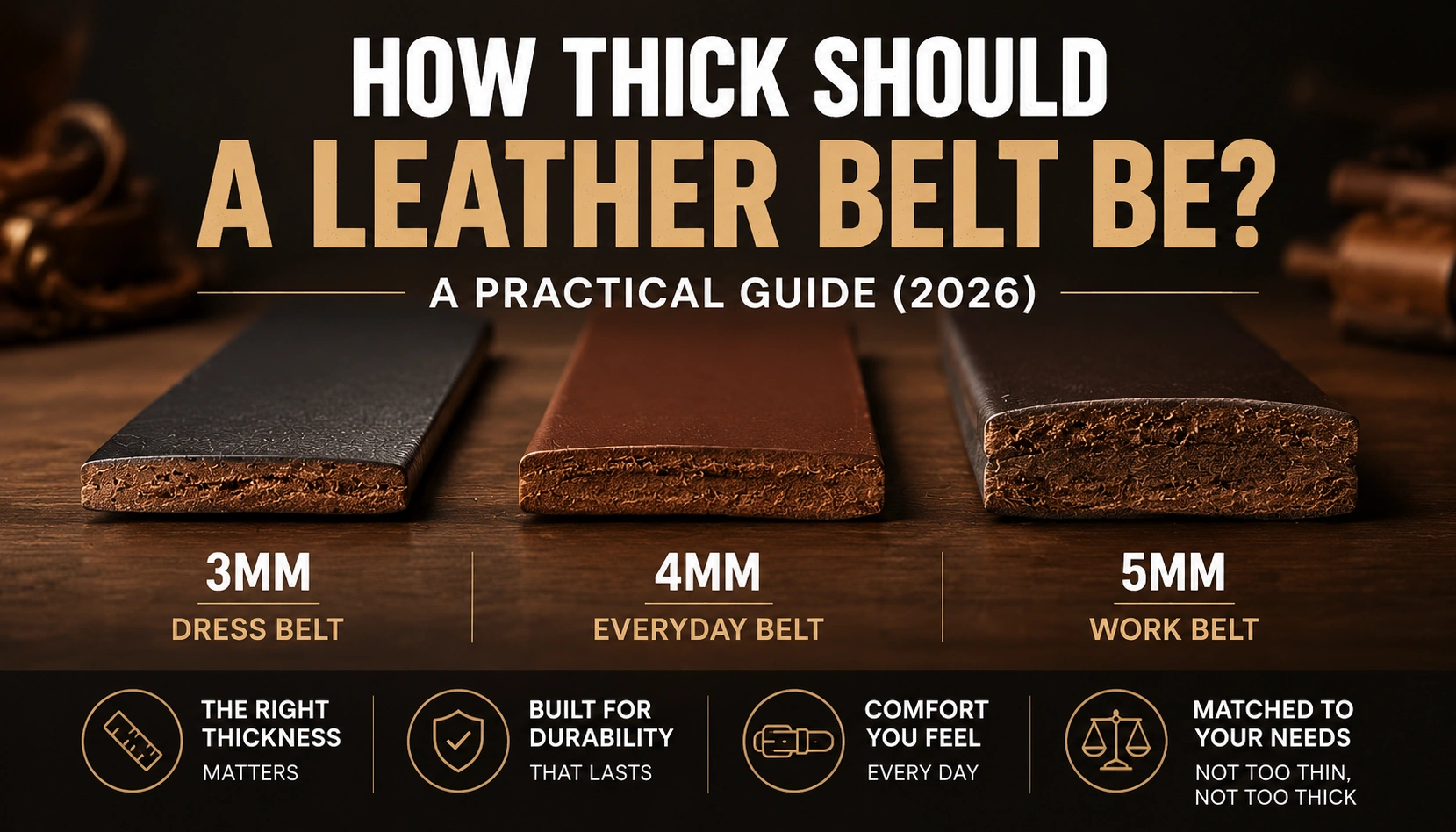
For most everyday leather belts, around 4mm is a reliable starting point. That thickness provides enough material to resist deformation at the holes under daily use, holds its shape through the buckle fold without cracking prematurely, and still has enough flexibility to sit comfortably around your body without feeling rigid.
Thinner than that — toward 3mm — suits dress belts and formal wear, where a sleeker profile matters more than outright durability.
Thicker than that — toward 5mm — gets into work belt and heavy-duty territory, where the belt is expected to carry real load or survive harder conditions than a daily commute.
But the longer answer involves understanding what each of those thicknesses actually feels like and what it's suited for — which is where most belt buyers run into trouble, because thickness isn't something you can evaluate in a product photo.
Why Belt Thickness Matters More Than People Think
The most common assumption is that thicker equals better. Tougher, more durable, more premium.
Not necessarily.
Thickness is one variable in a system that includes leather grade, construction, and intended use. A 5mm belt made from thin, heavily corrected leather isn't more durable than a 4mm belt made from dense full-grain cowhide — it's just thicker, which means it also takes longer to thread through loops, sits more rigidly against the body, and requires a longer break-in period before it starts feeling comfortable.
Where thickness does make a direct difference is in a few specific areas:
Hole wear is the most significant one. Every time the buckle pin goes through the same hole, it puts concentrated stress on a small piece of leather. A thicker belt has more material surrounding that hole to absorb and distribute that stress, which is why holes on thicker belts tend to stay round and cleanly sized longer than holes on thinner ones.
Buckle fold performance is related. The fold where the belt bends through the buckle frame flexes hundreds of times a year. Thicker leather has more fiber depth to absorb that repeated bending, while thinner leather concentrates the stress in a smaller cross-section — which, over a long enough timeline, can contribute to earlier surface cracking at that specific point.
Comfort and flexibility go in the opposite direction. Thicker leather is stiffer, which feels more structured but can also feel more constrictive, particularly when sitting for long periods. There's a real trade-off here, and pretending there isn't doesn't help anyone choose the right belt.
What Does A 3mm Leather Belt Feel Like?
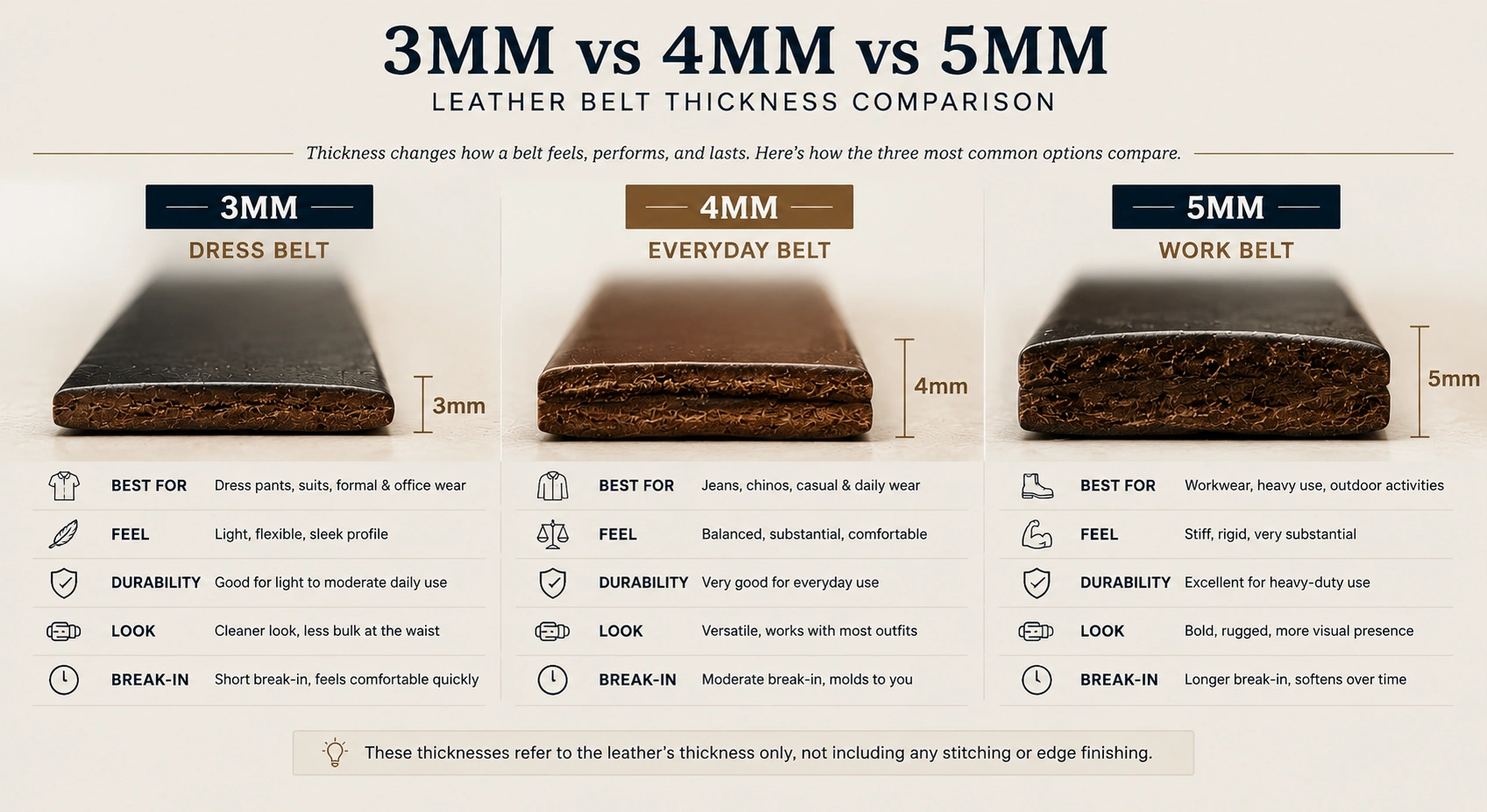
Light. Flexible. Noticeably dressier in how it carries on the body.
A 3mm belt has a slimmer profile that looks cleaner with tailored trousers and dress pants — the proportions work, the belt doesn't add visual bulk at the waist, and it sits flat under a tucked shirt without creating any awkward ridge. When you flex it in your hands, it bends easily and springs back without much resistance.
That flexibility is actually a feature in the right context. Office wear involves a lot of sitting, and a stiffer belt around the waist for eight hours becomes noticeable in a way that a 3mm belt generally doesn't.
The trade-off is durability under heavy daily stress. Thinner leather has less surrounding fiber at the hole points, which means those holes can start showing wear a bit earlier than they would on thicker material — particularly if the belt is the person's only belt, worn six days out of seven. For lighter use and formal contexts, this doesn't matter much. For someone wearing a 3mm belt on construction sites or through fourteen-hour workdays, the thickness is going to show its limits.
Best suited for: dress pants, office wear, business casual, any context where a clean profile matters more than maximum durability.
What Does A 4mm Leather Belt Feel Like?
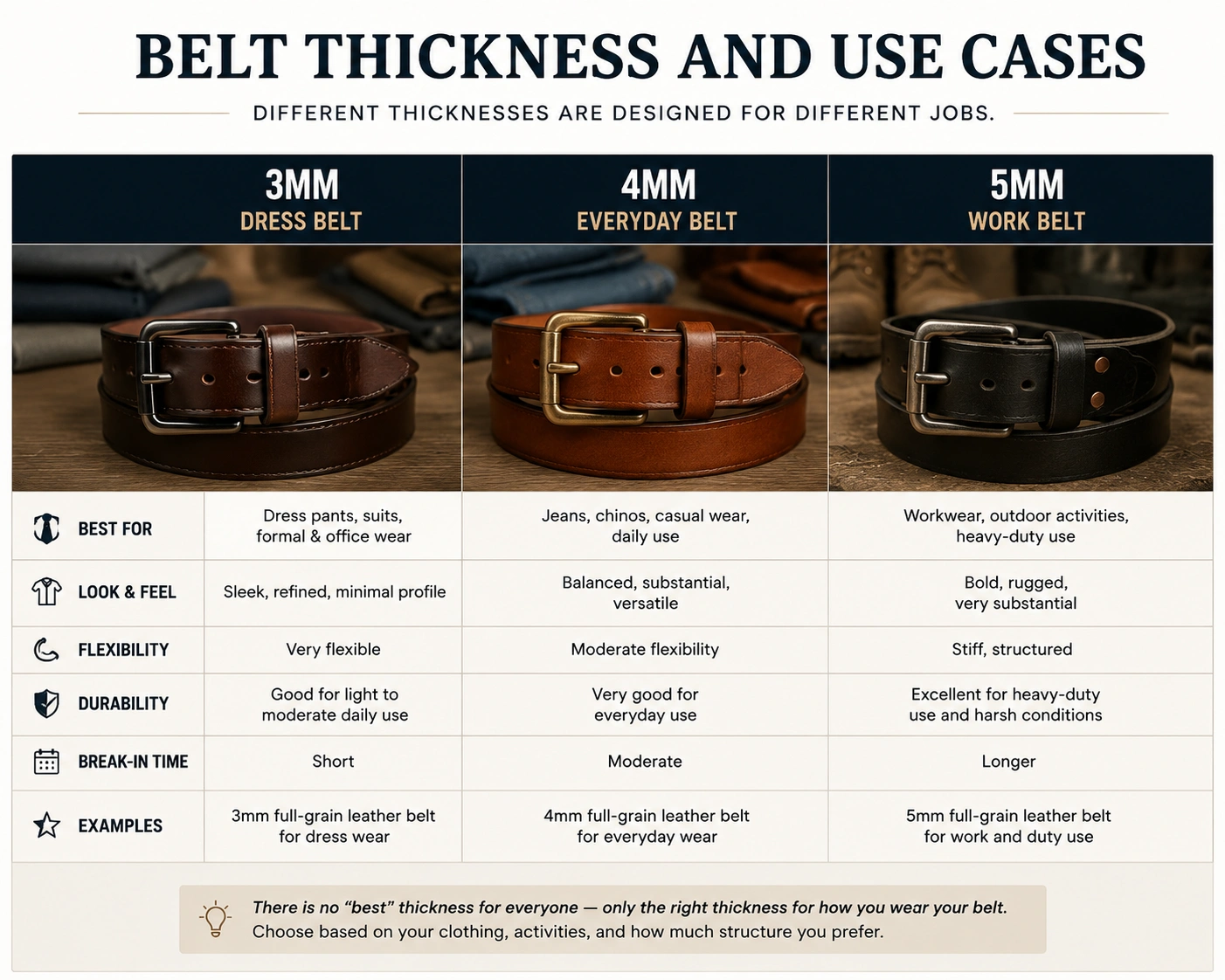
This is the range where most quality everyday belts land, and there's a reason for that.
4mm provides enough material to feel genuinely substantial when you hold it — it has weight, it has some rigidity — but it still threads through standard belt loops without the effortful feeding-through that a 5mm belt sometimes requires. Worn, it sits firmly without feeling like it's fighting the body. After a reasonable break-in period, it tends to move with the wearer rather than against them.
The durability profile is where 4mm earns its status as the sweet spot. The holes hold up well under daily buckle stress. The buckle fold, reinforced by that extra millimeter of fiber depth compared to 3mm, tends to stay clean longer. The belt maintains its shape through years of daily use rather than gradually softening and losing structure.
One thing many belt owners notice around the six-month mark with a new 4mm belt: it starts to feel noticeably better than it did when new. The initial stiffness softens, the leather molds slightly to the specific wearing pattern, and the whole thing settles into a comfortable, structured feel that a thinner belt rarely achieves and a thicker belt takes much longer to arrive at.
Of course, thickness only matters if the belt fits correctly in the first place, which is why a proper belt size chart is worth checking before you order.
Best suited for: daily wear with jeans and casual trousers, chinos, versatile everyday use, most of what most people's wardrobes actually require.
What Does A 5mm Leather Belt Feel Like?
Different enough that it's worth being honest about, rather than presenting it as simply "more of a good thing."
A 5mm belt is noticeably stiffer when new. Threading it through belt loops requires more attention — the belt doesn't flex easily to accommodate the angle changes that feeding through a series of loops involves. The buckle fold requires some deliberate working-in before the leather moves naturally at that point.
Worn, it has a firmness that some people find reassuring and others find rigid. It holds its shape regardless of body movement in a way that thinner belts don't, which is exactly the right quality if the belt is expected to carry the weight of tools or equipment throughout the day. For work belts functioning as part of a load-bearing system, that firmness is a feature.
For everyday office or casual wear, it often isn't. The added bulk, the longer break-in, the stiffness that can feel more constraining than supportive during a day of normal movement — these are real trade-offs that don't disappear just because the leather is thick.
5mm also has a ceiling on how narrow it can realistically be. A 5mm thick belt at 1.25-inch width starts to feel like a plank. The thickness works better at 1.5 inches and above, which is part of why work belts tend to be both wide and thick — the two specifications reinforce each other at that usage level.
Best suited for: heavy-duty work belts, belts expected to carry equipment, outdoor and trade contexts, situations where the belt is a functional tool rather than a finishing detail.
Is A Thicker Belt Always Better?
No. This is worth being direct about, because the "more is better" assumption costs people comfort and convenience without necessarily giving them better durability in return.
A 5mm belt that's the wrong match for its context creates specific, practical problems that wouldn't exist with a 4mm belt:
Threading through loops becomes work. Standard jean loops accommodate a 4mm belt comfortably and a 5mm belt tightly — tight enough that the end-of-day removing-the-belt experience involves some wrestling. For dress pants with narrower loops, a 5mm belt may not fit through at all.
The buckle fold takes longer to break in at higher thickness, which means the stiffness that's an asset for work use is an annoyance during the first several months of ownership when the belt is still rigid at that point.
Visually, excess thickness adds bulk at the waist that doesn't look intentional in contexts where a cleaner profile is appropriate. A thick work belt worn with chinos at a dinner reads the same way that wearing work boots to a dinner does — not wrong, exactly, but mismatched to the occasion in a way that draws attention.
The right thickness is the one that matches how the belt will actually be used.
How Thickness Affects Durability
This is where thickness does its clearest, most defensible work.
Hole integrity over time. The hole that gets used every day is under more cumulative stress than any other part of the belt. Thicker leather surrounding those holes has more fiber to absorb the repeated pressure of the buckle pin before that hole starts to show oval distortion. This is one of the concrete, mechanical advantages of 4mm over 3mm for daily wear.
Buckle fold resistance. More fiber depth at the fold means more material absorbing each flex cycle before the surface starts showing stress. It's not that thinner leather can't withstand repeated bending — it's that thicker leather handles the same number of flex cycles with less per-cycle strain.
Edge wear. Belt edges experience friction from clothing and belt loops throughout the day. Thicker leather has more material before the edge becomes structurally compromised, though how the edge is finished — burnished, painted, or left raw — matters at least as much as the raw thickness.
Buckle attachment point. Where the leather folds back over the buckle bar and is secured with hardware, thicker leather provides more material for the fastening mechanism to grip. On thin leather, the attachment point can start to show deformation around the hardware over time in a way that thicker leather resists.
For a deeper look at what causes belt failure at these specific points, the mechanics are covered in detail in why leather belts crack. And for the broader picture of how these factors add up over a belt's life, how long do leather belts last approaches the question from the lifespan angle.
What Thickness Is Best For Different Situations?
| Use Case | Recommended Thickness | Why |
|---|---|---|
| Dress pants / formal wear | 3mm | Slim profile, flexible, appropriate for narrower dress loops |
| Office and business casual | 3–3.5mm | Comfortable for prolonged sitting, professional appearance |
| Everyday casual and jeans | 4mm | Balance of durability, comfort, and versatility |
| Active outdoor or casual work | 4–4.5mm | Extra durability without full work-belt stiffness |
| Heavy work, tool-carrying belts | 5mm+ | Firmness and load capacity, intentional rigidity |
These aren't hard cutoffs — a 4mm belt in a particularly dress-oriented context might be slightly thick, while a 3.5mm belt in a particularly hard-wear context might be slightly thin. The ranges are starting points, not specifications.
What Thickness Do Most People Actually Need?
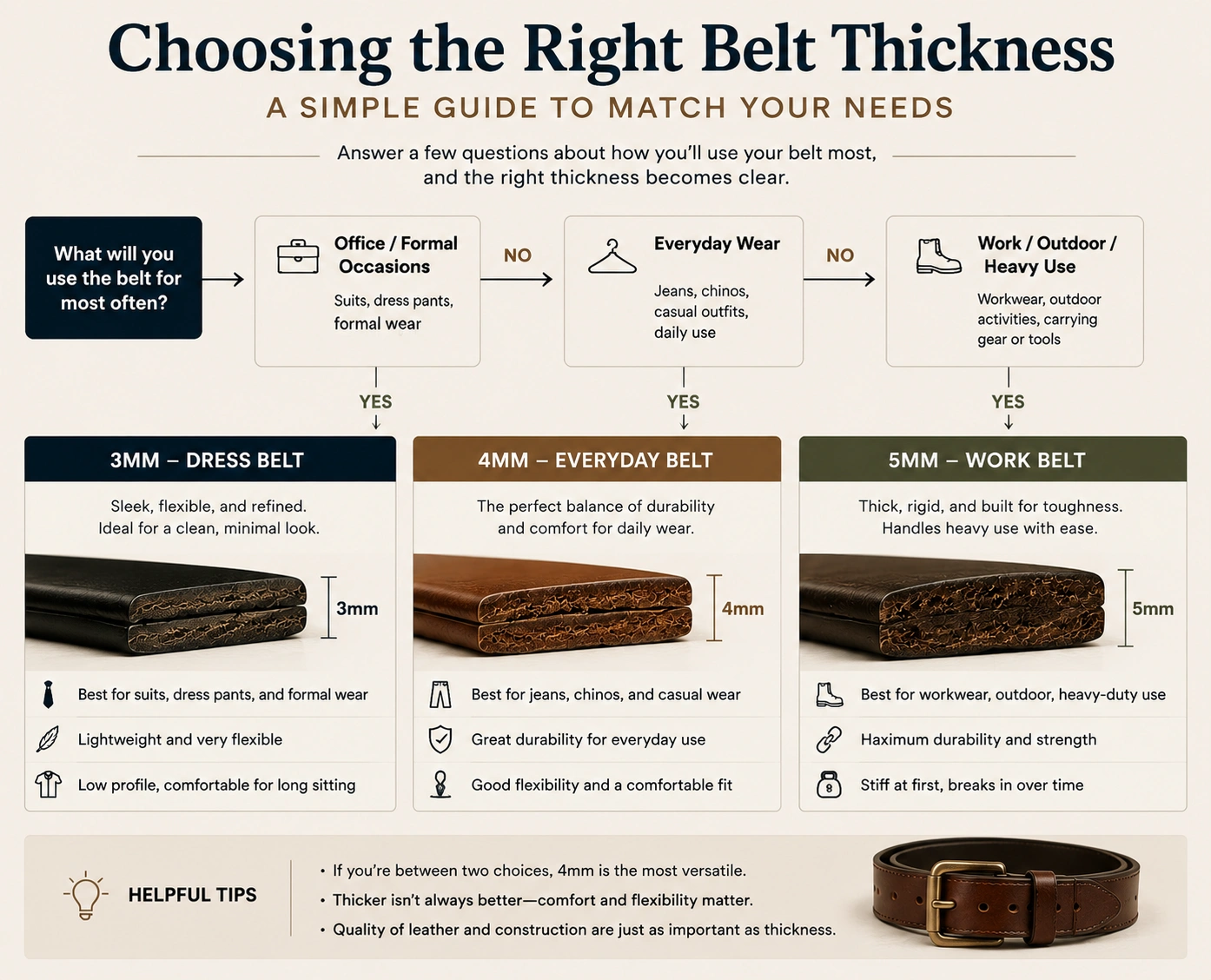
Most people do not need the thickest belt available.
This is worth saying plainly, because the pull toward "getting the most durable option" is real, and not always matched to actual needs.
For the majority of people wearing a belt with jeans and casual pants, going to the office, doing light physical activity — a well-made 4mm leather belt is the better choice over a 5mm belt. It's durable enough for everything in that usage profile, it's comfortable from earlier in its life, it threads through loops without effort, and it doesn't add bulk that doesn't belong in those contexts.
The 5mm belt is excellent for what it's designed for. But most people's daily lives don't call for what it's designed for — and wearing a heavy work belt to compensate for buying a thin, poor-quality belt is solving the wrong problem in the wrong direction.
The better path is a 4mm belt made from genuinely good leather — dense, properly constructed, with solid hardware — rather than a thicker belt made from material that can't justify the thickness. Thickness and leather quality together produce durability; thickness alone doesn't.
For a fuller picture of what else goes into a belt that actually holds up, what makes a good leather belt covers leather grade, construction, and hardware alongside thickness. And if you've been thinking about width alongside thickness, what belt width should I wear addresses those decisions together.
Final Thoughts
The best belt thickness isn't the thickest option on the shelf.
It's the thickness that matches how the belt will actually be used — and how that belt will feel after the first week, the first year, the first decade.
For most people, that's 4mm. Not because it's a compromise, but because it genuinely is the right tool for the job: durable enough to hold up under real daily wear, flexible enough to be comfortable throughout a full day, and proportioned correctly for the clothing most people actually wear.
The cases where you'd want to go lower are real. The cases where you'd want to go higher are real too. But they're specific cases, not the general rule — and knowing which one you're actually buying for is most of what separates a belt purchase that works out from one that doesn't.
Frequently Asked Questions
How thick should a leather belt be?
For most everyday use, around 4mm is the practical sweet spot — thick enough to resist hole deformation and hold its shape through the buckle fold over years of daily wear, while remaining flexible and comfortable enough for all-day use. Dress belts tend toward 3mm; heavy work belts toward 5mm.
Is a 4mm leather belt thick enough?
For most daily use, yes. A well-made 4mm full-grain leather belt provides durability that suits everyday wear with jeans and casual trousers, holds up at the hole and buckle fold points over time, and doesn't carry the stiffness penalty that comes with heavier work-oriented belts.
Is a 5mm leather belt too thick?
For heavy work use, no — the extra stiffness and material depth are appropriate for carrying tools or load, and the longer break-in period is expected. For everyday casual or office wear, 5mm often is more than necessary: harder to thread through loops, stiffer at the waist for prolonged sitting, and adds bulk that doesn't serve those contexts well.
What is the best belt thickness for everyday wear?
4mm is the most widely useful thickness for general everyday wear. It balances durability and comfort in a way that 3mm sometimes sacrifices durability and 5mm sometimes sacrifices comfort.
Does a thicker belt last longer?
It depends on what "thicker" is being compared to and what failure mode is in question. Thicker leather has more material at hole points and the buckle fold, which does extend the life of those specific areas under repeated stress. But a 5mm belt made from poor-quality leather won't outperform a 4mm belt made from dense full-grain leather — leather grade and construction matter at least as much as thickness, and usually more.
What thickness is best for dress belts?
Around 3mm is standard for dress belts. The thinner profile suits the narrower belt loops and cleaner visual proportions of dress trousers and suits, and the greater flexibility is a comfort advantage in formal contexts where the belt is worn for long periods without being put through physical stress.