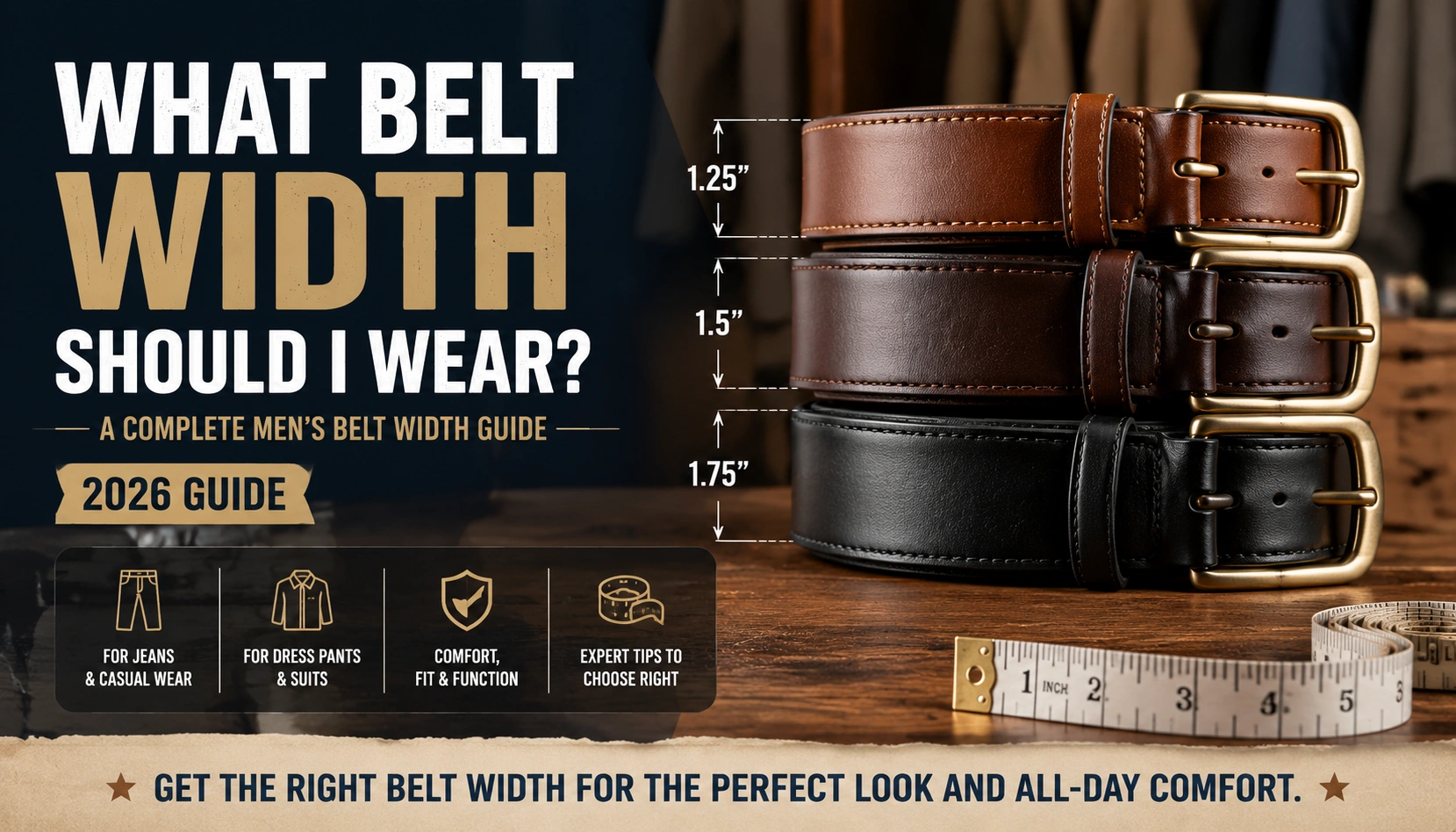
For most men, a 1.5-inch belt width is the right starting point. It fills standard jean loops properly, works with chinos and casual trousers, and carries enough visual weight to look intentional without being bulky. If you're dressing up — tailored trousers, dress pants, a suit — step down to 1.25 inches. If you're doing hard physical work and need a belt that holds up under real load, a 1.75-inch belt makes sense.
Most people shopping for a leather belt think about color first, then the buckle, sometimes the leather grade. Width is usually an afterthought — or not a thought at all. But width is the specification that determines whether the belt looks right on your body, fits your belt loops without forcing or floating, and carries the visual weight appropriate for how you're dressed. Get everything else right and choose the wrong width, and the belt still looks slightly off. This guide explains why, and how to get it right.
Belt Width Chart: Common Belt Sizes Explained
Use this as a starting framework, then refine based on your specific pants and context.
| Width | Best Use Case | Typical Context |
|---|---|---|
| 1 inch | Very formal or slim-profile styles | Dress suits, very narrow trouser loops |
| 1.25 inch | Dress pants, formal occasions | Business wear, tailored trousers, chinos |
| 1.5 inch | Everyday casual and semi-casual | Jeans, chinos, work pants, most men's everyday |
| 1.75 inch | Heavy-duty, workwear, tactical | Work belts, outdoor use, tool-carrying applications |
| 2 inch and above | Specialized work or tactical use | Utility belts, certain western styles |
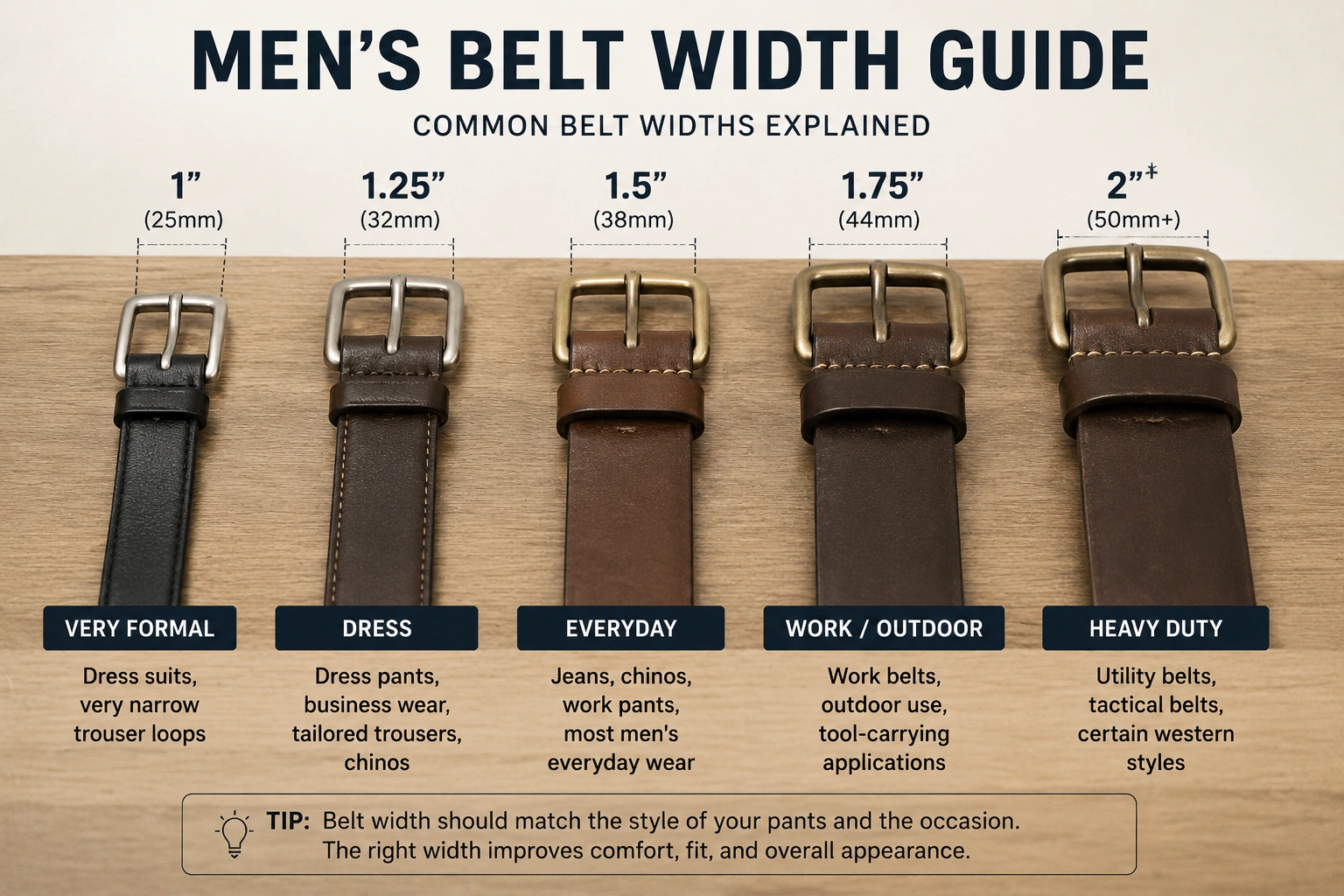
The standard belt width for men's everyday wear has settled around 1.5 inches for good practical reasons, which the rest of this guide explains. The numbers in this chart aren't fashion opinions — they reflect the physical reality of how belt loops are sized and how belt proportions read at different clothing levels.
Why Belt Width Matters More Than Most People Think
Belt width is one of those specifications that's invisible when it's right and obvious when it's wrong.
The most immediate issue is physical fit. Belt loops on jeans are designed to accommodate a 1.5-inch belt. They're not built to a random dimension — they're sized that way because it's the standard. A belt that's narrower than the loop doesn't fill it, which means the belt can shift, twist, and sit unevenly around your waist throughout the day. A belt that's wider than the loop has to be forced through, which stresses the stitching on the loop and can eventually cause it to tear loose from the pants.
Then there's proportion. A belt doesn't sit in isolation — it sits in the visual context of the pants you're wearing, the shirt you're tucking in, the overall silhouette of the outfit. A 1-inch belt on heavy denim looks spindly, like a detail that got lost. A 1.75-inch belt with slim tailored trousers reads as aggressive and out of place. The width of the belt needs to match the visual weight of the clothing it's paired with.
Comfort is the third factor, and it's underrated. A belt that fits its loops correctly sits flat and stays flat. A belt that's the wrong width for the loop tends to roll, fold, or torque as you move, which creates pressure points and a subtle but persistent irritation through the day. You notice it without necessarily identifying it as a width problem.
The experience of wearing a good leather belt — one that sits flat, holds its position, and disappears into the background of your outfit — is largely a function of getting the width right. It's the first specification to check, not the last.
What Is the Best Belt Width for Jeans?
The answer is 1.5 inches, and it's not a close call.
Most standard jeans are designed with belt loops that comfortably fit around a 1.5-inch belt. This is one reason why 1.5 inches has become one of the most common choices for casual leather belts — it fills the loop cleanly, holds the belt in position, and creates a balanced visual proportion against heavier denim fabrics.
At 1.5 inches, a leather belt fills the loop from edge to edge. You can see the belt — it has presence — without it dominating the pants or straining the loop attachment points. The width also means there's enough surface area for the leather to sit flat and stable, which matters when you're moving around, sitting, or loading the belt with the weight of a phone, wallet, and keys in your pockets.
A 1.25-inch belt on jeans is slightly too narrow. It fits through the loops fine, but it doesn't fill them, which means the belt has room to shift. Visually, the narrower belt looks slightly underdressed for denim — the proportion reads as a detail that doesn't quite belong, even if you can't immediately identify why.
This is a common issue many belt owners only notice after wearing the belt through a full day: the belt keeps rotating slightly in the loops, the buckle drifts off-center by midmorning, and readjusting it doesn't hold. The cause is almost always a width mismatch — the belt is narrower than the loop was designed for, so there's nothing stopping it from moving. Switching to a 1.5-inch belt on the same pair of jeans typically resolves the problem immediately.
A 1.75-inch belt on standard jeans is borderline. Some jeans — particularly workwear styles and heavier denim — have larger loops that accommodate 1.75 inches without forcing. On most standard jeans, a 1.75-inch belt will fit but will push against the loop edges, which looks and feels slightly wrong.
For most jeans in most situations, 1.5 inches is the right width because it's the width the pants were designed for.
What Belt Width Should Men Wear for Everyday Use?
The 1.5-inch belt earns its status as the standard men's belt width through sheer versatility. It's the one width that works across most of the pants most men own.
With jeans: fills the loop correctly, looks proportional, suits the casual context.
With chinos: most chino belt loops are cut to accommodate 1.5 inches. The belt sits cleanly and the proportion works — chinos occupy a middle ground between casual and smart-casual that a 1.5-inch belt matches well. If your chinos are on the dressier end and you're wearing them with a sport coat or blazer, 1.25 inches can work, but 1.5 inches won't look wrong.
With casual trousers and work pants: loop sizes here vary, but most are built for 1.5 inches. Workwear trousers often have slightly larger loops to accommodate heavier belts, so 1.5 inches fits without effort.
With heavier workwear: 1.5 inches holds up well under real use. The width provides enough surface area for the leather to resist the torsional stress that comes from physical work — bending, lifting, carrying. If you're supporting tool weight on your belt, 1.75 inches starts to make more sense, but for general-purpose work without tools, 1.5 handles it.
The practical reason 1.5 inches dominates the everyday men's belt market: it's the one width you can buy once and have it work with almost everything in a typical wardrobe. A man who owns one good 1.5-inch leather belt and a second 1.25-inch belt for formal occasions has his width needs covered entirely.
Dress Belt Width vs. Casual Belt Width
This is where the distinction matters most, and where ignoring width causes the most visible problems.
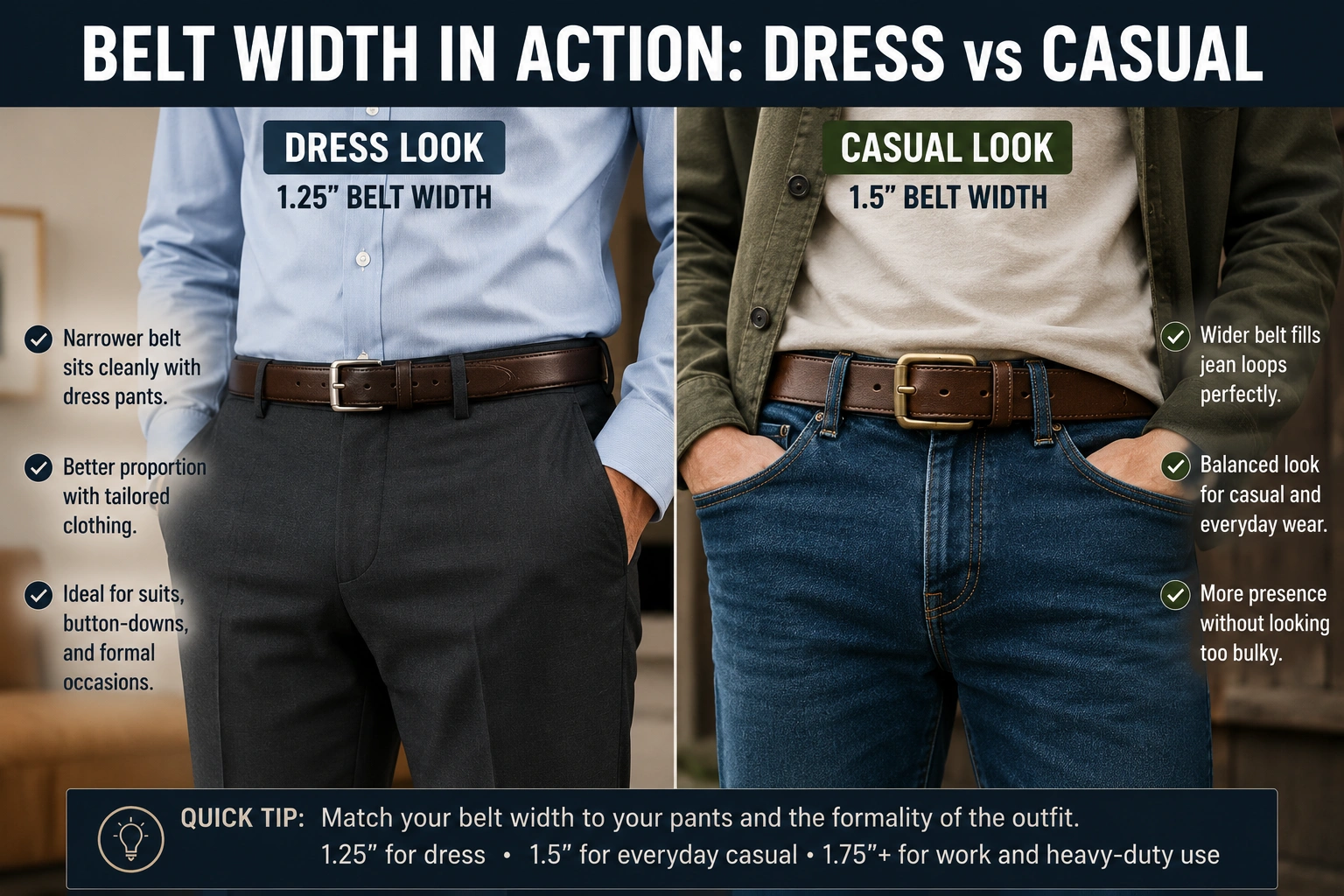
Dress Belts: 1 to 1.25 Inches
Dress pants — the kind worn with a suit jacket, a blazer, or in a formal business setting — are cut with narrower belt loops. The loops are typically built for a 1 to 1.25-inch belt, and that's not arbitrary. The narrower loop matches the visual scale of the garment: finer fabric, slimmer cut, smaller details throughout. The belt is meant to be present but not prominent.
A dress belt is usually 1.25 inches wide, paired with a smaller, sleeker buckle — often a frame buckle with a fixed bar, or a simple pin buckle with minimal hardware. The leather is typically thinner than a casual belt, which helps it lie flat under a jacket without creating bulk at the waist. The finish tends toward polished or smooth rather than the textured or distressed look that works on casual leather.
Wearing a 1.5-inch belt with dress pants doesn't always look disastrous, but it's pushing the width against the limits of the loop and the proportion of the outfit. With a well-cut suit, it reads as a small but clear mismatch.
A common customer problem in this category: someone owns a single good leather belt — a 1.5-inch everyday belt they're happy with — and wears it with dress trousers for a work event or a formal occasion. The belt technically fits through the loops, but barely, and the extra width creates a slight bulge at each loop that's visible under a tucked shirt. The visual weight of the belt fights the clean line of the trousers. The fix isn't a different belt per se — it's a second, narrower belt reserved for dressed-up contexts. A 1.25-inch dress belt used only for formal wear solves the problem entirely.
Casual Belts: 1.5 Inches
The 1.5-inch casual belt is the opposite in almost every respect: thicker leather, more pronounced hardware, and the width to carry that presence without looking out of place. Casual dressing — particularly with denim — tolerates and actually benefits from a belt with more visual weight. A substantial leather belt on jeans looks like it belongs. A slim dress belt on the same jeans looks like someone grabbed the wrong belt on the way out the door.
The leather on a casual belt can be whatever finish suits the wearer: matte, waxed, crazy horse, vegetable-tanned, distressed. The weight and texture that would look heavy under a suit jacket looks entirely natural with a pair of jeans.
The bottom line: the occasion determines the width, and the width determines the belt. These aren't interchangeable.
Is a Wider Belt Always More Durable?
No — and this is a misconception worth clearing up directly, because it leads to people buying belts that are wider than they need in the belief that they're getting something more durable.
Width and durability are different properties of a belt. Width is a dimension. Durability is a function of leather grade, leather thickness, construction method, and hardware quality.
A 1.75-inch belt made from bonded leather will fail faster than a 1.5-inch belt made from full-grain cowhide. The wider belt has more material in the cross-section, but if that material is lower quality — pressed leather scraps over a fabric backing — it doesn't hold together under real use. The seams separate. The surface coating peels. The holes tear wider over time.
A narrower belt made from dense, full-grain leather has more structural integrity at the fiber level than a wider belt made from lower-grade material. The tight interlocking fibers of full-grain leather resist the concentrated stress at the buckle holes and the sustained pull of a loaded belt in ways that no surface width can compensate for.
Where wider belts do provide a practical advantage is in load distribution. A 1.75-inch belt worn with tools or equipment distributes the weight of those items across a larger surface area, which reduces the stress concentration at the attachment points. For a work belt carrying real load, width contributes to function in a specific way. For an everyday belt that's just holding up pants, width beyond 1.5 inches doesn't add durability — it adds bulk.
The material determines the durability. The width determines the fit and proportion. Don't confuse them.
Common Belt Width Mistakes
These are the errors that make otherwise good belts look or feel wrong:
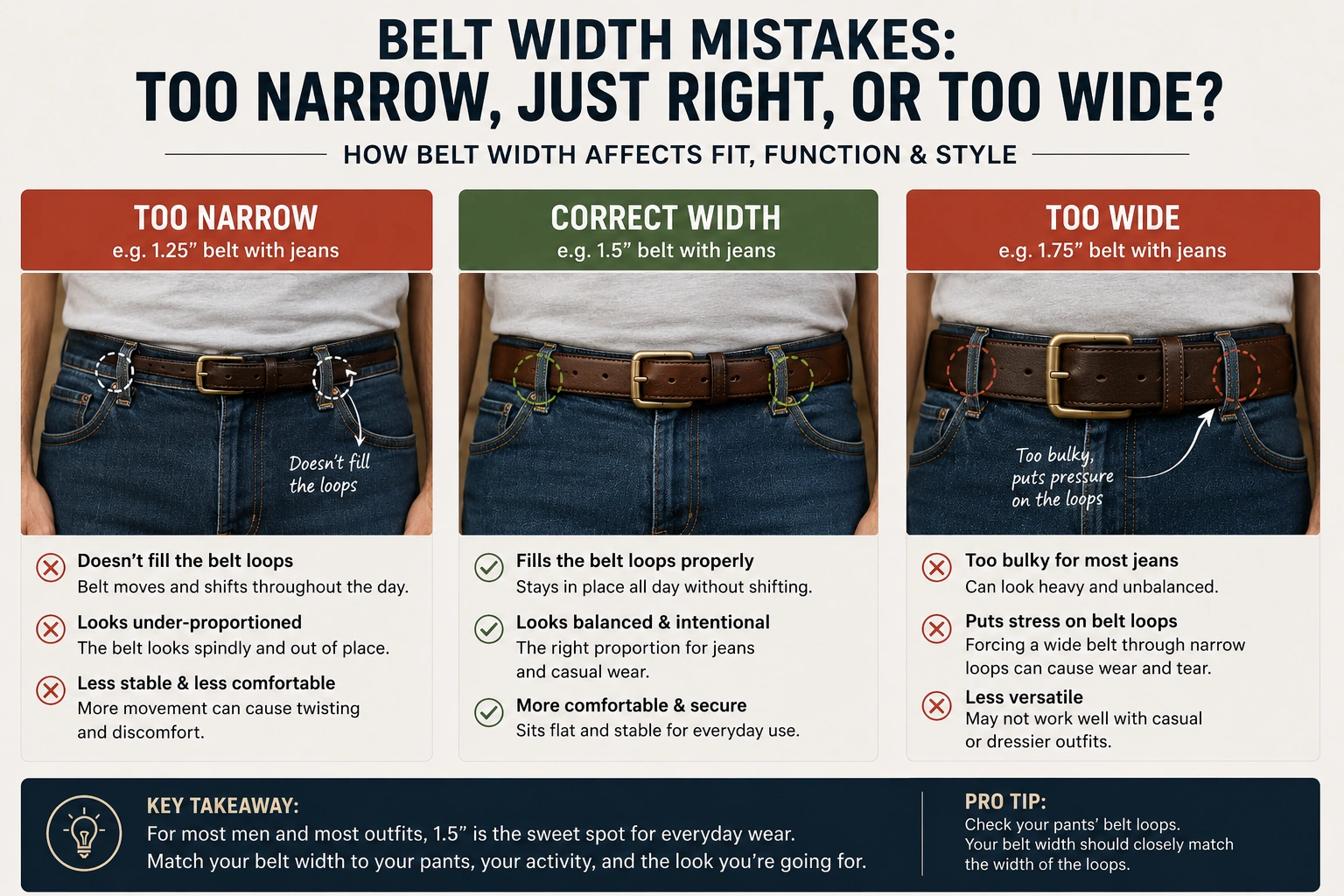
Buying too narrow for jeans. The most common mistake. A 1.25-inch belt on a pair of standard-cut jeans looks slightly off — the belt doesn't fill the loop, which means it shifts and doesn't anchor properly. The visual proportion is wrong too: denim is a heavy fabric with a strong visual presence, and a narrow belt looks like an accessory that wandered in from a different outfit. If you wear jeans, own a 1.5-inch belt.
A related issue many people notice: a narrow belt on heavier denim — the kind used in workwear jeans — can look almost invisible against the fabric. The belt is there, technically doing its job, but it has no visual presence relative to the weight of the pants. The outfit looks unfinished at the waist even though nothing is technically missing. This is purely a proportion problem, and a 1.5-inch belt corrects it without any other changes to the outfit.
Buying too wide for dress pants. A 1.75-inch belt on tailored trousers creates two problems: it doesn't fit properly through the narrower loops, and visually it fights the clean line of the garment. Dress pants are designed for a slimmer belt profile. Working against that proportion makes the whole outfit look slightly disordered, even if nothing else is wrong.
Checking length but not width before ordering. Most people know to think about belt size (the length from buckle pin to middle hole) before ordering. Fewer people think to check the width specification against the actual belt loops on their pants. Belt loops on different pants vary — workwear jeans often have larger loops than slim-cut chinos, which have different loops than dress trousers. Measure the width of your belt loops before ordering anything, especially if the belt is expensive.
Assuming one width works for all occasions. A single 1.5-inch belt is genuinely versatile across most casual and semi-casual contexts. But it doesn't work for everything. If you own suits or dress trousers and wear them regularly, a separate 1.25-inch dress belt is worth the investment. The wrong width at a formal occasion is more visible than almost any other styling error.
Choosing width based on aesthetics alone. A very wide belt can look bold and intentional in the right context. But if that bold belt doesn't fit through the loops on the pants you're wearing it with, the aesthetic doesn't matter — it's the wrong tool for the job. Always start with the physical requirement: what do my belt loops accommodate? Then work backward to style.
How to Choose the Right Belt Width Before Buying
A short checklist that prevents most width-related mistakes:
Measure your belt loops. Before ordering any belt, measure the width of the loops on the specific pants you plan to wear it with. Use a ruler or tape measure across the opening of the loop. This tells you the maximum width that will fit cleanly — and minimum you need to fill the loop properly. Most jeans measure 1.5 inches; most dress trousers measure 1 to 1.25 inches.
Consider the occasion and context. Casual, everyday use points to 1.5 inches. Formal or business dress points to 1.25 inches or narrower. Heavy work or load-bearing use may point to 1.75 inches. If the belt needs to function across multiple contexts, 1.5 inches covers the widest practical range.
Think about leather thickness alongside width. A wider belt in thinner leather can feel flimsy. A narrower belt in very thick leather can be difficult to fit through loops. The two specifications interact: for most full-grain everyday belts, 1.5 inches wide with around 3.5 to 4mm of thickness is a balance that works well — enough width to sit stable, enough thickness to hold structure.
Match the buckle hardware to the width. Belt hardware is sized to fit specific widths. A 1.5-inch buckle on a 1.25-inch belt or vice versa looks wrong and may not function correctly. When ordering a belt or replacing hardware, confirm the buckle width matches the belt.
Get the size right at the same time. Width is one dimension; length is the other. After choosing the correct width, using a belt size chart can help confirm the right belt length before ordering. If you're figuring out belt width, it's a good moment to also confirm your belt size using the correct method — measuring from the buckle pin to your most-used hole. Getting both right at once saves a second return.
Frequently Asked Questions
What width belt should I wear?
For most everyday use with jeans and casual pants, 1.5 inches. For dress pants and formal occasions, 1.25 inches. For heavy workwear or tool-carrying use, 1.75 inches. When in doubt, measure the belt loops on the pants you'll be wearing the belt with — the loop width tells you exactly what will fit.
What is the standard men's belt width?
1.5 inches is the standard for men's everyday and casual wear. This is the width that fits standard jean loops, works with chinos, and carries enough visual weight for most casual outfits. Dress belts typically run narrower at 1 to 1.25 inches.
Is a 1.5-inch belt too wide?
Not for jeans or casual pants — it's exactly right. For dress trousers or a suit, 1.5 inches is slightly wide and 1.25 inches or narrower is more appropriate. Whether it's "too wide" depends entirely on what you're wearing it with and what the belt loops can accommodate.
What belt width is best for jeans?
1.5 inches. Standard denim belt loops are sized for 1.5-inch belts, and the width creates the right visual proportion for the fabric weight of jeans. A narrower belt floats in the loop and looks slightly mismatched; a wider belt strains the loop edges.
What width are dress belts?
Dress belts typically run between 1 and 1.25 inches wide. The narrower profile matches the finer fabric and slimmer loops of dress trousers and suits, and it pairs correctly with the smaller, sleeker buckle hardware that formal wear calls for.
Are wider belts more durable?
Not necessarily. Durability depends on leather grade, thickness, and construction — not width. A wide belt made from low-quality leather will fail faster than a narrower belt made from dense full-grain leather. Width helps distribute load in work applications where the belt is carrying equipment weight, but for everyday pants-holding use, it doesn't add meaningful durability over a properly made 1.5-inch belt.
Does belt width affect comfort?
Yes, in two ways. First, a belt that correctly fills its loops sits flat and doesn't shift during movement, which is more comfortable than a belt that rolls or repositions itself. Second, a wider belt distributes the pressure of the buckle tension across more surface area, which can reduce localized discomfort during extended wear — particularly relevant for people who wear a belt all day in physical work.