If you browse discussions about leather belts in gear forums or subreddits, one thing shows up consistently.
Most people don't start by researching leather grades or construction methods.
They start with whatever looks decent at a reasonable price — a belt from a denim brand, a workwear label, something attached to a pair of jeans they already liked. It looks fine. It does its job. Then after a year or so, something starts to go wrong. The hole stretches. The buckle plate wears through. The surface starts peeling in strips.
And the conversation that follows almost always arrives at the same conclusion:
The real difference between belts that last and belts that don't isn't the brand name. It's how the belt is actually built.
Why Most Leather Belts Look Better Than They Perform
This gap between appearance at purchase and performance over time is the central problem with buying a belt online.
Leather belts don't fail immediately. The failure mode of a poorly made belt is slow and invisible — it starts in the fiber structure and at the stress points months before anything becomes visible on the surface. By the time you notice the most-used hole going oval, or the edge starting to separate, or the buckle plating flaking off at the friction points, the material has usually been degrading for a while.
The failure was decided before you ever put the belt on. You just couldn't see it yet.
The three places where a leather belt fails first are always the same: the hole you use every day, the fold where the leather bends through the buckle frame, and the surface coating (if the leather has one). These three locations experience more concentrated, repeated stress than the rest of the belt combined. They're also the three places where the difference between quality leather and poor leather becomes undeniable.
A belt that looked identical to a quality belt on day one will look dramatically different at the eighteen-month mark. This is normal. The material differences that determine the outcome were present from the beginning — just not visible yet.
What Actually Makes a Good Leather Belt?
🔑 Quick Summary:
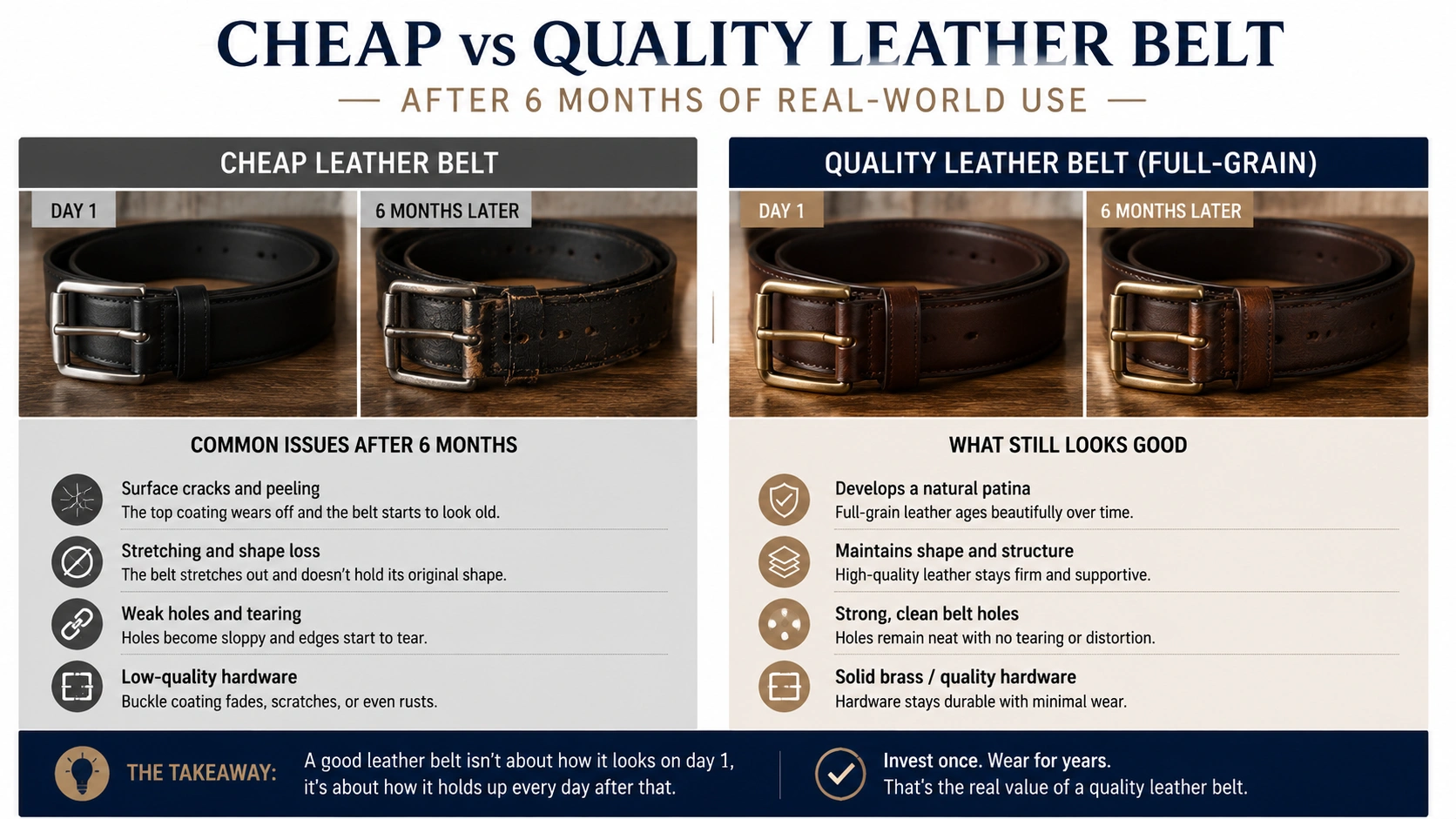
- Leather grade determines durability at the stress points — full-grain fiber structure is denser and more resistant than lower grades
- Thickness at 4mm is the practical minimum for everyday wear — below that, hole deformation shows up faster than most buyers expect
- Single-piece construction has no adhesive bonds to fail; layered construction does
- Solid brass hardware ages well under daily mechanical load; plated zinc alloy wears through the plating within months
- Correct sizing matters as much as materials — a quality belt at the wrong size still fails at the holes early
Leather grade is the biggest variable, and the one most obscured by product labeling.
"Genuine leather" sounds like a quality guarantee. It isn't. It's a minimum threshold — it confirms the product contains animal hide, full stop. It says nothing about which layer of the hide was used, how dense the fiber structure is, or whether the surface was sanded, corrected, and coated to look uniform.
Full-grain leather is different in a specific, mechanical way. It uses the outermost layer of the hide with the natural fiber structure left completely intact. That outer layer has the tightest, most interlocked collagen fiber structure of any part of the hide. This density is what resists deformation at the hole points and cracking at the buckle fold over years of daily use. It's not a marketing distinction. It's a structural one.
Thickness matters primarily at the holes — the leather surrounding each hole is what absorbs the buckle pin's pressure with every single fastening. Thinner leather has less fiber depth before that deformation becomes visible. 4mm is the practical minimum for everyday belt use. Below that, hole wear shows up faster than most buyers expect.
Construction is the factor almost nobody checks before buying. A belt cut from a single continuous piece of leather has no seams and no adhesive bonds. A belt built from multiple thinner layers glued together looks identical when new. Over years, the adhesive bond between layers eventually fails — the belt separates at the edges, not from wear but from the bond giving out.
⚠️ A quick check you can do: look at the cut edge of the belt at the tail end. One dense, uniform cross-section is single-piece. A visible line between materials is layered construction.
Buckle hardware determines how the mechanism ages, not just how it looks on day one. Solid brass doesn't corrode and doesn't crack under the sustained mechanical load a buckle experiences daily. Plated zinc alloy looks identical when new, wears through the plating at friction points within months, and the underlying base metal is more brittle under sustained stress. The buckle pin — which bears the full tension of the belt at the hole with every fastening — is where alloy buckles fail structurally.
What People Actually Notice After a Year of Wearing Entry-Level Belts
This isn't a critique of any specific brand. It's a pattern that shows up consistently once you start paying attention.
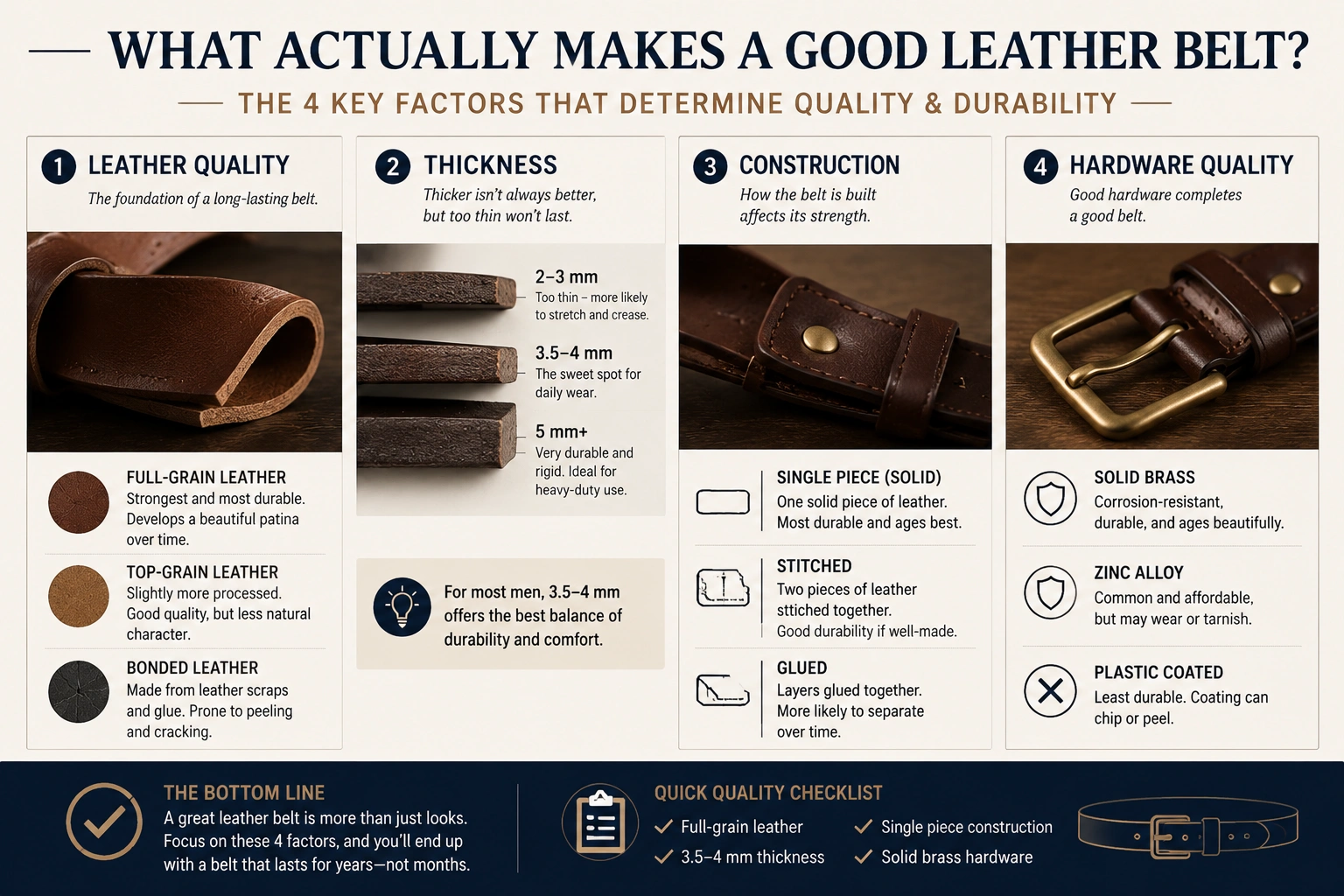
A lot of people spend years cycling through belts in the $25–45 range — denim brand belts, workwear brand belts, department store belts. They're not cheap in any absolute sense. They look fine when new. And they follow a predictable trajectory.
The hole stretches within a year. The surface starts showing wear in a way that doesn't look like aging — it looks like deterioration. The edge starts separating. The buckle loses its finish. And the natural conclusion most people reach is: "I need a better belt."
What they're actually discovering is the difference between leather that was built to look good and leather that was built to perform.
I've seen this pattern described the same way across dozens of conversations: people don't realize they've been buying belts at the wrong level until they try one built differently. The reference point shifts and the old belts suddenly look like what they always were.
This isn't about price alone. There are expensive belts made from poor materials and modestly priced belts made from quality ones. The variable that predicts performance is construction, not cost. But construction is invisible at point of sale — which is exactly why so many buyers end up making the same purchase twice.
The 3 Mistakes Most Buyers Make
Choosing leather that's too thin for how they actually wear it.
A 3mm belt bought for everyday jeans use isn't a value purchase. It's a product that will show hole wear within a year of daily use and need replacement at a timeline shorter than a 4mm belt would have reached. The material difference between these thicknesses isn't subtle under the specific stress of the hole point.
The price difference between 3mm and 4mm is usually smaller than the cost of the replacement. And that's before accounting for the time spent re-researching belts.
Accepting "genuine leather" as a meaningful quality signal.
Two belts, both accurately labeled "genuine leather," can be made from split leather (lower hide layers with looser fiber structure), corrected grain (sanded outer hide with a coating doing the structural work), or bonded composite (shredded leather scraps held together with polyurethane binder). These are three different products with three different failure timelines.
The label is accurate. It's just answering a different question than the one most buyers think they're asking.
Getting the size wrong and not realizing it's a sizing problem.
Belt size is not the same as pants size. A 34-inch waist needs approximately a 36-inch belt. This isn't an approximation — it reflects how the buckle mechanism works and where the belt is designed to bear load.
A belt fastened consistently at the first or last hole — because the sizing is off — puts the buckle pin in the wrong mechanical relationship with the leather at every single wearing. The hole that should last years under appropriate stress wears faster under excessive stress. The belt size chart takes two minutes. Dealing with a belt that doesn't fit correctly takes considerably longer.
Full Grain Leather vs Everything Else
This comparison gets simplified more than it should be, so it's worth being specific about what the difference actually is — and when it matters.
Full-grain leather retains the outer hide's natural fiber structure without any sanding or correction. The fibers at this layer are the most densely packed of any part of the hide. Under repeated stress — the thousands of buckle pin insertions and removals a belt experiences annually — that density is what resists deformation at the hole and cracking at the fold.
Genuine leather, corrected grain, and split leather all involve some modification of the original hide structure, either through sanding away the surface layer, processing lower hide layers with looser fiber structure, or reconstituting leather materials into a composite. Each modification that moves material away from the original outer hide structure reduces the density at the stress points.
Does this always matter? No.
A dress belt worn twice a month accumulates stress slowly. A quality corrected-grain belt in the right thickness may serve that use case for many years. The grade difference is real; whether it shows up in your specific timeline depends on how hard the belt is working.
For everyday jeans wear — five or six days a week, daily buckle stress, years of use — the difference between full-grain and lower grades becomes visible within a year or two. The full-grain vs genuine leather breakdown has the full detail.
The practical rule: match the leather grade to the frequency and intensity of use. For daily use, full-grain is the grade where the performance difference justifies the price difference.
How to Choose a Belt That Will Actually Last Years
The specification that predicts long-term performance more reliably than price, brand, or appearance:
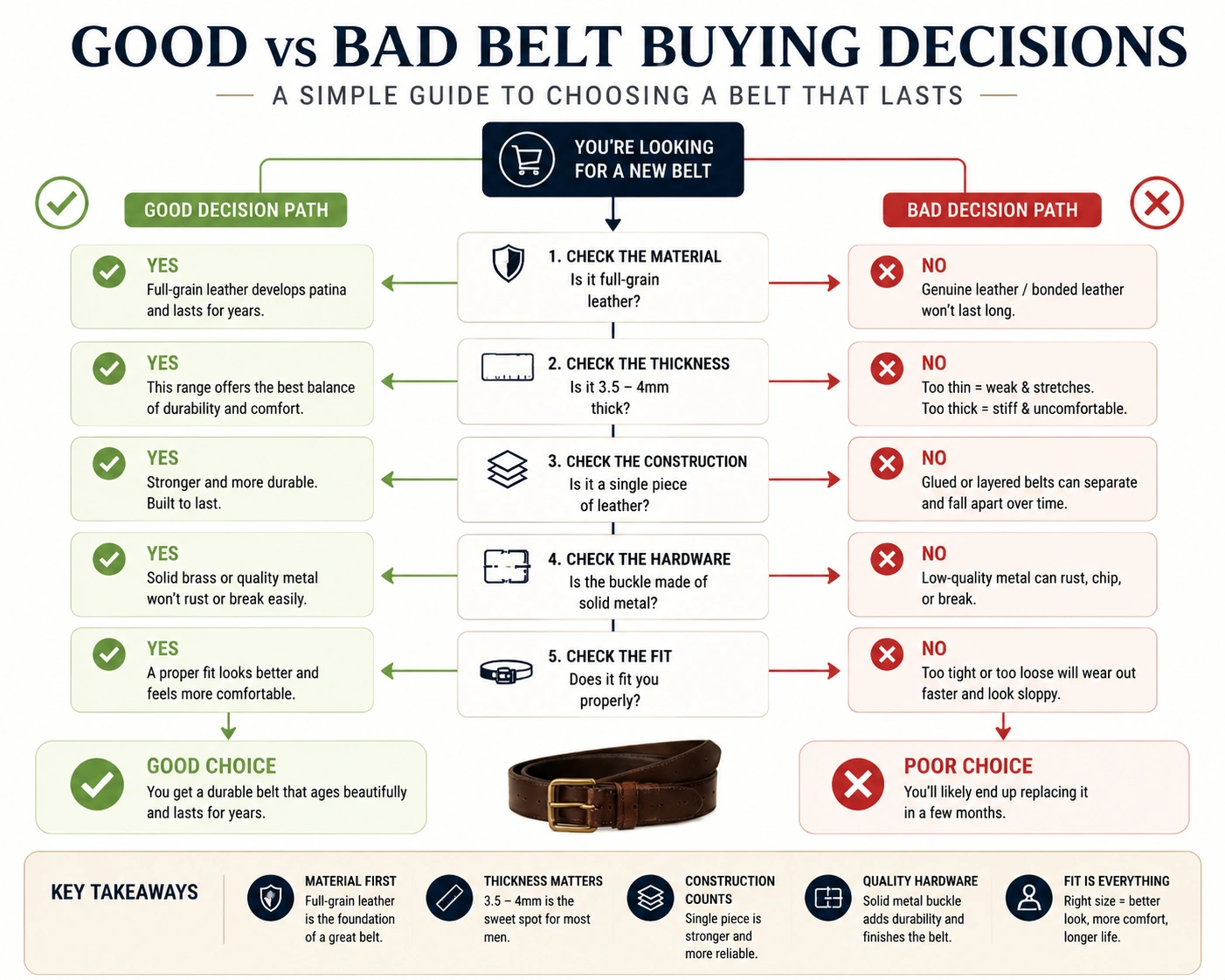
Full-grain leather, 4mm thickness, single-piece construction, solid brass buckle, sized to fasten at the middle hole.
Each of those five elements is doing specific work:
- Full-grain provides the fiber density that resists hole deformation and fold cracking over years
- 4mm provides the material depth at the holes specifically — the stress point where thin leather fails first
- Single-piece eliminates the adhesive bond that layered belts develop as a failure point
- Solid brass eliminates the plating failure and brittleness that alloy buckles introduce
- Middle hole sizing puts the mechanical load exactly where the belt was built to carry it
These aren't premium specifications — they're the baseline specifications for a belt that will still be performing in five years. Some of them cost more to produce. None of them require paying for a recognizable brand name.
A secondary consideration: edge finishing. Burnished edges that have been compressed and sealed resist fraying over years of belt loop friction. Raw edges don't. It's a detail, but it's the kind of detail that separates a belt built to last from one built to look like it will.
For a deeper look at how thickness specifically affects hole longevity, the leather belt thickness guide breaks it down by use case. For the full picture on what drives belt failure over time, why leather belts crack covers the mechanics in detail.
What We Focus On at KKICO
We build around the same five specifications covered above — not as a marketing claim, but because they're the five things that actually predict whether a belt is still in your regular rotation three years from now.
Full-grain leather because the fiber structure at the outer hide is what the stress points need.
Appropriate thickness because the leather at the hole is where most belts fail first, and there needs to be enough material there to absorb years of daily use.
Single-piece construction because there's no seam to fail, and no adhesive bond to give out.
Solid brass hardware because the buckle should age the same direction as the leather, not give out before it.
Solid brass develops its own surface character over time — a warm, slightly darkened patina that matches aged leather rather than fighting it. Both components of the belt moving in the same direction, over the same timeline.
That's the version of a belt worth buying once and carrying for years.
Frequently Asked Questions
What is the best leather belt for men?
For most men's everyday use, the answer comes down to construction rather than brand: full-grain leather, 4mm thickness, single-piece construction, solid brass hardware, sized to fasten at the middle hole. These specifications are about matching the material to what a daily-use belt actually asks of it — durability at the holes, structural integrity over years, and hardware that doesn't fail before the leather does.
What makes a leather belt good quality?
Quality in a belt is mostly invisible at purchase and becomes visible after a year of use. The factors that determine it: leather grade and fiber density at the stress points, thickness relative to how often and hard the belt is used, single-piece versus layered construction, hardware material, and sizing that puts the buckle pin at the right mechanical position on the leather. A belt that gets all five right is a belt that will still be performing in five years.
Are expensive belts worth it?
It depends on what you're paying for. A higher price attached to genuine full-grain leather, single-piece construction, and solid brass hardware is a price that buys real performance over time. A higher price attached to a brand name, but the same thin leather and plated alloy hardware as a $30 belt, is not. The specifications matter more than the price. The full-grain leather comparison is useful context here.
Is full-grain leather better for belts?
For belts worn regularly, yes — in a specific, mechanical sense. Full-grain leather's denser fiber structure resists hole deformation and buckle fold cracking longer than lower grades under the same daily wear conditions. The difference becomes visible over a year or two of regular use. For belts worn occasionally, the gap between grades is smaller and may not justify the price difference.
How long should a leather belt last?
A well-built full-grain leather belt, properly sized and given basic periodic conditioning, should last considerably longer than most people expect from a belt — often many years of daily use. The variables that most affect longevity are leather grade, thickness at the holes, whether the belt is the correct size, and whether it ever gets conditioned. For a detailed breakdown by leather grade, how long leather belts last covers the realistic timelines.