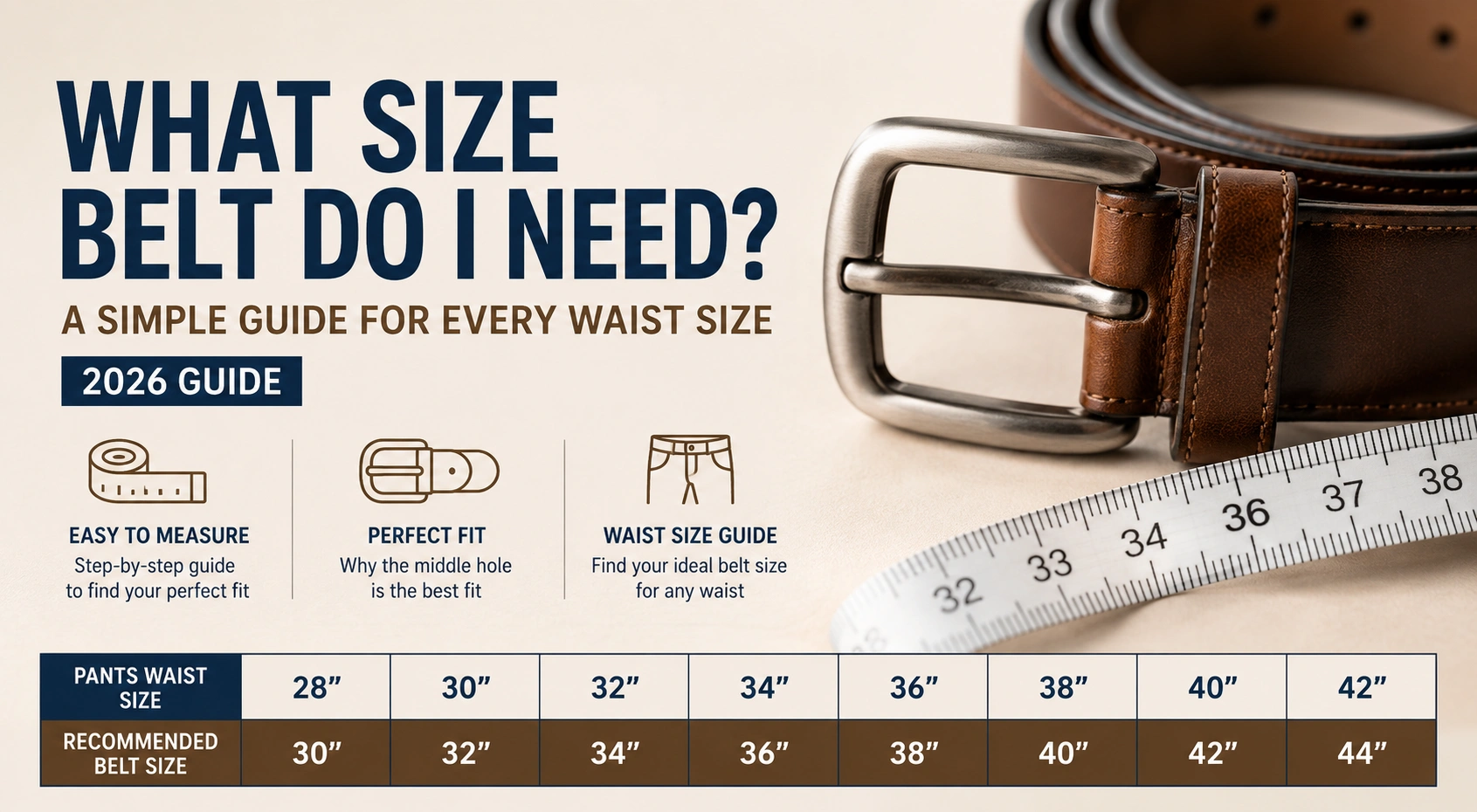
Most people need a belt size about two inches larger than their pants waist size. If your pants are a 34-inch waist, start with a 36-inch belt. If you're a 36-inch waist, look at a 38-inch belt — and so on.
That rule gets most people close. But "close" isn't the same as correct, and belt sizing has enough variation across brands that guessing can still get you a belt that fits awkwardly — too long, too short, or fastening at the wrong position. The most accurate method is measuring a belt you already own, which takes about two minutes and eliminates the guesswork entirely.
This guide covers how belt sizes actually work, how to measure for the right fit, and answers the specific waist-size questions that come up most often. If you've ever opened a box to find a belt that technically closes but still feels or looks wrong, the explanation — and the fix — is here.
Quick Belt Size Chart
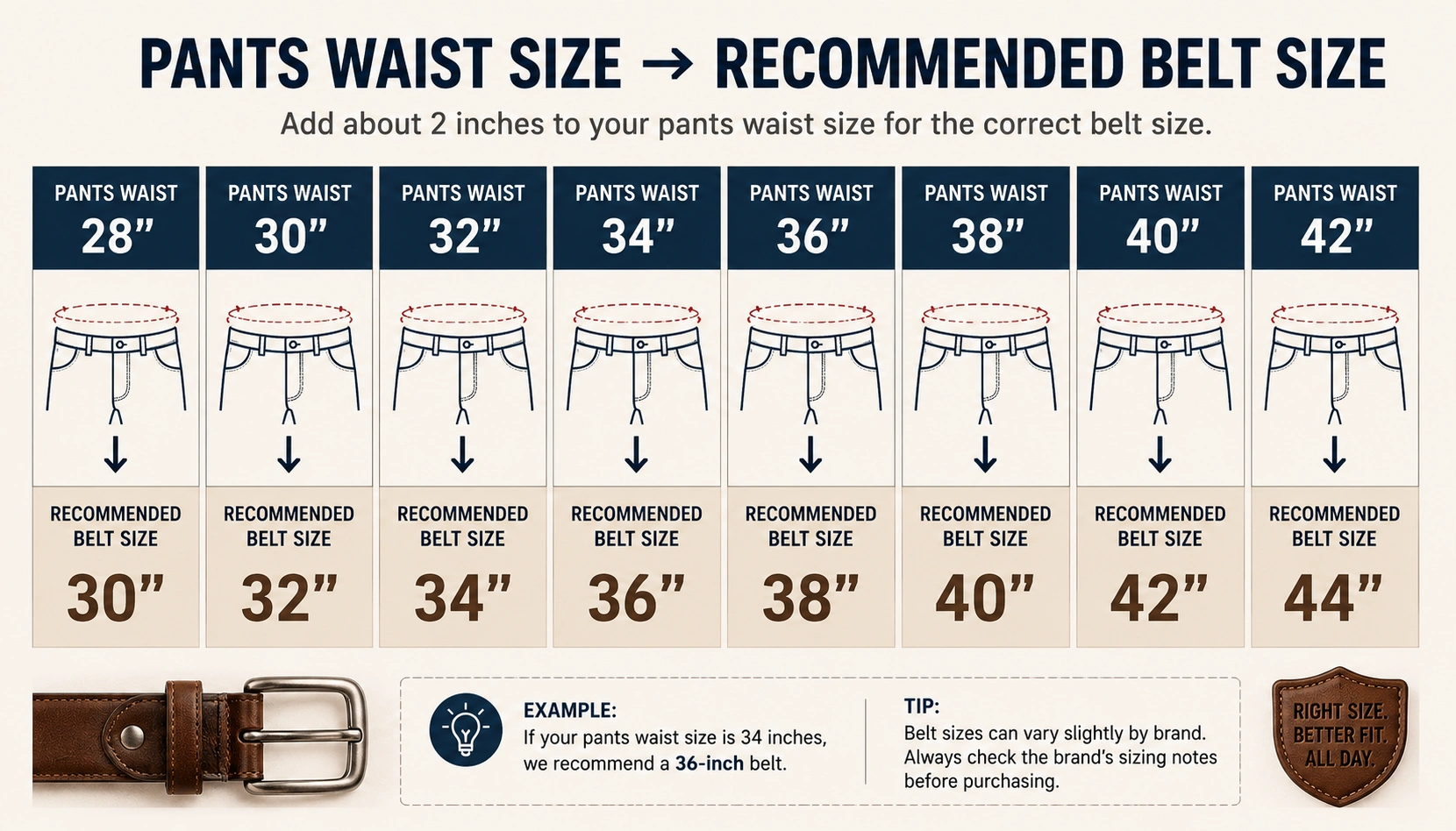
Use this as a starting point when ordering. Verify against the specific brand's sizing notes before purchasing, as conventions vary.
| Pants Waist Size | Recommended Belt Size |
|---|---|
| 28" | 30" |
| 30" | 32" |
| 32" | 34" |
| 34" | 36" |
| 36" | 38" |
| 38" | 40" |
| 40" | 42" |
| 42" | 44" |
The two-inch addition accounts for the buckle mechanism, the leather that folds back through the buckle frame, and the comfortable fastening position. This conversion holds across most standard belt constructions, but it's a starting point rather than a universal rule — which is why measuring an existing belt, covered below, produces more reliable results.
This chart is designed as a quick reference. For a more detailed breakdown of measurement methods, sizing conventions, and how to read a brand's specific sizing notes, see our complete Belt Size Chart Guide.
How Do Belt Sizes Work?
Belt sizing confuses people partly because the number on a belt doesn't mean what they expect it to mean.
When a quality manufacturer labels a belt as size 36, that number typically refers to the distance from the buckle pin connection point — the slot in the leather where the pin actually engages — to the middle hole of the belt's five-hole series. A size 36 belt is designed so that a person who fastens it at the middle hole is using 36 inches of functional belt length.
This is different from the total length of the leather strap. That full measurement — from the tip of the tail to the end of the leather behind the buckle — is considerably longer than the belt size, often by five to eight inches depending on the design. Some brands label their belts by this total length rather than by the usable middle-hole measurement, which produces a larger number for the same wearable size.
The practical result of this inconsistency: a belt labeled "36" from one brand may fit someone who wears a 34-inch pant, while a belt labeled "36" from another brand may be several inches shorter in usable length. This is why reading the specific brand's sizing notes — not just the label — matters before ordering.
How belt sizing works in the most useful terms: focus on the distance from the buckle pin to the middle hole. That's the number that tells you whether the belt will fit your body. Everything else is secondary.
Why Your Pants Size Is Not Your Belt Size
This is the single most common source of belt-buying frustration, and it comes down to a simple fact: your pants size measures your body, and your belt size measures the belt.
Pants are sized by your waist circumference — the measurement around your body at the position where the pants sit. A 34-inch pant waist means the garment was cut to fit a 34-inch body.
A belt works differently. When you wear a belt, it doesn't sit against your bare waist. It threads through loops over a layer of fabric, and the buckle mechanism consumes some of the belt's functional length as the leather folds back through the frame. By the time the belt is fastened, the effective circumference it needs to cover is larger than your bare waist measurement — and the usable length of the belt between the buckle pin and the fastening hole needs to match that circumference.
Here's what that looks like in practice: a person with a 34-inch pant waist typically needs a belt where the middle hole is at 36 inches. If they order a size 34 belt, the middle hole sits at 34 inches — right for someone with a 32-inch waist. The buyer ends up fastening on the very last hole, if the belt closes at all.
The pants size vs. belt size gap is consistent enough that the two-inch addition rule exists for a reason. It isn't a rough estimate — it reflects the real mechanical difference between how pants are measured and how belts work.
How to Measure Belt Size Correctly
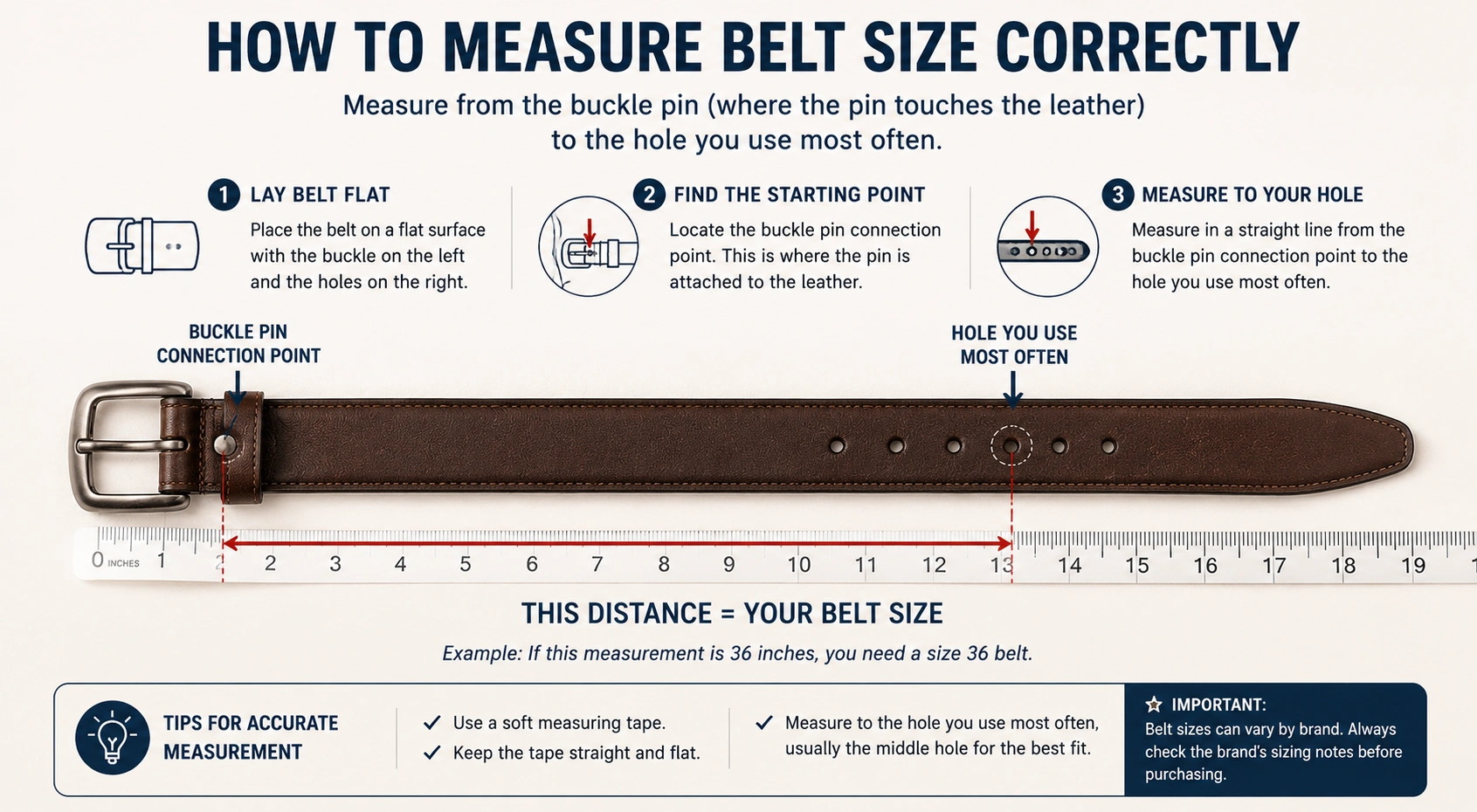
Two methods. The first is more accurate; the second works when you don't have a well-fitting belt to reference.
Method 1: Measure a Belt You Already Own
This is the most reliable approach because you're measuring actual wear data rather than estimating from your body measurement.
Find a belt that currently fits you the way you want — one that fastens comfortably, sits level, and leaves a reasonable amount of tail past the buckle.
Step 1: Lay the belt flat on a hard surface, facing downward so the back of the buckle hardware is visible.
Step 2: Locate the buckle pin connection point. This is the hole or slot in the leather where the buckle pin actually sits — not the edge of the buckle frame, not the end of the hardware. This is your starting point.
Step 3: Measure from that connection point to the hole you use most often. Run the tape straight along the belt's length. The distance between these two points is your functional belt size.
Write that number down. It's the size to use when ordering, provided the brand uses the same convention (measuring to the middle hole). If they size by total belt length, you'll need to add approximately four to five inches.
Method 2: Measure Your Waist Through the Belt Loops
If you don't have a well-fitting belt to reference:
Thread a flexible measuring tape through all the belt loops on a pair of pants you regularly wear. Keep the tape flat and positioned where a belt would actually sit — don't press it tight, let it rest naturally the way a worn belt would. Read the measurement where the ends meet.
Add two inches to that number. The result is your starting belt size.
This method is slightly less precise because it doesn't account for the specific buckle mechanism of the belt you're ordering. But for standard construction, the plus-two result gets you to the right neighborhood. For fine-tuning, cross-reference against the brand's own sizing notes before ordering.
Why the Middle Hole Is the Best Fit
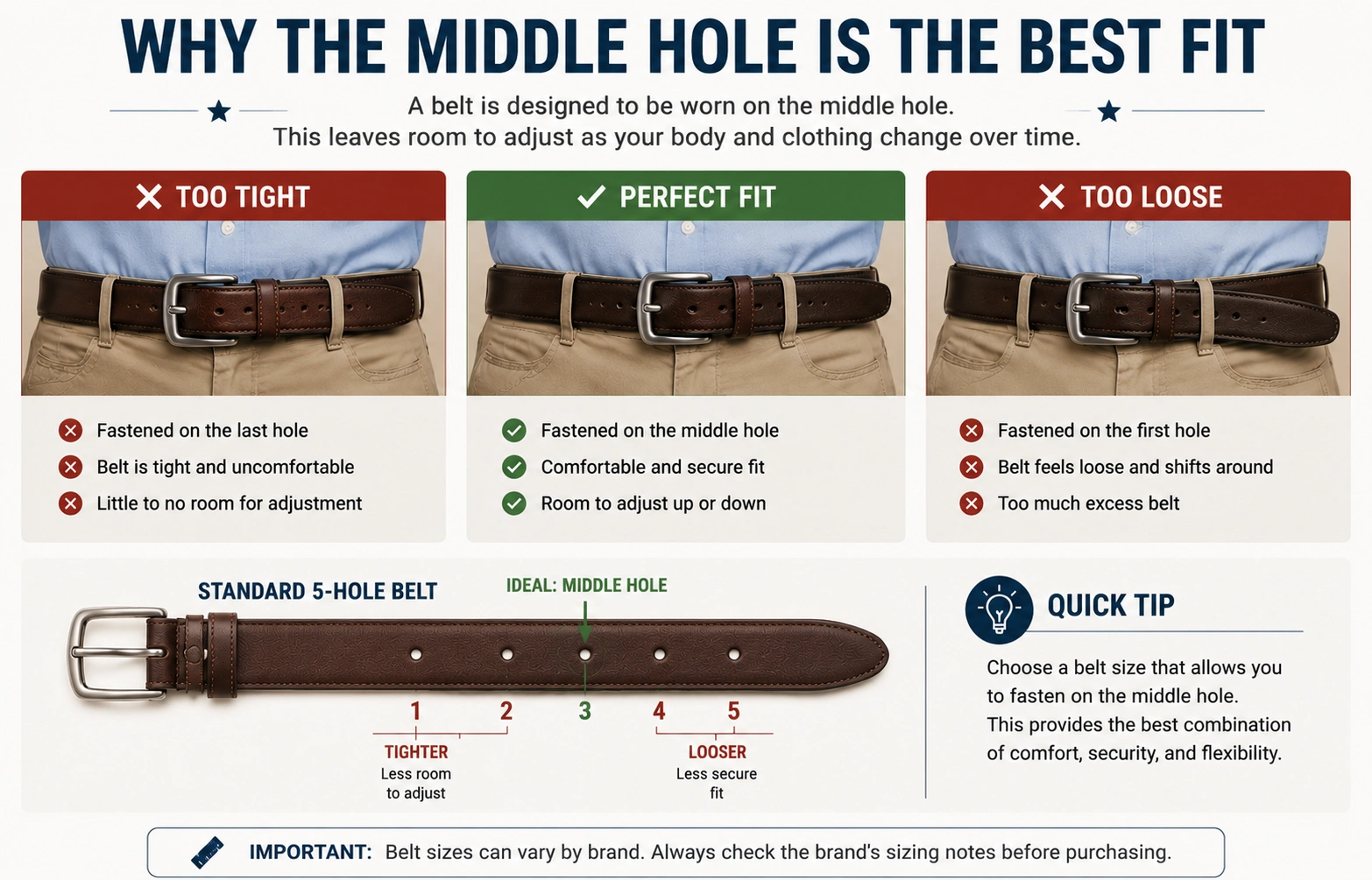
If there's one principle that improves most people's experience with belts, it's this: buy the size that lets you fasten at the middle hole.
Most belts come with five holes spaced one inch apart. The middle hole — the third one — is the position the belt is designed to fasten at for its labeled size. Using the middle hole isn't just a starting point; it's the correct position.
Here's why it matters:
Weight fluctuates. Over the course of a year, most people gain and lose a few pounds. A belt fastened at the middle hole gives you two full holes of adjustment in each direction — two inches tighter, two inches looser — to accommodate that range without needing a different belt.
Seasonal clothing changes the fit. A belt worn over a lightweight summer shirt sits differently than the same belt worn over a heavy flannel and thermal undershirt in January. Two inches of range handles this easily.
Comfort varies through the day. After a large meal, after a long drive, late in a workday — the body changes slightly through any given day. Middle-hole fit means you're never at the edge of the belt's range.
A belt that only closes on the first or last hole has no practical adjustment range. It fits one way, in one set of conditions, and any variation pushes it outside what's usable. The middle hole is where a correctly sized belt belongs — and choosing a size that puts you there is the single most useful thing you can do when buying a belt.
If you're still wondering how a belt should fit, the simplest answer is this: a properly sized belt should fasten near the middle hole, sit comfortably around your waist, and leave enough tail to pass through the first belt loop without extending excessively beyond the second.
What Size Belt for Different Waist Sizes?
What Size Belt for a 34-Inch Waist?
For a 34-inch pant waist, the starting recommendation is a size 36 belt.
At size 36, the middle hole is positioned for someone with a functional belt measurement of 36 inches — which is what a 34-inch pant waist typically requires once you account for fabric thickness and buckle overlap.
A size 36 belt fastened at the middle hole should give you comfortable adjustment room in both directions. If you're between sizes or find that a particular brand's 36 runs small, a size 38 may serve you better.
One note: always confirm the brand's sizing convention before ordering. A "36" from a brand that measures total belt length is a different product from a "36" measured to the middle hole. If the product listing isn't clear, contact the brand directly.
What Size Belt for a 36-Inch Waist?
For a 36-inch pant waist, a size 38 belt is the standard recommendation.
The same logic applies: you want the middle hole at approximately 38 inches of functional belt length, which is what a 36-inch waist requires in practice. If you wear your pants high on your natural waist, or if you regularly layer heavier clothing, you may find the 38 works well at the middle hole or slightly toward the looser end — both are fine. If you wear pants low on your hips, the circumference may be larger, and a size 40 might give you a better middle-hole fit.
What Size Belt for a 38-Inch Waist?
For a 38-inch pant waist, start with a size 40 belt.
At this size range, it becomes especially important to check the specific brand's sizing because the plus-two rule holds broadly but individual products vary. Some brands at the 40-inch range size their belts generously; others run narrow. If possible, measure your waist through your belt loops directly and use that number as your reference rather than relying solely on your pant size.
What Size Belt for a 40-Inch Waist?
For a 40-inch pant waist, the recommendation is a size 42 belt.
At larger sizes, the gap between pant size and belt size remains consistent at roughly two inches, but the variance across brands tends to be wider. Some workwear and heavy-duty belt brands size their 42-inch belts with more generous hole spacing specifically to accommodate larger bodies more precisely. Reading the sizing notes carefully — and measuring your own belt loop circumference if you have any doubt — is time well spent before ordering at this size.
Real Customer Problem: "My Belt Fits, But Something Feels Wrong"
This one is subtle, and it comes up often enough to be worth addressing directly.
The scenario: a belt closes at a comfortable tightness. The buckle looks fine sitting at the front. But the tail extends four or five inches past the second belt loop, and no matter what the wearer does, it won't stay controlled in the keeper loop. Or the opposite: the buckle position looks slightly off-center, or the belt seems to pull subtly in one direction.
In most of these cases, the belt is technically the wrong size — but only just barely wrong. It falls outside the ideal hole range without being obviously too large or too small. The buckle sits correctly, but at the outermost hole instead of the middle, which shifts the tail length just enough to look awkward.
This isn't a quality problem. The belt is working as designed; it's just designed for a slightly different body. The fix is either sizing down by one and shortening if needed, or in some cases adjusting the belt's hole position to move the fastening point toward the middle of the range.
One of the most common observations from belt owners is: "The belt technically fits, but I'm always using the last hole." That's usually a sign the belt size is slightly off, even if it closes comfortably. A correctly sized belt should never require the outermost hole under normal conditions.
If you find yourself wondering why a belt that closes doesn't quite look right, the middle-hole principle is usually where the answer lives. For a more detailed look at what proper belt length looks like in practice, the guide on how long a belt should be covers the tail length and buckle positioning questions in full.
Signs You Bought the Wrong Belt Size
Knowing what to look for makes it easier to catch a sizing problem before you've worn the belt long enough that returning it becomes complicated.
Signs the Belt Is Too Big
- You can only fasten it at the tightest hole, and even there the fit feels questionable
- The tail extends well past the second belt loop and won't stay in the keeper
- The buckle sits noticeably off-center because the fastening position is off
- The belt slides or shifts during the day because the fit isn't snug enough to hold position
Signs the Belt Is Too Small
- The belt only closes on the very last hole — the loosest available — and barely at that
- The tail barely reaches the first belt loop, or doesn't reach it
- Sitting down with the belt fastened creates noticeable pressure or discomfort
- You find yourself loosening the belt as the day goes on, past the range of available holes
In both cases, the solution is a different size. A belt that's too big can sometimes be shortened from the buckle end if the construction allows it — this is a straightforward modification on quality leather belts with removable buckle hardware. A belt that's too small needs to be exchanged for the next size up.
Do Leather Belts Stretch If They Feel Too Small?
This question comes up often, usually from someone hoping a slightly tight belt will break in and loosen into the right fit.
The honest answer: leather belts break in, but they don't stretch in any way that would fix a sizing problem.
Breaking in refers to the leather softening and becoming more comfortable over months of wear — the fibers at flex points compress slightly, the belt becomes more pliable, and the overall feel improves. This is real and it's a quality of good leather. But the dimensional change involved is minor — a few millimeters at most, concentrated at the buckle fold and hole edges. A belt that closes only on the last hole today will still close only on the last hole after six months of daily wear.
The distinction between break-in and stretching is worth understanding clearly: break-in improves comfort, stretching changes size. Quality full-grain leather does the former. It doesn't do the latter to any meaningful degree.
For a detailed explanation of how leather actually changes over time and what you can realistically expect from break-in, the piece on whether leather belts stretch covers the mechanics in full.
The practical conclusion: buy the correct size. Don't buy a belt that's too small on the assumption it will grow into fit.
Choosing the Right Leather Belt Size Before Buying
The steps that consistently produce a correct fit:
Measure first. Take two minutes to measure a belt you already own, or thread a tape through your belt loops and add two inches. Either method gives you a reliable starting number that's more accurate than guessing from your pants size.
Use the chart as a reference, not a guarantee. The pants-size-plus-two conversion is a reliable starting point, but individual brands vary. Check the brand's own sizing notes before ordering — specifically whether they're measuring to the middle hole or by total belt length.
Aim for the middle hole. When choosing between two adjacent sizes, pick the one that positions you closer to the middle of the five-hole range. The adjustment room that creates is worth more than the half-inch of precision you'd gain by choosing the exact edge of your range.
Don't guess. Belt sizing involves enough variables — brand conventions, buckle styles, wearing position — that guessing reliably produces wrong results. The two minutes spent measuring pays for itself the first time it prevents a return.
If you're shopping for a full-grain leather belt specifically, the same principles apply — but it's worth noting that well-made full-grain leather holds its shape and hole integrity over years in a way that lower-grade materials don't, which makes getting the size right from the start even more worthwhile.
Frequently Asked Questions
How do belt sizes work?
Most belt sizes refer to the distance from the buckle pin to the middle hole of the belt's five-hole series. A size 36 belt is designed to fasten at the middle hole when the usable belt length is approximately 36 inches. Some brands size by total strap length instead, which produces a larger number for the same wearable size — always check which convention a brand uses before ordering.
What size belt do I need?
Most people need a belt sized about two inches larger than their pants waist size. A 34-inch waist typically takes a 36-inch belt; a 36-inch waist takes a 38-inch belt. For the most accurate result, measure a belt you already own from the buckle pin connection point to the hole you use most. That measurement is your belt size.
What size belt am I?
The easiest way to determine what size belt you are is to measure from the buckle pin to the hole you use most often on a belt that already fits well. That distance is your belt size. If you don't have a well-fitting belt to reference, measure your waist through your belt loops and add two inches.
Should I buy a belt one size bigger?
Yes, in most cases — "one size bigger" in belt terms means adding approximately two inches to your pants waist size. A 34-inch pant waist wears a 36-inch belt. This accounts for fabric thickness, buckle overlap, and correct fastening position.
What size belt for a 34-inch waist?
A size 36 belt is the standard recommendation for a 34-inch waist. This puts the fastening position near the middle hole, leaving room for adjustment in both directions. Always verify against the specific brand's sizing convention before ordering.
What size belt for a 36-inch waist?
A size 38 belt is the starting recommendation for a 36-inch waist. You want the belt to fasten near the third hole of five, with room to move either direction as needed.
What size belt for a 38-inch waist?
A size 40 belt is the recommendation for a 38-inch waist. At this size range, measuring your belt loop circumference directly gives more reliable results than relying solely on your pant size.
What size belt for a 40-inch waist?
A size 42 belt is the starting point for a 40-inch waist. Read the specific brand's sizing notes carefully, as workwear brands sometimes use different spacing conventions than fashion belt brands.
Should a belt fit on the middle hole?
Yes — ideally the third hole of five. The middle hole is where a correctly sized belt is designed to fasten, and it gives you two holes of adjustment in each direction. A belt that only closes on the first or last hole has no practical adjustment range and is likely the wrong size.
How do I know if my belt is too big?
Signs include fastening only at the tightest hole, an excessively long tail that won't stay in the keeper loop, and a buckle that sits off-center. If the belt closes but something looks proportionally wrong, the belt is likely fastening at the edge of its range rather than the center.
How do I know if my belt is too small?
Signs include fastening only at the loosest hole, a tail that barely reaches the first belt loop, and discomfort when sitting. A belt that requires the very last hole to close is too small — there's no adjustment range available.
Do leather belts stretch over time?
Not meaningfully. Quality leather belts break in and become more comfortable, but the dimensional change is minimal — not enough to turn a wrong size into a right one. A belt that's too small won't stretch into a correct fit. Buy the correct size from the start.