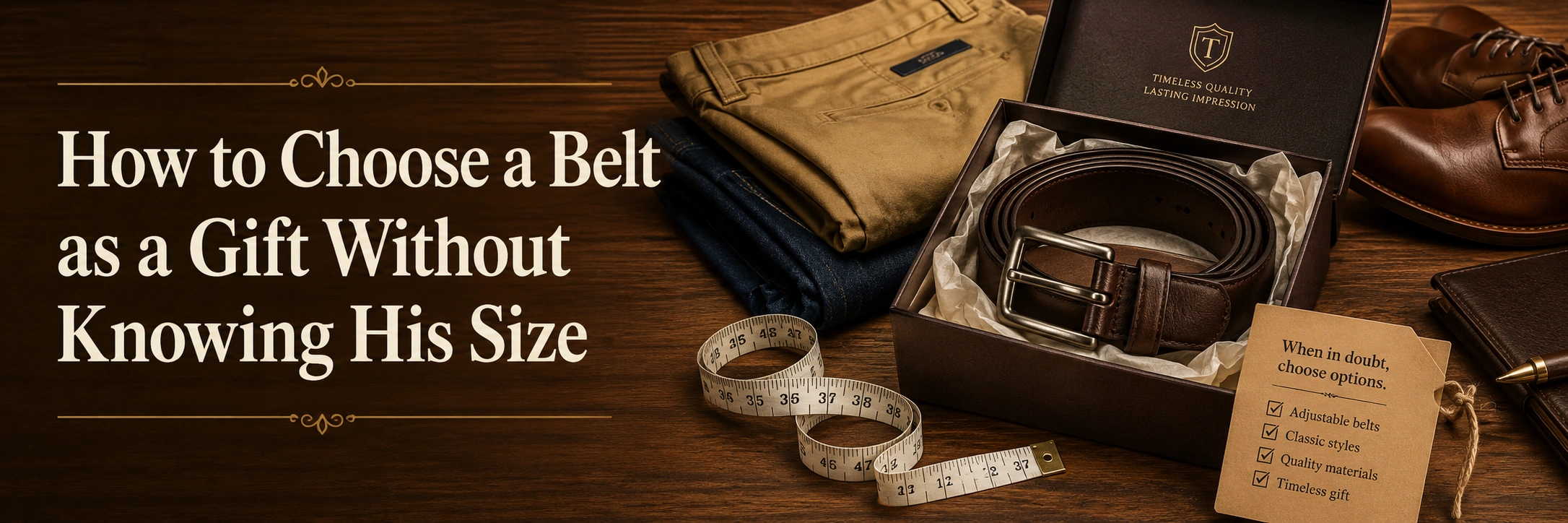
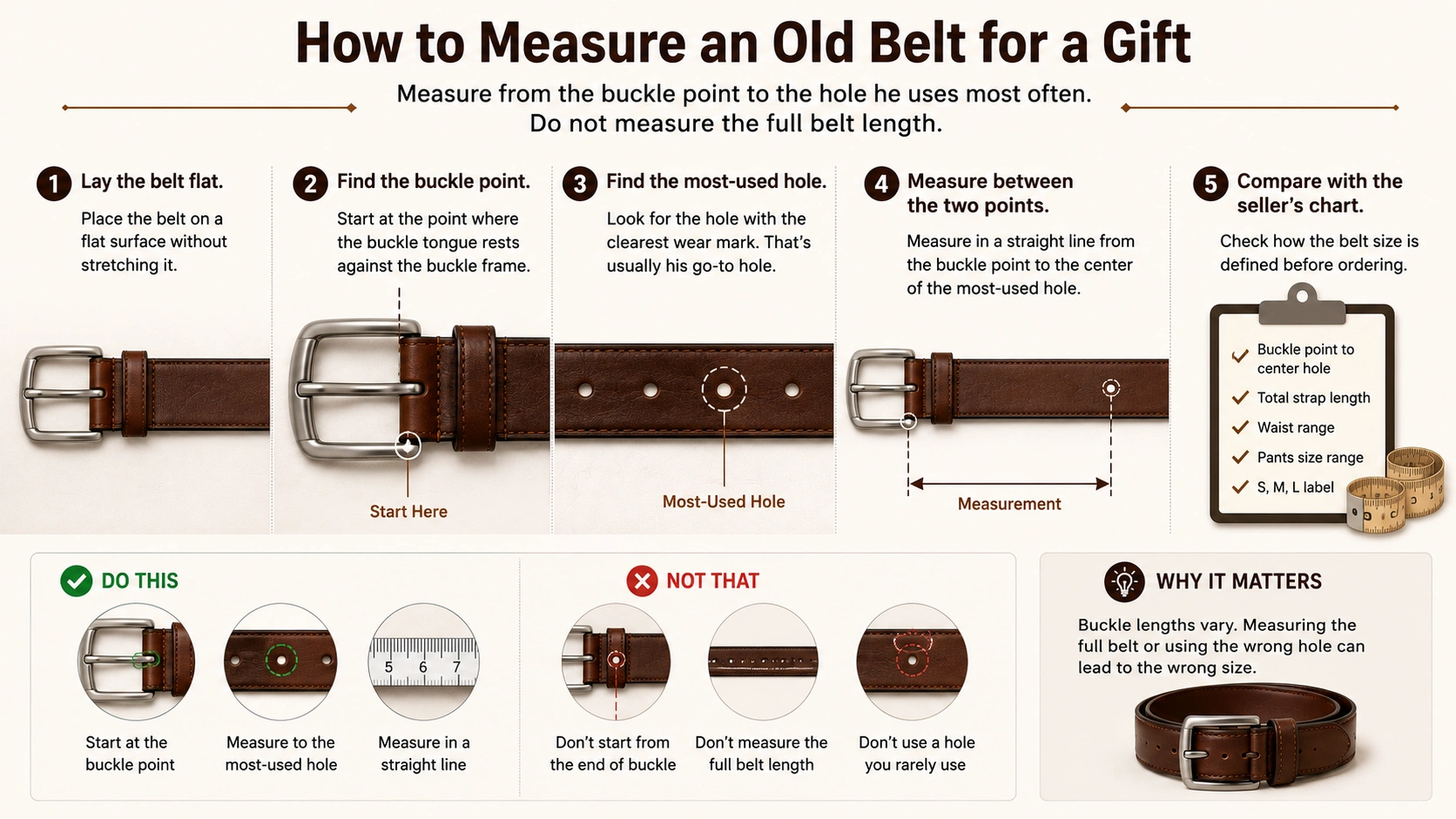
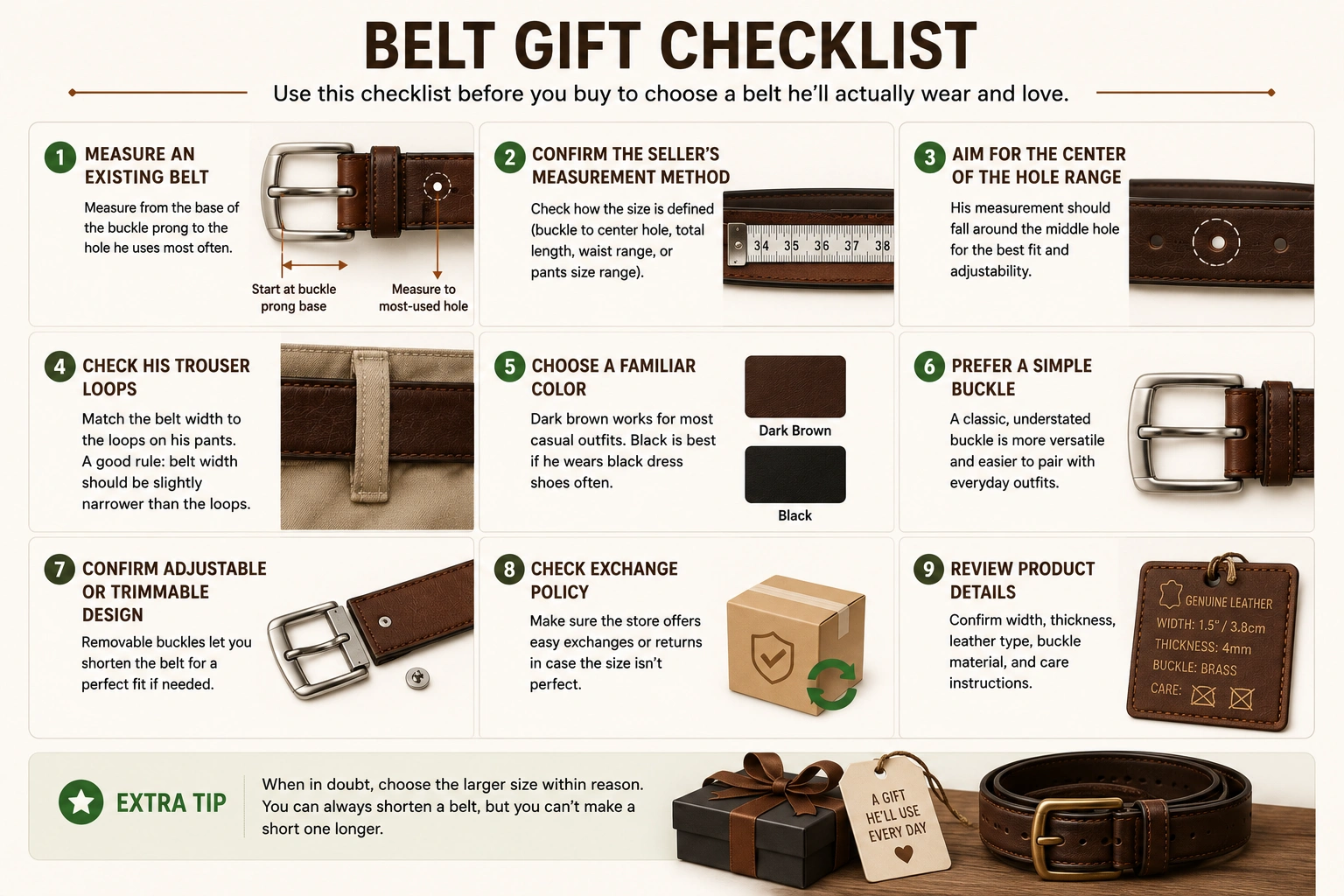
The safest way to choose a belt as a gift is to measure one he already wears comfortably. Measure from the point where the buckle tongue meets the buckle frame to the hole he uses most often—not from one end of the belt to the other.
The total length of a belt is not the same as the wearer’s size. Buckles vary in length, brands label sizes differently, and two men who wear the same pants size may still prefer different belt lengths.
Style matters too. A belt can fit correctly and still go unworn if the color, width, or buckle does not suit his usual clothes.
If you can quietly measure a belt he already wears, that measurement is more reliable than guessing from age, body type, or clothing size.
Quick Answer: How Do You Buy a Belt as a Gift Without Knowing His Size?
Use the best information you can access without asking him directly.
| Information Available | Best Method | Reliability |
|---|---|---|
| A belt he wears regularly | Measure from the buckle point to the most-used hole | Best |
| Pants waist size | Use it as a starting estimate | Moderate |
| Access to his wardrobe | Check several pants labels | Moderate |
| Help from a partner or family member | Confirm his usual belt or pants size | Good |
| No reliable size information | Choose an adjustable or trimmable belt | Lower risk |
| Measurement falls between sizes | Usually choose the larger size | Safer |
An old belt measurement is the strongest reference because it reflects how he actually wears his trousers.
Pants size is still useful, but it should be treated as an estimate. The number on a jeans label may not match the wearer’s actual waist measurement, and different brands often fit differently.
Best Method: Measure a Belt He Already Wears
Choose a belt he wears often and appears comfortable in. Avoid one that is visibly stretched, rarely used, or already too short.
1. Lay the belt flat.
Place it on a table without pulling or stretching the leather. Let the strap lie naturally.
2. Find the buckling point.
Start at the point where the buckle tongue rests against the buckle frame. Do not begin at the outer end of the buckle. A longer buckle would otherwise make the belt appear larger even though the wearable length is unchanged.
3. Find the most-used hole.
Look for the hole with the clearest bending or wear mark. That is usually the position he uses most often.
4. Measure between those two points.
The distance from the buckle point to the most-used hole is the most useful gift-size reference.
5. Compare it with the seller’s chart.
Check how the product page defines belt size. It may refer to:
-
Buckle point to center hole
-
Total strap length
-
Waist range
-
Pants-size range
-
A general S, M, or L label
Two brands can use the same size label while measuring the belt differently.
Use a detailed belt size chart to measure belt size correctly before placing the order.
Always compare the actual measurement with the seller’s measurement method rather than assuming that two brands use the same size labels.
What If You Cannot Measure His Current Belt?
When no belt is available, combine several clues instead of relying on one number.
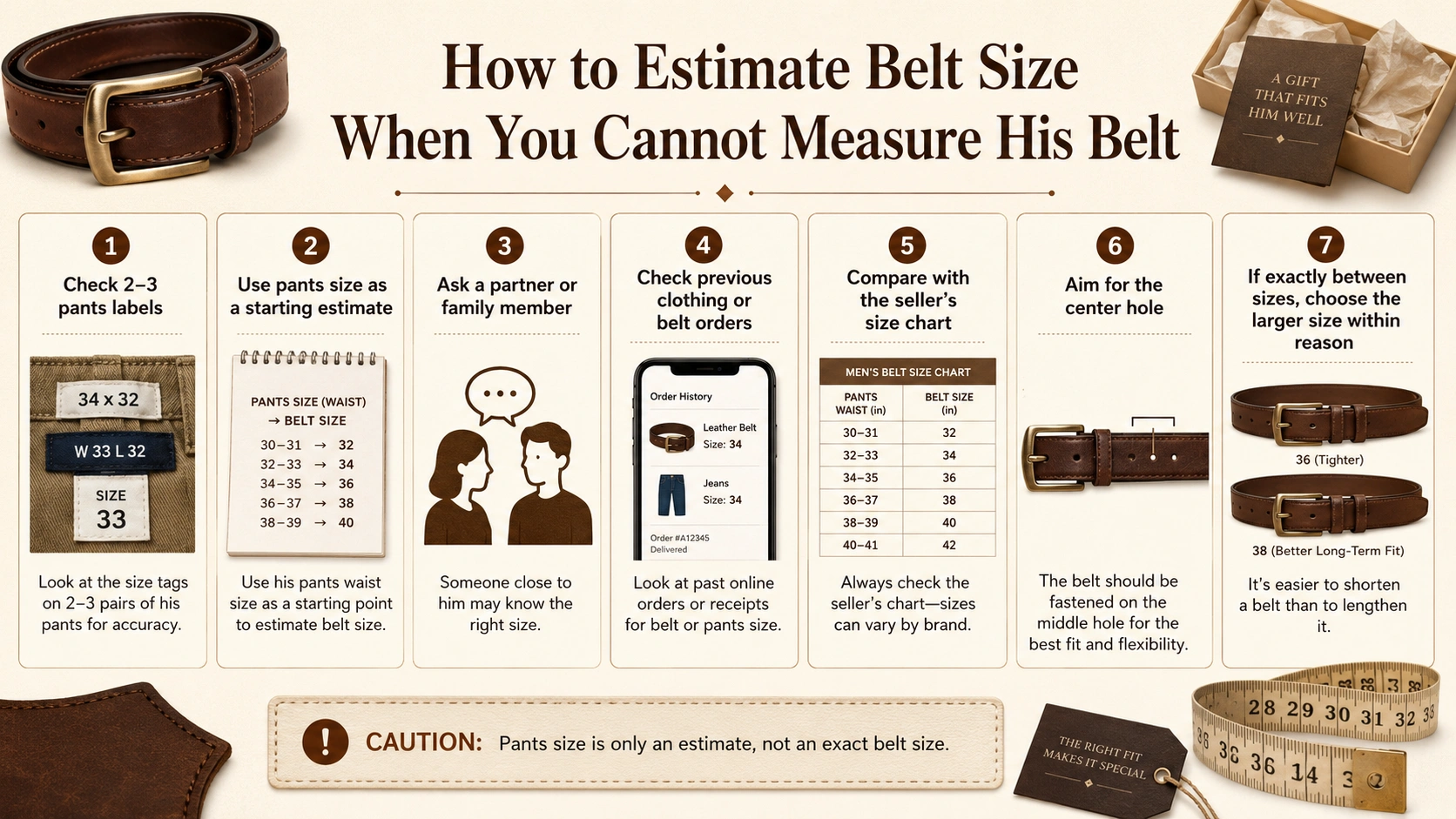
Check the labels on two or three pairs of pants he wears regularly. Jeans, chinos, work pants, and dress trousers may all fit differently, so repeated sizes are more useful than one isolated label.
Pants size can be misleading because:
-
Some brands use vanity sizing
-
Trousers may be worn at the waist or lower on the hips
-
Stretch fabrics fit differently
-
Thick clothing changes the required belt length
-
Older pants may no longer reflect his current fit
Someone close to him may also know his usual pants or belt size. Ask for the actual number rather than a vague small, medium, or large.
Previous order records can help if he has recently purchased trousers or a belt, but older orders should be used carefully. Fit preferences and body measurements change.
Our guide on how to convert pants size to belt size explains why pants size is a starting point rather than an exact answer.
When no belt is available to measure, use several clues together rather than relying on one clothing label.
Should You Size Up When Buying a Belt as a Gift?
Buying a belt about two inches larger than the labeled pants waist is a common starting rule.
For example:
-
34-inch pants often suggest a 36-inch belt
-
36-inch pants often suggest a 38-inch belt
This rule can be helpful, but it is not reliable enough to replace an old-belt measurement. Pants sizing, buckle construction, belt thickness, and the seller’s measuring method can all change the result.
When a measurement falls between two available sizes, the larger option is usually safer. A belt that is slightly long still has room for adjustment, and some removable-buckle belts can be shortened later.
Do not choose a much larger size “just to be safe.” Too much extra length can leave the tail hanging past the keeper loop or place the normal fastening point at the innermost hole.
The best fit usually places the frequently used position near the middle of the hole range. Read more about the correct belt length before deciding between two sizes.
Choose enough extra room for adjustment, not the largest size available.
Choose a Style, Color and Width He Will Actually Wear
A gift belt should fit the wardrobe he already has, not the wardrobe you imagine for him.
Match His Usual Clothes
| His Usual Clothing | Safer Belt Style |
|---|---|
| Suits and dress trousers | Narrow, smooth dress belt |
| Jeans and boots | Medium or wider casual belt |
| Chinos and office-casual clothing | Refined casual or crossover belt |
| Work pants and rugged clothing | Substantial casual belt |
| Mixed wardrobe | Medium-width crossover belt |
If he wears suits, polished shoes, and dress trousers, choose a smooth belt with a restrained buckle.
If he lives in jeans, boots, overshirts, and work jackets, a thicker belt with more visible grain will usually feel more natural.
A simple crossover belt is the safest option for a mixed wardrobe. It may have moderate thickness, a clean frame buckle, and enough texture to work with jeans without looking too rugged for chinos.
See how to choose between a dress and casual belt when his wardrobe includes both.
Choose for the clothes he already wears, not for an outfit you hope he will start wearing.
Pick a Familiar Color
Black is the safer choice when he regularly wears:
-
Black dress shoes
-
Grey or black trousers
-
Business clothing
-
Monochrome outfits
Dark brown is often safer for an everyday wardrobe built around:
-
Blue jeans
-
Chinos
-
Brown shoes or boots
-
Navy trousers
-
Smart-casual clothing
Cognac or medium brown works well with blue denim, khaki pants, and warmer footwear, but it is more noticeable than dark brown.
If he wears black dress shoes regularly, choose black. If his wardrobe is mostly jeans, chinos, and brown shoes or boots, dark brown is usually the safer gift.
Use our belt color matching guide for more outfit combinations.
Keep the Width and Buckle Practical
Dress trousers usually need a narrower belt. Jeans and chinos can support a medium-width strap, while heavy denim and workwear often look better with a wider belt.
When his preferences are unknown, a medium width is less risky than either extreme. Always confirm that it will fit his trouser loops.
Our guide can help you choose the correct belt width.
For the buckle, favor:
-
A simple frame shape
-
Medium size
-
An understated metal finish
-
Proportions that match the strap
-
Hardware suitable for daily wear
Oversized plate buckles, heavy decoration, unusual metal colors, and bold embossing depend more heavily on personal taste.
Adjustable and Trimmable Belts Can Reduce Sizing Risk
An adjustable or trimmable belt gives the recipient more room to correct a close-but-imperfect estimate.
A removable buckle may allow the strap to be shortened from the buckle end while preserving the finished tip and original holes. It can also make future hardware replacement easier.
This is useful when:
-
You know the approximate size but not the exact measurement
-
The selected size may be slightly long
-
The wearer prefers the buckle position centered
-
The belt is designed to be adjusted at home
Not every belt can be cut safely. Fixed buckles, permanent rivets, stitching, and layered construction may prevent simple adjustment.
Before trimming anything, confirm the attachment system and follow a proper method to shorten a leather belt safely.
Adjustability lowers the risk of a sizing mistake, but it does not replace choosing a reasonable starting size.
Common Mistakes and a Safe Belt Gift Checklist
Avoid these common mistakes:
-
Measuring the full length of an old belt
-
Starting at the outer edge of the buckle
-
Relying on one pants label
-
Choosing the smallest possible size
-
Buying a highly decorative buckle without knowing his taste
-
Ignoring the width of his trouser loops
Before ordering, check:
-
Did you measure a belt he wears comfortably?
-
Does the seller size from the buckle point to the center hole?
-
Are there adjustment holes on both sides of the estimated position?
-
Does the width fit his usual trousers?
-
Is the buckle simple enough for regular use?
-
Does the color work with his usual shoes?
-
Can the belt be shortened or exchanged?
-
Is the return or size-exchange policy clear?
-
Are the width, thickness, and buckle material listed?
The safest gift is usually a belt based on an existing measurement, in a familiar color, with a simple buckle and enough adjustment around the center hole.
Explore our leather belt collection and compare each design’s size range, width, color, buckle material, and adjustment method before choosing a gift.
Final Verdict
The most reliable way to choose a belt as a gift is to measure one he already wears.
Start at the buckle tongue and measure to the hole he uses most often. Do not use the total belt length as his size.
When no belt is available, compare several pants labels, ask someone close to him, and use the larger option if the estimate falls just between two sizes.
For style, copy what already works in his wardrobe. Black suits regular black dress shoes. Dark brown is usually safer for jeans, chinos, and brown boots. A medium-width strap and a simple buckle reduce the risk of choosing something too formal or too bold.
When buying a belt as a gift, copy what already works: measure a belt he wears, choose a color that matches his usual shoes, and select a simple style with enough room for adjustment.
Frequently Asked Questions
How Do You Measure a Belt Without Him Knowing?
Borrow a belt he wears regularly and lay it flat. Measure from the point where the buckle tongue meets the frame to the hole with the clearest wear mark. Do not measure from the outer end of the buckle or use the full strap length.
What Size Belt Should I Buy for a 34-Inch Waist?
A 36-inch belt is a common starting estimate for 34-inch pants, but brand sizing varies. Measuring an existing belt is more reliable. Always compare the result with the seller’s specific method and center-hole measurement.
Should I Buy a Belt One Size Larger as a Gift?
When the measurement falls between two sizes, the larger option is usually safer. It provides more adjustment and may be shortened if the belt has removable hardware. Avoid choosing several sizes larger because the tail may become excessively long.
What Is the Safest Belt Color for a Man?
Dark brown is often the safest everyday option for jeans, chinos, navy trousers, and brown footwear. Black is the better choice when he regularly wears black dress shoes, formal trousers, or business clothing.
Is a Black or Brown Belt Better as a Gift?
Choose black for a wardrobe built around black shoes and formal clothing. Choose dark brown for jeans, chinos, boots, and smart-casual outfits. His existing shoes are a better guide than a general rule about which color is more versatile.
What If the Belt Is the Wrong Size?
Check whether the seller offers a size exchange. If the belt is slightly long and has a removable buckle, it may be possible to shorten it from the buckle end. Do not cut the strap until the construction and correct adjustment method are confirmed.